Monday, July 4, 2011

Uh...hi. And Orwell link.

Well, it's certainly been a while, hasn't it? In between doing to millions of other things, I've been pondering over the last several months how to remake Crib From This, starting, as it were, from scratch. I've got a few cool ideas here and there, and I will let you know (if you or anyone else is actually reading this...) when it will be ready to put into practice. So anyway, stay tuned.

(My god, that was vague...)

So anyway, I just happened across one of my favorite George Orwell essays, Notes on Nationalism, and I'm once again impressed with how unbelievable prescient this plain-spoken anti-genius could be. I imagine that October 1945, when it originally ran in a journal called Polemic: A Magazine of Philosophy, Psychology & Aesthetics, this essay captured, in uncomfortably vivid detail, the deleterious effects of various kinds of nationalism upon the capacity of educated—supposedly 'civilized'—Englishmen and Europeans to think clearly.

What's even more astonishing, however, is to behold just how close Orwell's brilliant analysis comes to capturing the essence of the kinds of shortsighted allegiances that have captured the minds of our (the US's and the West's more generally) 'best and brightest', as we ordinary mortals observe powerlessly their arrogant, ham-fisted mishandling of our current geopolitical situation. Here's Orwell laying the groundwork for his argument, in Notes on Nationalism:
[T]here is a habit of mind which is now so widespread that it affects our thinking on nearly every subject, but which has not yet been given a name. As the nearest existing equivalent I have chosen the word 'nationalism', but it will be seen in a moment that I am not using it in quite the ordinary sense, if only because the emotion I am speaking about does not always attach itself to what is called a nation — that is, a single race or a geographical area. It can attach itself to a church or a class, or it may work in a merely negative sense, AGAINST something or other and without the need for any positive object of loyalty.

By 'nationalism' I mean first of all the habit of assuming that human beings can be classified like insects and that whole blocks of millions or tens of millions of people can be confidently labelled 'good' or 'bad'.* But secondly — and this is much more important — I mean the habit of identifying oneself with a single nation or other unit, placing it beyond good and evil and recognising no other duty than that of advancing its interests. Nationalism is not to be confused with patriotism. Both words are normally used in so vague a way that any definition is liable to be challenged, but one must draw a distinction between them, since two different and even opposing ideas are involved. By 'patriotism' I mean devotion to a particular place and a particular way of life, which one believes to be the best in the world but has no wish to force on other people. Patriotism is of its nature defensive, both militarily and culturally. Nationalism, on the other hand, is inseparable from the desire for power. The abiding purpose of every nationalist is to secure more power and more prestige, NOT for himself but for the nation or other unit in which he has chosen to sink his own individuality.
* Nations, and even vaguer entities such as Catholic Church or the proleteriat, are commonly thought of as individuals and often referred to as 'she'. Patently absurd remarks such as 'Germany is naturally treacherous' are to be found in any newspaper one opens and reckless generalization about national character ('The Spaniard is a natural aristocrat' or 'Every Englishman is a hypocrite') are uttered by almost everyone. Intermittently these generalizations are seen to be unfounded, but the habit of making them persists, and people of professedly international outlook, e.g., Tolstoy or Bernard Shaw, are often guilty of them. (Orwell's footnote)

So long as it is applied merely to the more notorious and identifiable nationalist movements in Germany, Japan, and other countries, all this is obvious enough. Confronted with a phenomenon like Nazism, which we can observe from the outside, nearly all of us would say much the same things about it. But here I must repeat what I said above, that I am only using the word 'nationalism' for lack of a better. Nationalism, in the extended sense in which I am using the word, includes such movements and tendencies as Communism, political Catholicism, Zionism, Antisemitism, Trotskyism and Pacifism. It does not necessarily mean loyalty to a government or a country, still less to ONE'S OWN country, and it is not even strictly necessary that the units in which it deals should actually exist. To name a few obvious examples, Jewry, Islam, Christendom, the Proletariat and the White Race are all of them objects of passionate nationalistic feeling: but their existence can be seriously questioned, and there is no definition of any one of them that would be universally accepted.

It is also worth emphasising once again that nationalist feeling can be purely negative. There are, for example, Trotskyists who have become simply enemies of the U.S.S.R. without developing a corresponding loyalty to any other unit. When one grasps the implications of this, the nature of what I mean by nationalism becomes a good deal clearer. A nationalist is one who thinks solely, or mainly, in terms of competitive prestige. He may be a positive or a negative nationalist — that is, he may use his mental energy either in boosting or in denigrating — but at any rate his thoughts always turn on victories, defeats, triumphs and humiliations. He sees history, especially contemporary history, as the endless rise and decline of great power units, and every event that happens seems to him a demonstration that his own side is on the upgrade and some hated rival is on the downgrade. But finally, it is important not to confuse nationalism with mere worship of success. The nationalist does not go on the principle of simply ganging up with the strongest side. On the contrary, having picked his side, he persuades himself that it IS the strongest, and is able to stick to his belief even when the facts are overwhelmingly against him. Nationalism is power-hunger tempered by self-deception. Every nationalist is capable of the most flagrant dishonesty, but he is also — since he is conscious of serving something bigger than himself — unshakeably certain of being in the right.

Now that I have given this lengthy definition, I think it will be admitted that the habit of mind I am talking about is widespread among the English intelligentsia, and more widespread there than among the mass of the people. For those who feel deeply about contemporary politics, certain topics have become so infected by considerations of prestige that a genuinely rational approach to them is almost impossible. Out of the hundreds of examples that one might choose, take this question: Which of the three great allies, the U.S.S.R., Britain and the USA, has contributed most to the defeat of Germany? In theory, it should be possible to give a reasoned and perhaps even a conclusive answer to this question. In practice, however, the necessary calculations cannot be made, because anyone likely to bother his head about such a question would inevitably see it in terms of competitive prestige. He would therefore START by deciding in favour of Russia, Britain or America as the case might be, and only AFTER this would begin searching for arguments that seemed to support his case. And there are whole strings of kindred questions to which you can only get an honest answer from someone who is indifferent to the whole subject involved, and whose opinion on it is probably worthless in any case. Hence, partly, the remarkable failure in our time of political and military prediction. It is curious to reflect that out of al the 'experts' of all the schools, there was not a single one who was able to foresee so likely an event as the Russo-German Pact of 1939.* And when news of the Pact broke, the most wildly divergent explanations were of it were given, and predictions were made which were falsified almost immediately, being based in nearly every case not on a study of probabilities but on a desire to make the U.S.S.R. seem good or bad, strong or weak. Political or military commentators, like astrologers, can survive almost any mistake, because their more devoted followers do not look to them for an appraisal of the facts but for the stimulation of nationalistic loyalties.** And aesthetic judgements, especially literary judgements, are often corrupted in the same way as political ones. It would be difficult for an Indian Nationalist to enjoy reading Kipling or for a Conservative to see merit in Mayakovsky, and there is always a temptation to claim that any book whose tendency one disagrees with must be a bad book from a LITERARY point of view. People of strongly nationalistic outlook often perform this sleight of hand without being conscious of dishonesty.
* A few writers of conservative tendency, such as Peter Drucker, foretold an agreement between Germany and Russia, but they expected an actual alliance or amalgamation which would be permanent. No Marxist or other left-wing writer, of whatever colour, came anywhere near foretelling the Pact. (Orwell's footnote)

** The military commentators of the popular press can mostly be classified as pro-Russian or anti-Russian, pro-blimp or anti-blimp. Such errors as believing the Mrginot Line impregnable, or predicting that Russia would conquer Germany in three months, have failed to shake their reputation, because they were always saying what their own particular audience wanted to hear. The two military critics most favoured by the intelligentsia are Captain Liddell Hart and Major-General Fuller, the first of whom teaches that the defence is stronger that the attack, and the second that the attack is stronger that the defence. This contradiction has not prevented both of them from being accepted as authorities by the same public. The secret reason for their vogue in left-wing circles is that both of them are at odds with the War Office. (Orwell's footnote)

Orwell goes on to say:
In England, if one simply considers the number of people involved, it is probable that the dominant form of nationalism is old-fashioned British jingoism. It is certain that this is still widespread, and much more so than most observers would have believed a dozen years ago. However, in this essay I am concerned chiefly with the reactions of the intelligentsia, among whom jingoism and even patriotism of the old kind are almost dead, though they now seem to be reviving among a minority. Among the intelligentsia, it hardly needs saying that the dominant form of nationalism is Communism — using this word in a very loose sense, to include not merely Communist Party members, but 'fellow travellers' and Russophiles generally. A Communist, for my purpose here, is one who looks upon the U.S.S.R. as his Fatherland and feels it his duty to justify Russian policy and advance Russian interests at all costs. Obviously such people abound in England today, and their direct and indirect influence is very great. But many other forms of nationalism also flourish, and it is by noticing the points of resemblance between different and even seemingly opposed currents of thought that one can best get the matter into perspective.

Ten or twenty years ago, the form of nationalism most closely corresponding to Communism today was political Catholicism. Its most outstanding exponent — though he was perhaps an extreme case rather than a typical one — was G. K. Chesterton. Chesterton was a writer of considerable talent who chose to suppress both his sensibilities and his intellectual honesty in the cause of Roman Catholic propaganda. During the last twenty years or so of his life, his entire output was in reality an endless repetition of the same thing, under its laboured cleverness as simple and boring as 'Great is Diana of the Ephesians.' Every book that he wrote, every scrap of dialogue, had to demonstrate beyond the possibility of mistake the superiority of the Catholic over the Protestant or the pagan. But Chesterton was not content to think of this superiority as merely intellectual or spiritual: it had to be translated into terms of national prestige and military power, which entailed an ignorant idealisation of the Latin countries, especially France. Chesterton had not lived long in France, and his picture of it — as a land of Catholic peasants incessantly singing the MARSEILLAISE over glasses of red wine — had about as much relation to reality as CHU CHIN CHOW has to everyday life in Baghdad. And with this went not only an enormous overestimation of French military power (both before and after 1914-18 he maintained that France, by itself, was stronger than Germany), but a silly and vulgar glorification of the actual process of war. Chesterton's battle poems, such as Lepanto or The Ballad of Saint Barbara, make The Charge of the Light Brigade read like a pacifist tract: they are perhaps the most tawdry bits of bombast to be found in our language. The interesting thing is that had the romantic rubbish which he habitually wrote about France and the French army been written by somebody else about Britain and the British army, he would have been the first to jeer. In home politics he was a Little Englander, a true hater of jingoism and imperialism, and according to his lights a true friend of democracy. Yet when he looked outwards into the international field, he could forsake his principles without even noticing he was doing so. Thus, his almost mystical belief in the virtues of democracy did not prevent him from admiring Mussolini. Mussolini had destroyed the representative government and the freedom of the press for which Chesterton had struggled so hard at home, but Mussolini was an Italian and had made Italy strong, and that settled the matter. Nor did Chesterton ever find a word to say about imperialism and the conquest of coloured races when they were practised by Italians or Frenchmen. His hold on reality, his literary taste, and even to some extent his moral sense, were dislocated as soon as his nationalistic loyalties were involved.

Obviously there are considerable resemblances between political Catholicism, as exemplified by Chesterton, and Communism. So there are between either of these and for instance Scottish nationalism, Zionism, Antisemitism or Trotskyism. It would be an oversimplification to say that all forms of nationalism are the same, even in their mental atmosphere, but there are certain rules that hold good in all cases. The following are the principal characteristics of nationalist thought:

OBSESSION. As nearly as possible, no nationalist ever thinks, talks, or writes about anything except the superiority of his own power unit. It is difficult if not impossible for any nationalist to conceal his allegiance. The smallest slur upon his own unit, or any implied praise of a rival organization, fills him with uneasiness which he can relieve only by making some sharp retort. If the chosen unit is an actual country, such as Ireland or India, he will generally claim superiority for it not only in military power and political virtue, but in art, literature, sport, structure of the language, the physical beauty of the inhabitants, and perhaps even in climate, scenery and cooking. He will show great sensitiveness about such things as the correct display of flags, relative size of headlines and the order in which different countries are named.* Nomenclature plays a very important part in nationalist thought. Countries which have won their independence or gone through a nationalist revolution usually change their names, and any country or other unit round which strong feelings revolve is likely to have several names, each of them carrying a different implication. The two sides of the Spanish Civil War had between them nine or ten names expressing different degrees of love and hatred. Some of these names (e.g. 'Patriots' for Franco-supporters, or 'Loyalists' for Government-supporters) were frankly question-begging, and there was no single one of the which the two rival factions could have agreed to use. All nationalists consider it a duty to spread their own language to the detriment of rival languages, and among English-speakers this struggle reappears in subtler forms as a struggle between dialects. Anglophobe-Americans will refuse to use a slang phrase if they know it to be of British origin, and the conflict between Latinizers and Germanizers often has nationalists motives behind it. Scottish nationalists insist on the superiority of Lowland Scots, and socialists whose nationalism takes the form of class hatred tirade against the B.B.C. accent and even the often gives the impression of being tinged by belief in sympathetic magic — a belief which probably comes out in the widespread custom of burning political enemies in effigy, or using pictures of them as targets in shooting galleries.
* Certain Americans have expressed dissatisfaction because 'Anglo-American' is the form of combination for these two words. It has been proposed to substitute 'Americo-British'. (Orwell's footnote)

INSTABILITY. The intensity with which they are held does not prevent nationalist loyalties from being transferable. To begin with, as I have pointed out already, they can be and often are fastened up on some foreign country. One quite commonly finds that great national leaders, or the founders of nationalist movements, do not even belong to the country they have glorified. Sometimes they are outright foreigners, or more often they come from peripheral areas where nationality is doubtful. Examples are Stalin, Hitler, Napoleon, de Valera, Disraeli, Poincare, Beaverbrook. The Pan-German movement was in part the creation of an Englishman, Houston Chamberlain. For the past fifty or a hundred years, transferred nationalism has been a common phenomenon among literary intellectuals. With Lafcadio Hearne the transference was to Japan, with Carlyle and many others of his time to Germany, and in our own age it is usually to Russia. But the peculiarly interesting fact is that re-transference is also possible. A country or other unit which has been worshipped for years may suddenly become detestable, and some other object of affection may take its place with almost no interval. In the first version of H. G. Wells's OUTLINE OF HISTORY, and others of his writings about that time, one finds the United States praised almost as extravagantly as Russia is praised by Communists today: yet within a few years this uncritical admiration had turned into hostility. The bigoted Communist who changes in a space of weeks, or even days, into an equally bigoted Trotskyist is a common spectacle. In continental Europe Fascist movements were largely recruited from among Communists, and the opposite process may well happen within the next few years. What remains constant in the nationalist is his state of mind: the object of his feelings is changeable, and may be imaginary.

But for an intellectual, transference has an important function which I have already mentioned shortly in connection with Chesterton. It makes it possible for him to be much MORE nationalistic — more vulgar, more silly, more malignant, more dishonest — that he could ever be on behalf of his native country, or any unit of which he had real knowledge. When one sees the slavish or boastful rubbish that is written about Stalin, the Red Army, etc. by fairly intelligent and sensitive people, one realises that this is only possible because some kind of dislocation has taken place. In societies such as ours, it is unusual for anyone describable as an intellectual to feel a very deep attachment to his own country. Public opinion — that is, the section of public opinion of which he as an intellectual is aware — will not allow him to do so. Most of the people surrounding him are sceptical and disaffected, and he may adopt the same attitude from imitativeness or sheer cowardice: in that case he will have abandoned the form of nationalism that lies nearest to hand without getting any closer to a genuinely internationalist outlook. He still feels the need for a Fatherland, and it is natural to look for one somewhere abroad. Having found it, he can wallow unrestrainedly in exactly those emotions from which he believes that he has emancipated himself. God, the King, the Empire, the Union Jack — all the overthrown idols can reappear under different names, and because they are not recognised for what they are they can be worshipped with a good conscience. Transferred nationalism, like the use of scapegoats, is a way of attaining salvation without altering one's conduct.

INDIFFERENCE TO REALITY. All nationalists have the power of not seeing resemblances between similar sets of facts. A British Tory will defend self-determination in Europe and oppose it in India with no feeling of inconsistency. Actions are held to be good or bad, not on their own merits, but according to who does them, and there is almost no kind of outrage — torture, the use of hostages, forced labour, mass deportations, imprisonment without trial, forgery, assassination, the bombing of civilians — which does not change its moral colour when it is committed by 'our' side. The Liberal NEWS CHRONICLE published, as an example of shocking barbarity, photographs of Russians hanged by the Germans, and then a year or two later published with warm approval almost exactly similar photographs of Germans hanged by the Russians.* It is the same with historical events. History is thought of largely in nationalist terms, and such things as the Inquisition, the tortures of the Star Chamber, the exploits of the English buccaneers (Sir Francis Drake, for instance, who was given to sinking Spanish prisoners alive), the Reign of Terror, the heroes of the Mutiny blowing hundreds of Indians from the guns, or Cromwell's soldiers slashing Irishwomen's faces with razors, become morally neutral or even meritorious when it is felt that they were done in the 'right' cause. If one looks back over the past quarter of a century, one finds that there was hardly a single year when atrocity stories were not being reported from some part of the world; and yet in not one single case were these atrocities — in Spain, Russia, China, Hungary, Mexico, Amritsar, Smyrna — believed in and disapproved of by the English intelligentsia as a whole. Whether such deeds were reprehensible, or even whether they happened, was always decided according to political predilection.
* The NEWS CHRONICLE advised its readers to visit the news film at which the entire execution could be witnessed, with close-ups. The STAR published with seeming approval photographs of nearly naked female collaborationists being baited by the Paris mob. These photographs had a marked resemblance to the Nazi photographs of Jews being baited by the Berlin mob. (Orwell's footnote)
The nationalist not only does not disapprove of atrocities committed by his own side, but he has a remarkable capacity for not even hearing about them. For quite six years the English admirers of Hitler contrived not to learn of the existence of Dachau and Buchenwald. And those who are loudest in denouncing the German concentration camps are often quite unaware, or only very dimly aware, that there are also concentration camps in Russia. Huge events like the Ukraine famine of 1933, involving the deaths of millions of people, have actually escaped the attention of the majority of English Russophiles. Many English people have heard almost nothing about the extermination of German and Polish Jews during the present war. Their own antisemitism has caused this vast crime to bounce off their consciousness. In nationalist thought there are facts which are both true and untrue, known and unknown. A known fact may be so unbearable that it is habitually pushed aside and not allowed to enter into logical processes, or on the other hand it may enter into every calculation and yet never be admitted as a fact, even in one's own mind.

Every nationalist is haunted by the belief that the past can be altered. He spends part of his time in a fantasy world in which things happen as they should — in which, for example, the Spanish Armada was a success or the Russian Revolution was crushed in 1918 — and he will transfer fragments of this world to the history books whenever possible. Much of the propagandist writing of our time amounts to plain forgery. Material facts are suppressed, dates altered, quotations removed from their context and doctored so as to change their meaning. Events which it is felt ought not to have happened are left unmentioned and ultimately denied.* In 1927 Chiang Kai Shek boiled hundreds of Communists alive, and yet within ten years he had become one of the heroes of the Left. The re-alignment of world politics had brought him into the anti-Fascist camp, and so it was felt that the boiling of the Communists 'didn't count', or perhaps had not happened. The primary aim of propaganda is, of course, to influence contemporary opinion, but those who rewrite history do probably believe with part of their minds that they are actually thrusting facts into the past. When one considers the elaborate forgeries that have been committed in order to show that Trotsky did not play a valuable part in the Russian civil war, it is difficult to feel that the people responsible are merely lying. More probably they feel that their own version was what happened in the sight of God, and that one is justified in rearranging the records accordingly.
* An example is the Russo-German Pact, which is being effaced as quickly as possible from public memory. A Russian correspondent informs me that mention of the Pact is already being omitted from Russian year-books which table recent political events. (Orwell's note)

Indifference to objective truth is encouraged by the sealing-off of one part of the world from another, which makes it harder and harder to discover what is actually happening. There can often be a genuine doubt about the most enormous events. For example, it is impossible to calculate within millions, perhaps even tens of millions, the number of deaths caused by the present war. The calamities that are constantly being reported — battles, massacres, famines, revolutions — tend to inspire in the average person a feeling of unreality. One has no way of verifying the facts, one is not even fully certain that they have happened, and one is always presented with totally different interpretations from different sources. What were the rights and wrongs of the Warsaw rising of August 1944? Is it true about the German gas ovens in Poland? Who was really to blame for the Bengal famine? Probably the truth is discoverable, but the facts will be so dishonestly set forth in almost any newspaper that the ordinary reader can be forgiven either for swallowing lies or failing to form an opinion. The general uncertainty as to what is really happening makes it easier to cling to lunatic beliefs. Since nothing is ever quite proved or disproved, the most unmistakable fact can be impudently denied. Moreover, although endlessly brooding on power, victory, defeat, revenge, the nationalist is often somewhat uninterested in what happens in the real world. What he wants is to FEEL that his own unit is getting the better of some other unit, and he can more easily do this by scoring off an adversary than by examining the facts to see whether they support him. All nationalist controversy is at the debating-society level. It is always entirely inconclusive, since each contestant invariably believes himself to have won the victory. Some nationalists are not far from schizophrenia, living quite happily amid dreams of power and conquest which have no connection with the physical world.

Orwell goes on to elaborate a typology of forms of nationalism. Laser-sharp thinking that—as with pretty much everything Orwell ever wrote—has a lot to say to us today.

Thursday, March 3, 2011

Wisconsin's gubernatorial "Vanna White veto."

Like many people, among the political developments I've been following as closely as I can (which isn't always very closely) is the widespread outrage among progressives and labor supporters to the scheme of Wisconsin's new Governor Scott Walker—along with his fellow Republicans in the legislative branch—to, in one fell swoop, strip the state's public unions of their collective bargaining rights. The standoff between Walker and his state's public employees has continued for weeks, with Wisconsin State Senate Democrats having decamped to undisclosed locations in Illinois—a tactic of last resort to prevent their Republican colleagues from ramming their draconian measure through without argument or objection.

A recent article appearing on the Web site of the Atlantic Monthly provides perhaps the most alarming in all of this story's peculiar twists:
Two weeks into the collective bargaining protests in Madison, the interior of the Wisconsin state Capitol feels like a high-traffic liberal website given physical form. It's a world of text. Sheets of paper are affixed to every reachable surface with little strips of blue non-staining painter's tape. Some pages have slogans markered on them, others have columns of dense printing. "Retired teacher from California supports Wisconsin Workers" "One day longer!" "You can't silence Wisconsin." "Why can't we be friends with benefits?" There's a printout of a George Lakoff article, notices of other protests around the state, a lost-kid board, and a flier for somebody's self-published apocalyptic novel. Ranging up and down both sides of a grand marble staircase are printouts of 10,000 e-mails from Wisconsin citizens to Gov. Scott Walker (R), opposing his proposal to strip collective bargaining rights from public sector workers.

But the boisterous messages hide a sobering reality as the stalemate over Walker's budget repair bill deepens. A deal floated by moderate Republican state Sen. Dale Schultz, under which collective bargaining rights would automatically reactivate in 2013, seems to have drawn no interest from either side. One possible reason: the Wisconsin veto makes such a compromise impossible to enforce.

What most people outside Wisconsin don't know is that our governor wields a veto power on appropriations bills so strong as to be frankly comic. It's not just a line-item veto; Walker has the power to veto individual phrases and words (PDF) -- like "not" -- from sentences. If the state Senate returns to session and passes a bill with time limits on Walker's favored provisions, he can strip out the new language and sign his own decompromised version into law. If that sounds crazy, keep in mind that until 2008 governors of Wisconsin could -- and did! -- veto multi-page sections of bills, leaving in place only eight or nine words spelling out a law the governor wanted to enact. And that, in turn, was a much-narrowed version of the so-called "Vanna White veto" power enjoyed by Wisconsin governors prior to 1990, when they could veto individual letters out of words and individual digits out of numbers.

Thursday, February 24, 2011

Prank call reveals Wisconsin governor as stooge of corporations with nationwide anti-labor agenda.

This is our time to change the course of history!
Wisconsin's newly elected governor, Scott Walker
I'm not a huge fan of the idea of journalists pulling pranks like this, and I don't think that this conversation yielded any important new insights. The audio clip of a prank call that a journalist, posing as a rich businessman, made to Wisconsin's governor Scott Walker nevertheless makes for fascinating listening. It's especially important to keep in mind that Governor Walker believes himself to be talking on the phone to a 'conservative billionaire'. The Gov sure sounds more than a little chummy (specifically, the kind of chummy wherein one is also sycophantic). More explanation in this clip from the AP:


Who says this ain't a new Gilded Age?

Thursday, February 17, 2011

On Wisconsin!!!

I have no idea how you managed to elect this despotic thug named Scott Walker as your governer, but don't give up the fight against his unprecedented and draconian assault on workers' rights!

Wednesday, February 2, 2011

Snow Daze....A pictorial dispatch from Chicago.

Or, anyway, from the portion of my neighborhood, beyond which I dared not travel. These photos were taken several hours after the onslaught of snow finally ceased. Some people were able to dig their cars out from underneath iced-over slabs of snow. Others weren't so lucky.
The thing about this snowstorm was not its magnitude per se, but rather its severity. Huge amounts of precipitation and wickedly strong wind gusts were concentrated within a disconcertingly brief span of time. As a result, the school day was canceled in both the private and public schools across the city. This might not seem so out of the ordinary, but apparently, today was Chicago Public Schools' first declared 'snow day' in 12 years(!).
It's said that this long streak of eschewing weather-induced school cancellations has been a point of pride among CPS officials, which is actually admirable considering the fact that so many poor children depend upon the schools for vital services that are frequently unavailable to them at home (including breakfast and lunch). But road conditions have continued to be so bad today that it would have been genuinely irresponsible for the administrators not to have called off school. They've also called off school for tomorrow, February 3rd, which is also more than merely the prudent option.

If you want to know how dangerous the roads still are in this city, consider that Lake Shore Drive—Chicago's bustling thoroughfare that races alongside the coast of Lake Michigan—had to be closed to traffic yesterday and, as I type, has not yet been reopened(!). Not only that, but apparently, there are still hundreds of abandoned cars stuck in the snow in the middle of this four-to-six-lane highway.
Nothing to do on a day like this except take photographs. And post them on one's normally horribly neglected blog. And tomorrow's going to be more of the same.

Mubarak's thugs remind us that neocons & repressive dictators speak the same language: violence.

In the wake of Mubarak's announcement to the Egyptian people that he will resign from office at the end of his current presidential term (they have "terms"?!), we are reminded of Max Weber's famous observation in Economy and Society: "legal coercion by violence is the monopoly of the state."

We citizens of the modern bourgeois, cosmopolitan West ignore this relationship between violence and the state at our peril. A hundred years after the First World War, the fundamental premise of statehood remains unaltered: it is a form of social organization in whose name the use of violence is accorded legitimacy. It's through this lens that I've begun to view the recent eruptions of violence in Cairo, Alexandria and elsewhere in Egypt.

Weeks of remarkably peaceful anti-Mubarak protests culminated yesterday in the collegial, civilized march of a million (or, anyway, a whole hell of a lot of) demonstrators. This was the moment Mubarak chose to make his LBJ-like announcement. And, within moments of his television address, he gave the signal to his police thugs, to paid-off petty criminals (the same criminals who'd previously been given free reign to loot stores, etc., all to increase the public's sense of chaos and instability), and to camel-riding mercenaries—apparently summoned from the tourism industry(!)—to confront the anti-Mubarak throng.
 The result? Violence and chaos. But this time, instead of operating behind the scenes, to cultivate an atmosphere of unease—a strategy that had failed—the incitement happened right in front of the television cameras of the international press. Some of the supposed Mubarak-lovers riding camels onto the scene! As blatant a coordinated provocation as can be imagined.

My first reaction to this orchestrated provocation from the obviously phony "pro-Mubarak protesters" was: How could Mubarak be so ham-fisted? I quickly realized that, of course, there was nothing ham-fisted about it: Its obviousness is the whole point.

Paying off petty criminals and/or plainclothes policemen to loot stores was a genuine attempt to generate a sense of chaos, undifferentiated violence, economic uncertainty, and a yearning for the 'law and order' among the civilian population (this yearning being Mubarak's—or any repressive dictator's—political trump card).

By contrast, the coordinated "pro-Mubarak" incitement of violence represents a deliberate and ostentatious flexing of the state's muscle: an example of 'legitimate' state violence. The message to the protesting masses is simple: "Okay, you've extracted the best concession you're gonna get from us; now go home."

There is a separate message simultaneously being beamed to the heavy-weights in the Egyptian business community (and members of the middle class whose livelihood depends upon the smooth functioning of the latter), which is: "You still need us to keep the order." In this sense, the contrast between the ruling regime's highly uncharacteristic use of restraint over the past week and the volatility of recent developments is being used as an illustration of what happens when the state does not maintain the order with its iron fist.

The army plays an interesting role in this process. Its restraint, over the past week, has served as a way in which to preserve its popularity with the Egyptian public. Now, when Mubarak's thugs have been dispatched to the scene—by the busload, apparently—in order to spill some blood, the Egyptian army's restraint and 'impartiality' takes on a particularly sinister quality.

And so, when we witness the pro-Mubarak stance of some prominent neoconservatives, we should not see it as a sudden, surprising neoconservative embrace of Realpolitik—a posture that these same figures so often claim to despise (take their supposed belief in 'democracy-building' in Iraq, for example).

Instead, the neoconservatives are showing a tendency that has consistently been at the very heart of their system of values: the neocons, just like Mubarak, just like Ahmadinejad, believe in violence.

The neocons, like these repressive dictators, are suspicious of messy, unpredictable things like political and religious liberty, the rule of law, intellectualism, political discourse, and democratic deliberation. Although the neocons might occasionally speak the language of democracy, in fact they they understand only the language of violence.

See also: Slavoj Žižek on the cynicism and hypocrisy in the attitudes of many Westerners toward democratic revolutions in the Middle East.

Saturday, January 15, 2011

The untimely passing of Broadcast's Trish Keenan.

My god, what a tragedy! Trish Keenan, the creative and talented lead singer and lyricist of the British band Broadcast, has passed away at the shockingly young age of 42. Keenan, a resident of Birmingham, UK, died of "complications of pneumonia," according to the Web site of Broadcast's record label, Warp Records, which continues:
Our thoughts go out to James, Martin, her friends and her family and we request that the public respect their wishes for privacy at this time.

This is an untimely tragic loss and we will miss Trish dearly - a unique voice, an extraordinary talent and a beautiful human being. Rest in Peace.
The Toronto Sun provides additional details on this horrible horrible turn of events:
The Broadcast frontwoman picked up a strain of swine flu while touring Australia in December. She was hospitalized on her return to England and spent two weeks in intensive care after she was also diagnosed with pneumonia.

Keenan's sister told fans the rocker was "fighting for her life" on Thursday, and the following morning, the star passed away after suffering complications from the inflammatory lung condition.
I'm simply too shocked and sad about this to wax eloquent about the joy and comfort that Broadcast's music has brought me over the years—in particular, their 2005 album Tender Buttons, on which the band's line-up was stripped down to a duo, bringing into sharper focus Trish's beautiful voice/diction and evocative lyrics. That masterpiece's juxtaposition of Trish's voice—simultaneously mellow and icy—against frequently cacophonous musical accompaniments is showcased on Track 10, "Subject to the Ladder," which is possibly my favorite Broadcast song.

Subject to the Ladder (please feel free to ignore the visuals...I have no idea what they're supposed to be all about; it happens that this video represents the only posting of this song that appears on YouTube):


And here's the more tuneful and every bit as wonderful song Black Cat, also from Tender Buttons:


Why does it always seem to be the good people, who bring happiness into the world? Why not Tom Delay, or Henry Kissinger, or somebody like that?

Rest in Peace, Trish. We're really going to miss you.

Tuesday, December 21, 2010

Who (or what) the hell is that?

OK, so I'm happy that Obama is going to get his treaty with Russia ratified and everything, but you'll forgive me if I'm distracted by this prominently placed photo of someone—or something—that is just begging to be put out of its misery.

Turns out it's Senator Jon Kyl, among the GOP Senators who were plotting to prevent the ratification of any treaty that might decrease the world's stockpile of nukes. Way to go, you Leering, Creepy Ogre-Faced Old Coot. You bang that table with your fist. "I DON'T WANNA LEAVE A SAFER, LESS INSANE/DANGEROUS WORLD FOR MY CHILDREN/CHILDREN'S CHILDREN." Does he even have opposable thumbs? (Maybe he's just waiting for someone to shove a big fat banana in that gruesomely shriveled ogre-mouth of his.)

According to the Times article:
Eleven Republicans joined every Democrat present to support the treaty, known as New Start, which now heads to a seemingly certain final vote of approval on Wednesday, as the Senate wraps up business before heading out of town. Voting against the treaty were 28 Republicans who argued that it could hurt national security. [...]

Republican opponents continued to hammer away at the treaty, arguing that its verification procedures were inadequate and that nonbinding language in its preamble could give Russia leverage to try to keep the United States from deploying missile defense installations in Eastern Europe. They said Russia got more out of the treaty than the United States.

“The administration did not negotiate a good treaty,” Senator Jon Kyl of Arizona, the No. 2 Republican, told reporters. “They went into negotiations, it seems to me, with the attitude with the Russians just like the guy that goes into the car dealership and says, ‘I’m not leaving here until I buy a car.’” [emphasis added....—cft]

Seriously, get a closer look at this sideshow spectacle!


Kafka couldn't have made this guy up! (OK, maybe Kafka could have, but few others.)

Saturday, December 18, 2010

Journalist Dan Kennedy on Obama's "shameful" war on Wikileaks.

Boston-based journalist and blogger Dan Kennedy contributed a characteristically lucid and well-reasoned commentary to his occasional column in the UK's The Guardian last Thursday. Kennedy is a left-leaning veteran of the all-but-extinct profession of journalism.

One of the hallmarks of Kennedy's work is that his analysis of facts is always dispassionate and informed by historical context. Of particular relevance here is his knowledge of the history of journalism and the first amendment, and their relation 'state secrets'. He does a great job of articulating what is at stake in the White House's participation in, or rather, coordination of, the hysterical effort to vilify and prosecute Assange:
President Obama has decided to pursue a dangerous strategy that could cause irreparable harm to freedom of the press as we know it. According to Charlie Savage of the New York Times, Attorney General Eric Holder is investigating the possibility of prosecuting WikiLeaks founder Julian Assange in connection with the 250,000 diplomatic cables stolen – according to the government – by army private Bradley Manning.

By longstanding first amendment tradition, third parties such as news organisations — even an unconventional one like WikiLeaks — are not prosecuted for publishing leaked material, even if the person who gave it to them broke the law. So, Holder is working on the theory that WikiLeaks "colluded" with Manning, acting not as a passive recipient, but as an active participant in persuading Manning to give up the goods.

The problem is that there is no meaningful distinction to be made. How did the Guardian, equally, not "collude" with WikiLeaks in obtaining the cables? How did the New York Times not "collude" with the Guardian when the Guardian gave the Times a copy following Assange's decision to cut the Times out of the latest document dump?

For that matter, I don't see how any news organisation can be said not to have colluded with a source when it receives leaked documents. Didn't the Times collude with Daniel Ellsberg when it received the Pentagon Papers from him?

[...]

Almost since his inauguration nearly two years ago, Barack Obama has been disappointing liberals, whether it's through his half-measures on the economy and healthcare, his continued pursuit of unpopular wars in Iraq and Afghanistan or his failure to close Guantánamo, the very symbol of Bush-era overreach. Some of those complaints are overwrought. Politics is the art of the possible, and Obama can justifiably claim to have done what's possible in the face of Republican intransigence and the sheer difficulties of what he has faced.

By contrast, the White House's legal war against WikiLeaks is a shameful assault on our guarantee of free speech and a free press. It's ironic that after two years of bogus claims from the right that Obama is dismantling the constitution, now that he really is, the only people who seem to care are on the left.

This is a rare sounding-of-the-alarm from an experienced and sober-minded journalist who really knows what he's talking about.

Tuesday, December 7, 2010

Julian Assange arrested and denied bail in UK, pens an editorial in Australian newspaper.

Well, there it is. Wikileaks founder Julian Assange has been arrested by English authorities and is being held without bail. From the UK's The Guardian:
WikiLeaks founder Julian Assange was remanded in custody today after appearing in court on an extradition warrant.

The 39-year-old Australian, who is wanted in Sweden over allegations he sexually assaulted two women, was refused bail on the grounds there was a risk he would fail to surrender.

Before a packed court No 1 at Westminster magistrates court, District Judge Howard Riddle said Assange was to be remanded in custody until a further hearing on December 14.

The ruling came despite Jemima Khan, film director Ken Loach and veteran journalist John Pilger standing up in court to offer to act at surety for Assange.

But the judge concluded that because of the "serious" nature of the allegations against Assange, his "comparatively weak community ties" in the UK, and that it was believed he had the financial means and the ability to abscond, there was a substantial risk he would fail to surrender.

Assange, in an editorial piece published today in the newspaper The Australian, argues: "Don't shoot the messenger! for revealing uncomfortable truths":

WIKILEAKS deserves protection, not threats and attacks.

IN 1958 a young Rupert Murdoch, then owner and editor of Adelaide's The News, wrote: "In the race between secrecy and truth, it seems inevitable that truth will always win."

His observation perhaps reflected his father Keith Murdoch's expose that Australian troops were being needlessly sacrificed by incompetent British commanders on the shores of Gallipoli. The British tried to shut him up but Keith Murdoch would not be silenced and his efforts led to the termination of the disastrous Gallipoli campaign.

Nearly a century later, WikiLeaks is also fearlessly publishing facts that need to be made public.

I grew up in a Queensland country town where people spoke their minds bluntly. They distrusted big government as something that could be corrupted if not watched carefully. The dark days of corruption in the Queensland government before the Fitzgerald inquiry are testimony to what happens when the politicians gag the media from reporting the truth.

These things have stayed with me. WikiLeaks was created around these core values. The idea, conceived in Australia, was to use internet technologies in new ways to report the truth.

WikiLeaks coined a new type of journalism: scientific journalism. We work with other media outlets to bring people the news, but also to prove it is true. Scientific journalism allows you to read a news story, then to click online to see the original document it is based on. That way you can judge for yourself: Is the story true? Did the journalist report it accurately?

Democratic societies need a strong media and WikiLeaks is part of that media. The media helps keep government honest. WikiLeaks has revealed some hard truths about the Iraq and Afghan wars, and broken stories about corporate corruption.

People have said I am anti-war: for the record, I am not. Sometimes nations need to go to war, and there are just wars. But there is nothing more wrong than a government lying to its people about those wars, then asking these same citizens to put their lives and their taxes on the line for those lies. If a war is justified, then tell the truth and the people will decide whether to support it.

If you have read any of the Afghan or Iraq war logs, any of the US embassy cables or any of the stories about the things WikiLeaks has reported, consider how important it is for all media to be able to report these things freely.

WikiLeaks is not the only publisher of the US embassy cables. Other media outlets, including Britain's The Guardian, The New York Times, El Pais in Spain and Der Spiegel in Germany have published the same redacted cables.

Yet it is WikiLeaks, as the co-ordinator of these other groups, that has copped the most vicious attacks and accusations from the US government and its acolytes. I have been accused of treason, even though I am an Australian, not a US, citizen. There have been dozens of serious calls in the US for me to be "taken out" by US special forces. Sarah Palin says I should be "hunted down like Osama bin Laden", a Republican bill sits before the US Senate seeking to have me declared a "transnational threat" and disposed of accordingly. An adviser to the Canadian Prime Minister's office has called on national television for me to be assassinated. An American blogger has called for my 20-year-old son, here in Australia, to be kidnapped and harmed for no other reason than to get at me.

And Australians should observe with no pride the disgraceful pandering to these sentiments by Julia Gillard and her government. The powers of the Australian government appear to be fully at the disposal of the US as to whether to cancel my Australian passport, or to spy on or harass WikiLeaks supporters. The Australian Attorney-General is doing everything he can to help a US investigation clearly directed at framing Australian citizens and shipping them to the US.

Prime Minister Gillard and US Secretary of State Hillary Clinton have not had a word of criticism for the other media organisations. That is because The Guardian, The New York Times and Der Spiegel are old and large, while WikiLeaks is as yet young and small.

We are the underdogs. [...]

Has there been any response from the Australian government to the numerous public threats of violence against me and other WikiLeaks personnel? One might have thought an Australian prime minister would be defending her citizens against such things, but there have only been wholly unsubstantiated claims of illegality. The Prime Minister and especially the Attorney-General are meant to carry out their duties with dignity and above the fray. Rest assured, these two mean to save their own skins. They will not.

Every time WikiLeaks publishes the truth about abuses committed by US agencies, Australian politicians chant a provably false chorus with the State Department: "You'll risk lives! National security! You'll endanger troops!" Then they say there is nothing of importance in what WikiLeaks publishes. It can't be both. Which is it?

It is neither. WikiLeaks has a four-year publishing history. During that time we have changed whole governments, but not a single person, as far as anyone is aware, has been harmed. [...]US Secretary of Defence Robert Gates admitted in a letter to the US congress that no sensitive intelligence sources or methods had been compromised by the Afghan war logs disclosure. The Pentagon stated there was no evidence the WikiLeaks reports had led to anyone being harmed in Afghanistan. NATO in Kabul told CNN it couldn't find a single person who needed protecting. The Australian Department of Defence said the same. No Australian troops or sources have been hurt by anything we have published.

But our publications have been far from unimportant. The US diplomatic cables reveal some startling facts:

► The US asked its diplomats to steal personal human material and information from UN officials and human rights groups, including DNA, fingerprints, iris scans, credit card numbers, internet passwords and ID photos, in violation of international treaties. Presumably Australian UN diplomats may be targeted, too.

► King Abdullah of Saudi Arabia asked the US to attack Iran.

► Officials in Jordan and Bahrain want Iran's nuclear program stopped by any means available.

► Britain's Iraq inquiry was fixed to protect "US interests".

► Sweden is a covert member of NATO and US intelligence sharing is kept from parliament.

► The US is playing hardball to get other countries to take freed detainees from Guantanamo Bay. Barack Obama agreed to meet the Slovenian President only if Slovenia took a prisoner. Our Pacific neighbour Kiribati was offered millions of dollars to accept detainees.

In its landmark ruling in the Pentagon Papers case, the US Supreme Court said "only a free and unrestrained press can effectively expose deception in government". The swirling storm around WikiLeaks today reinforces the need to defend the right of all media to reveal the truth.
For ongoing updates on the Wikileaks/Assange situation, consult this page on The Guardian's Web site. Another frequently updated page following the Wikileaks phenomenon is the blog of a certain Greg Mitchell on The Nation's Web site. Further ongoing coverage and detailed analysis regarding Wikileaks and related phenomena provided by Glenn Greenwald, of Salon.com.

Lastly, if governments can shut down Wikileaks with a few phone calls to credit card companies and Web hosting services (CS Monitor), here's an article in which a certain Paul Wallis asks: what's to stop them from doing the same to any and all other media?

Monday, November 29, 2010

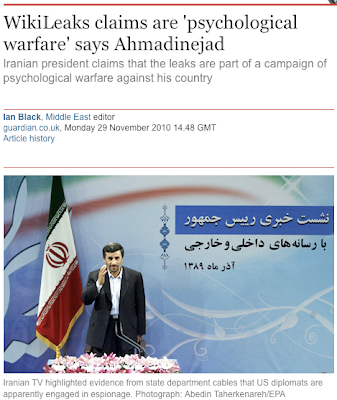
Wikileaks pisses off Hillary Clinton...and Mahmoud Ahmadinejad...and Sarah Palin.

Now, let's say that I were an average American citizen, who—let's say—wants to hold democratically elected (directly or [usually very...] indirectly) figures in its government accountable for their habitual excesses and deceptions.
Let's say that I've noticed it's difficult to do this, as my government—like most governments—is a bloated, cynical, bureaucratic, militarist nightmare. So much so that it apparently has no center of gravity morally or even strategically.
Let's suppose that, furthermore, control over media—and, therefore, over public discourse—in the United States is monopolized by a handful of multinational corporations, all of whom in effect collude with governments in order to maximize the financial and political benefits that accrue to a fraction of 1 percent of the world's population—a tiny, wealthy elite with the greatest interest in maintaining the status quo, with all of its injustices and irrationalities.
Let's pretend for a moment that all of the preceding is true.

Wouldn't I be likely to conclude that a single piece of information that manages to piss off Hillary Clinton and Mahmoud Ahmadinejad and Sarah Palin...well, wouldn't I be likely to conclude that such a release of information is a good thing?

Sunday, November 28, 2010

Wikileaks leaks more leaks!

Some of the tidbits of information that have been leaked. And other stuff. (More and better-labeled links re this to come tomorrowish, as it is late as I type.)

A writer for The Guardian (UK) asks an appropriate question: "Why do editors committed to press freedom attack Wikileaks?" Possible answer: because they aren't actually committed to press freedom. Why not? Because they're nothing but the hired stooges of the multinational business interests that own the world's mainstream media...? Just a thought.

Of course, these Wikileaks-opposing editors would argue that, as our free-press-loving government claims, the release of these documents is dangerous, and not merely embarrassing.

But, as it turns out, there's no evidence that any Wikileaks releases have hurt anyone.

Saturday, November 20, 2010

GOP Congressmen to America's 65,000 Unemployed: Stop eating food.

(This item by way of the back-in-business PhuckPolitics.)

On Thursday, the newly emboldened, self-congratulatory, and Wall Street-subsidized House Republicans "torpedoed a bill to extend benefits for the long-term unemployed" (The Washington Post). Just get an eyeful of this Old Boy's (Hair) Club (For Men):
It seems that the $12 billion price tag of intervening on behalf of those teetering on the brink of total bankruptcy and ruin is too steep for these steely-eyed Protectors of Industrial/Financial Interests The American Way. Look at the determination in their, uh, gut. The sense of honor and profundity in their Latte-sipping gait.

They just saved America $12 billion. Phew! I'd be drinking me some coffee, too. It's a tough job, pulling our nation back from the brink of financial apocalypse, but somebody's gotta do it.

Of course, the Bush Tax Cuts for the ultra-wealthy cost the nation $3 trillion (Alexander Stille), and that's only over the first eight years of the cuts' existence! Were those cuts to expire on schedule, as the Dems are apparently going to be too weak-kneed to insist—which, by the way, is insane, depressing and humiliating...if ever there were an issue on which the Dems should refuse to compromise....—"the projected cost of the Bush tax cuts to the federal budget over the next ten years is $3.9 trillion, an average of 1.4 percent of the country’s total economic activity (GDP) per year" (CAP). If the Republicans and their conservative Democrat accomplices succeed in actually extending the the tax cuts for the ultra-wealthy, the resulting drain on the US deficit would be an additional $4 million!

But, like I said, the Republicans should be proud of themselves that they've once again succeeded in cynically screwing over the struggling American families that are most vulnerable by sparing the US deficit that whopping $12 billion.

Friday, November 19, 2010

Progressives should oppose the intrustive pat-downs and sketchy scanners.

You know what? I'm with those who are complaining about the intrusiveness of these these "security measures."

I disagree, however, with the neocon creeps who think that racial profiling is a better idea.

And I also disagree with advocates of phony "free markets," who are being paid off by industrial interests to make the implausible argument that "privatizing" airport security is somehow going to solve the problem. It's awfully difficult to see how. That's because it's opportunistic gibberish.
I oppose these intrusive pat-downs and radiation-emitting scanners for one reason: they—like the majority of "security measures" that have been put into practice in airports—are little more than a decoy, Orwellian in character, whose audience are not "the terrorists" to whom their purportedly "sending a signal," but, rather: the American "middle class."
The functions of these "security measures" with respect to middle-class travelers are twofold:

1) To provide people with the illusion that their safety is being guaranteed. In reality, the "safety" that these devices and "procedures" are said to provide exceeds could never honestly be guaranteed. It's impossible. Don't believe me? Read this detailed piece of reporting that exposes the "Security Theater" in our airports, published in the Atlantic Monthly back in 2008.

2) To remind people, as frequently and as concretely as possible, that they should be scared, that they should not think for themselves, and that they require the guiding hand of a benevolent, external authority.
Now, if my second point sounds like the classic right-wing/libertarian argument that "government intervention in our lives is paternalistic," that's because it's pretty much the same claim. With a couple of important differences:

First, I submit that it is obvious that it makes little difference whether the paternalistic authority is embodied in a government agency or a privately administered company, which will have inevitably owed its monopoly in a given market(s) to the congressmen to whom they have donated their millions of dollars.

The second element differentiating my argument from that of the phony free-market types is that, if anything, private industry stands to gain as much, if not more from disingenuous and arrogant administration of "security" policy than does a government agency. This is because the sole motive of private industry is to gain profits. How, then, can it be argued that they would somehow be more likely to refrain from molesting old grannies, or demanding that a cancer survivor remove her prosthetic breast?

The whole thing stinks. I think progressives should be speaking up in opposition to the intrusive and unhealthy "security procedures." Speak up, and don't let the privateering/profiteering brigade change the subject! Speak up in defense of our Constitutionally protected civil liberties.

Saturday, October 23, 2010

Crib From This gets Hitched.

I know—dumb title; but who cares.

Over the years, we here at Crib From This have characterized the writings, spoken remarks, and ideas of Christopher Hitchens variously as dumb, smart, funny, and irrelevant [this is not a typo—ed.]. Through the thick and thin of these reactions to his work, it remains that Hitch is among the few commentators to appear regularly in the 'mainstream media' (whose ranks Hitchens—previously a longtime columnist for The Nation magazine—joined when he emerged as an early and ardent propagandist for prosecuting the Iraq War) to reliably possess any kind of panache or even sense of humor. So when Hitch revealed, a number of months ago, that he had been diagnosed with a life-threatening form of esophageal cancer, we, of course, felt that this was some pretty crap news.

So, in any event, when we happened accidentally upon a couple of his recent contributions to his column in Slate, we were pleasantly surprised to find that both are pithy and of a high caliber. Neither of them is—as Hitch has sometimes been perceived to be—controversial or even provocative. Rather, they both communicate successfully more-or-less obvious truths that lots of other commentators and/or media lack the clearheadedness or intellectual distance from the daily news cycle to state. This is the kind of commentary that is so thoroughly lacking right now and why 'the news', as it were, has become so unworthy of anyone's serious attention over the past six months or year-or-so.

Anyway, we link, first, to Hitchens's lucid take on the recent, bizarre, Rick Sanchez episode. Rick Sanchez is, by the way, a person I had never previously heard of and someone whose career, etc., I fail to find at all interesting. And this is precisely why Hitchens nails it: he doesn't find Sanchez or his remarks to be particularly interesting either. Part of the reason for this, Hitchens argues, is that it simply isn't controversial to "note the effectiveness of the Jewish Lobby."

And we link, second, to an article in which Hitchens reflects upon the inanities and utter lack of substance detectable in the supposed political 'debates' preceding the upcoming mid-term elections occurring across the country. A taste:
Asking my hosts in Connecticut if there was anything worth noting about the upcoming elections in their great state, I received the reply, "Well, we have a guy who wants to be senator who lied about his record of service in Vietnam, and a woman who wants to be senator who has run World Wrestling Entertainment and seems like a tough lady." Though full enough of curiosity to occupy, say, one course of lunch, that still didn't seem to furnish enough material to keep the mind focused on politics for very long.

And this dearth—of genuine topics and of convincing or even plausible candidates—appears to extend from coast to coast. In New York, a rather shopworn son of one Democratic dynasty (and ex-member by marriage of another) is "facing off," as people like to say, against a provincial thug with a line in pseudo-tough talk. In California, where the urgent question of something suspiciously like state failure is staring the electorate in the face, the Brown-Whitman contest hasn't yet risen even to the level of the trivial.
Hitch then carries this discussion in the direction of a general, broadly applicable, and yet incisive and satisfying question:
Consider: What normal person would consider risking their career and their family life in order to undergo the incessant barrage of intrusive questioning about every aspect of their lives since well before college? To face the constant pettifogging and chatter of Facebook and Twitter and have to boast of how many false friends they had made in a weird cyberland? And if only that was the least of it. Then comes the treadmill of fundraising and the unending tyranny of the opinion polls, which many media systems now use as a substitute for news and as a means of creating stories rather than reporting them. And, even if it "works," most of your time in Washington would be spent raising the dough to hang on to your job. No wonder that the best lack all conviction.

This may seem to discount or ignore the apparent flood of new political volunteers who go to make up the Tea Party movement. But how fresh and original are these faces? They come from a long and frankly somewhat boring tradition of anti-incumbency and anti-Washington rhetoric, and they are rather an insult to anyone with anything of a political memory. Since when is it truly insurgent to rail against the state of affairs in the nation's capital? How long did it take Gingrich's "rebel" forces in the mid-1990s to become soft-bottomed incumbents in their turn? Many of the cynical veterans of that moment, from Dick Armey to John Boehner, are the effective managers and controllers of the allegedly spontaneous Tea Party wave we see today.

Populism imposes its own humiliations on anyone considering a run. How many times can you stand in front of an audience and state: "I will always put the people of X first"? (Quite a lot of times, to judge by recent campaigns.) This is to say no more than that you will be a megaphone for sectional interests and regional mood swings and resentment, a confession that, to you, all politics is yokel.
I think that pieces like these—more reflective, more genial, less polemical, and yet every bit as unwavering—suit Hitchens's authorial voice just fine. It's almost as though his longtime infatuation with Orwell has begun to rub off on his style in a more direct way. I like it. Let's hope that the new, 'mature Hitchens' is able to stick around for a good while longer, because we need people to be writing like this in the midst of our present political/cultural landscape.

So, for as long as he continues to turn out work of a high caliber, we say: we'll gladly Hitch our wagons.

Saturday, October 9, 2010

"How completely isolated a world the German people live in..."


I'd like to share with you an excerpt from William Shirer's famous book The Rise and Fall of the Third Reich. Shirer, a newspaper reporter who lived in Berlin throughout the 1930s and into the early years of World War II, recounts how startled he had been at the ease with which German propaganda managed to fool an ever-more gullible German public. What follows is Shirer's description of the headlines of German newspapers during August, 1939, during the final days leading up to Germany's wholly unprovoked invasion of Poland:
In Berlin [...] a foreign observer could watch the way the press, under Goebbels' expert direction, was swindling the gullible German people. For six years, since the Nazi "co-ordination" of the daily newspapers, which had meant the destruction of a free press, the citizens had been cut off from the truth of what was going on in the world. For a time the Swiss German-language newspapers from Zurich and Basel could be purchased at the leading newsstands in Germany and these presented objective news. But in recent years their sale in the Reich had been either prohibited or limited to a few copies. For Germans who could read English or French, there were occasionally a few copies of the London and Paris journals available, though not enough to reach more than a handful of persons.
"How completely isolated a world the German people live in," I noted in my diary on August 10, 1939. "A glance at the newspapers yesterday and today reminds you of it." I had returned to Germany from a brief leave in Washington, New York and Paris, and coming up in the train from my home in Switzerland ten days before I had bought a batch of Berlin and Rhineland newspapers. They quickly propelled one back to the cockeyed world of Nazism, which was as unlike the world I had just left as if it had been on another planet. I noted further on August 10, after I had arrived in Berlin:
Whereas all the rest of the world considers that the peace is about to be broken by Germany, that it is Germany that is threatening to attack Poland... here in Germany, in the world the local newspapers create, the very reverse is maintained ... What the Nazi papers are proclaiming is this: that it is Poland which is disturbing the peace of Europe; Poland which is threatening Germany with armed invasion...

"Poland, Look Out!" warns the B.Z. [cft note: Berliner Arbeiterzeitung] headline, adding: Answer to Poland, the Runner-Amok [Amokläuffer] against Peace and Right in Europe!"

Or the headline in Der Fuehrer, daily paper of Karlsruhe, which I bought on the train: "Warsaw Threatens Bombardment of Danzig—Unbelievable Agitation of the Polish Archmadness [Polnischen Groessenwahsn]!"

You ask: But the German people can't possibly believe these lies? Then you talk to them. So many do.
By Saturday, August 26, the date originally set by Hitler for the attack on Poland, Goebbels' press campaign had reached its climax. I noted in my diary some of the headlines.
The B.Z.: "Complete Chaos in Poland—German Families Flee—Polish Soldiers Push to the Edge of the German Border!" The 12-Uhr Blatt: "This Playing With Fire Going Too Far—Three German Passenger Planes Shot At by Poles—In Corridor Many German Farmhouses in Flames!"

On my way to Broadcast House at midnight I picked up the Sunday edition (August 27) of the Voelkischer Beobachter. Across the whole top of the front page were inch-high headlines:
WHOLE OF POLAND IN WAR FEVER! 1,5000,000 MEN MOBILIZED! UNINTERRUPTED TROOP TRANSPORT TOWARD THE FRONTIER! CHAOS IN UPPER SILESIA!
There was no mention, of course, of any German mobilization, though, as we have seen, Germany had been mobilized for a fortnight.

The truth is a beautiful thing, even when it stings a bit. Do you suppose that the great William Shirer was spinning in his grave during the whole Weapons of Mass Destruction deception/embarrassment, which was aided and abetted by our American—putatively free, democratic—press?

I think it's fair to say that Shirer, like many in America's longstanding tradition of democratic patriots and truth-tellers, would be disappointed. He expected better of our elected leaders. We, unfortunately, have seen far too much arrogance and corruption among our leaders and their corporate handlers to reasonably hold the same expectation. But we can work hard to rebuild a genuine American republic in which future generations might reasonably expect it, just as Shirer did.

Saturday, August 21, 2010

Wikileaks & Julian Assange: What to Make of Yesterday's Bizzarely Heavy–Handed Smear?

Time to get current.

Wow. Okay, now I get it. We should be paying attention to this stuff.

Yesterday, I put together a page in this blog called What is 'Crib From This'?, in which I explained that Crib From This is intended to explore the complicated and changing relationship between information and knowledge.

Well, there is no question that Julian Assange, founder of Wikileaks, is giving us no choice but to confront this issue, and, particularly, its relation to nationalism, governmental claims of 'national security', propaganda, freedom of information, and the liberty of ordinary, everyday people to pursue and share knowledge. Without a doubt, these are questions that a lot of us—maybe all of us—would feel more comfortable not confronting, or would prefer to put off confronting until another day. But it seems as though it's too late for that, now. Particularly for we American observers.

So, this post is really just to say: it's time to, as it were, bone-up. Get current with this thing, if we're not already.

Yesterday's (absurdly heavy–handed & obviously fictitious) smear. And today's quick retraction.


Well, it's not news, of course, that Julian Assange has been pissing-off lots of people in high places. But up until yesterday, the most forceful attempts to criticize Wikileaks by way of character-assassination of Assange have come from the radical/loony Right-wing. And even these figures, like Liz Cheney, back on August 2, confined their accusations against Assange to aspects of the content of leaked data.

So, to get started, here are some links to articles about this bizarre episode:

First, an AP release from less than an hour ago (by way of Yahoo News):
STOCKHOLM – Swedish prosecutors withdrew an arrest warrant for the founder of WikiLeaks on Saturday, saying less than a day after the document was issued that it was based on an unfounded accusation of rape.

The accusation had been labeled a dirty trick by Julian Assange and his group, who are preparing to release a fresh batch of classified U.S. documents from the Afghan war.

Swedish prosecutors had urged Assange — a nomadic 39-year-old Australian whose whereabouts were unclear — to turn himself in to police to face questioning in one case involving suspicions of rape and another based on an accusation of molestation.

"I don't think there is reason to suspect that he has committed rape," chief prosecutor Eva Finne said, in announcing the withdrawal of the warrant.

...
Second, today, from Al Jazeera English:

'Dirty tricks'
After Swedish tabloid Expressen,first published reports that the arrest warrant had been issued for Assange, Wikileaks responded on Twittersaying: "We were warned to expect 'dirty tricks.' Now we have the first one."

"No one here has been contacted by Swedish police. Needless to say this will prove hugely distracting."

Assange's organisation has caused much controversy recently with the release of 75,000 classified US military documents containing information surrounding the wars in Iraq and Afghanistan.

The US government rejected the release of the documents, saying the website had "blood on its hands" for naming people who had helped its military in opposition to groups such as the Taliban and al-Qaeda, and ordered Wikileaks to return the files.

Wikileaks, meanwhile, has said that it is plans to reveal more of the remaining 15,000 classified documents it holds, possibly this month or next month.

A blogger for CNN asks Is Assange the target of a U.S. smear campaign? Uh...sure looks like it, doesn't it.

Finally, this article from BBC News says
The Swedish Prosecution Authority website said chief prosecutor Eva Finne had come to the decision that Julian Assange was not subject to arrest.

In a brief statement Eva Finne said: "I don't think there is reason to suspect that he has committed rape."

The website said there would be no further immediate comment.

Earlier, Karin Rosander, communications head at Sweden's prosecutors' office, said there were two separate allegations against Mr Assange, one of rape and the other of molestation. She gave no details of the accusations. She said that as far as she knew they related to alleged incidents that took place in Sweden.

Media reports say Mr Assange was in Sweden last week to talk about his work and defend the decision by Wikileaks to publish the Afghan war logs.

Last month, Wikileaks published more than 75,000 secret US military documents on the war in Afghanistan.

US authorities criticised the leak, saying it could put the lives of coalition soldiers and Afghans, especially informers, at risk.

Mr Assange has said that Wikileaks is intending to release a further 15,000 documents in the coming weeks.

Some idle speculation.

As my title suggests, here's the thing I don't get: why so obviously spurious a charge as rape? I mean, rape? Really? And why would Swedish prosecutors withdraw the charge after less than 24-hours? Was it because the case was really just so obviously without any merit that withdrawing it was the only way to regain some semblance of credibility? If that's the case, then how did it come to pass that the warrant was issued in the first place? Pressure from the USA?

If the latter scenario is the case, then perhaps the whole episode was little more than a (in all likelihood, successful) attempt to scare the hell out of Assange—a show of muscle, if you will.

Also, there's likely to be significance to the fact that the 'news' about Sweden's warrant for Assange broke on a Friday. People who follow things like how the 'news cycle' works always point out that, if you want to release a story but simultaneously bury it, release it on a Friday, because very few people will pay attention, and this low level of immediate interest insures that media will have forgotten all about it by the time the following Monday comes around.

The Friday release would appear to suggest that the false accusation and resulting Swedish warrant really were meant either as an attempt to scare Assange or to 'send him a message', like what evil governments do in cheesy conspiracy movies—i.e., look at how easy it would be for us to crush you like a bug if you piss us off—or as what is sometimes called a 'test balloon', as a de facto public opinion poll, whose research sample consists of the segment of the population that's paying attention to the news on Friday and Saturday?

A brief moment of moralizing.

Not to state the obvious, but shouldn't the US Government and its vast intelligence apparatus have more important things to do than picking on whistle-blowers and advocates for the freedom of information?

Remember, as I point out in What is 'Crib From This'?, the United States Constitution is among the most forceful, elegant and powerful forces for the freedoms of speech, thought, action and information. It's truly a sad day when its leaders decide—not clandestinely, but out in the open, with an obvious smear like this—to attack the world's most dedicated advocates of the very same freedoms that it is constitutionally mandated to protect.

Friday, August 20, 2010

Hyperlink: David David Petraeus Petraeus

The blog PhuckPolitics.com makes an elegant observation: at present, General David Petraeus is serving a public relations function on behalf of the Obama Administration's Afghanistan strategy that bears an uncanny resemblance to the public relations function he once served on behalf of the Bush Administration's Iraq strategy.

Read Obama’s Afghanistan full court press.

Thursday, August 5, 2010

The GOP wants to repeal the 14th Ammendment?

Stop paying attention to the news for a couple of days (or months), and this is the kind of great stuff that you miss out on. Get a load of the Grand Old Party's latest coordinated, demagogic/gestural exercise in—wink, wink—double-speak: in an effort to ratchet-up the appearance of being 'tough on illegal immigrants' (and, one surmises, in order to make damn certain that the Republicans lose the Hispanic vote once and for all [The Atlantic]), Senate Republicans are embracing the idea of holding hearings to determine whether or not to repeal the 14th Amendment to our nation's Constitution (NPR report).

We turn to the commentary of the frequently hilarious Democralypse Now, who reminds us of how excruciatingly embarrassing it is to pay attention to anything John McCain gets up to these days, as he begs for the support of the Republican far-Right:
"You know, look, I know it's babies we're talking about and it's hard to be tough on babies but let's remember we're talking about illegal aliens coming to this country for the purpose of birthing a child, not because they love the kid, cause they want that child to provide them the benefits of U.S. citizenship."—Attorney Wendy Murphy arguing to repeal the 14th amendment on Fox News (where else?)

When you have to start your sentence with the words "You know, look, I know it's babies we're talking about and it's hard to be tough on babies," perhaps that's a point you shouldn't be making.

I don't know, call me old fashioned, but any way you slice it, hating on babies just doesn't seem to be a very tasteful, not to mention, winning strategy.

Oooooh, sounds like Republicans just found themselves the perfect new rallying cry to fire up the base and boot that no good Barry fellow out of the White House and back into the harsh Kenyan wilderness where he belongs. This time, in the form of wretched diaper-wearing ne'r-do-wells looking for a free lunch, bottle of formula, lactating nipple, or whatever the case may be, by committing the unforgivable crime of being born within the nation's beautiful borders (Alaska included!), or at the very least, one of its lesser "territories" like Guam or "American" Samoa. The sweetly, conservative-named "anchor babies."

No, no, we're not talking about the adorable new cartoon infants to join Dora the Explorer on her maritime adventures, but something far far more sinister: pregnant women desperately climbing barbed-wire border fences (and dodging armed gangs of trigger-happy white supremacists) all for the chance to drop a tiny brown automatic U.S. citizen out of their gross foreigner wombs onto once-pure, now-sullied American soil.

[...]

Almost as amazing as watching Republicans try to out-crazy each other with terrible, untenable ideas, aimed at those most disadvantaged and unable to defend themselves, is the comical lengths some Republicans, such as certain former Prisoners of War turned current Prisoners of Wingnuts, are willing to go to try not to have to support this crazy idea, during an otherwise ho-hum morning press conference.
“We’re talking about the stimulus right now,” John McCain said, before darting off to the elevators down the hall from the Senate studio, where he again declined to take a question. Reporters eventually caught up with McCain in the basement of the Capitol, where he was walking toward to the man-operated train connecting the Senate with the Russell office building.

TPMDC asked, “Do you support the Minority Leader’s push for hearings into the repeal of birthright citizenship?”

“Sure, why not?” McCain said briefly.

“Do you support the idea itself?”

“I support the idea of having hearings,” McCain said.

“Do you have a problem with the 14th amendment?” another reporter asked.

“You’re changing the constitution of the United States,” McCain said. “I support the concept of holding hearings.”

“I support the concept of holding hearings,” McCain repeated, turning to the rail car conductor.

“Let’s go!” he snapped. "I don't have anything to add to that."
Now, typically there is something both hilariously funny and tragically sad about witnessing a withered old man shed every last fiber of his integrity en route to becoming a soulless, brain-dead puppet of the right, dancing (err, at least attempting) slowly around an issue as clear-cut and obvious as taking away the constitutional rights of the toothless, under-1 crowd who use pacifiers and diapers, need constant 24-hour care and coddling, and can't even do anything for themselves.

Read the full article.