Showing posts with label media. Show all posts

Monday, July 4, 2011

Uh...hi. And Orwell link.

Well, it's certainly been a while, hasn't it? In between doing to millions of other things, I've been pondering over the last several months how to remake Crib From This, starting, as it were, from scratch. I've got a few cool ideas here and there, and I will let you know (if you or anyone else is actually reading this...) when it will be ready to put into practice. So anyway, stay tuned.

(My god, that was vague...)

So anyway, I just happened across one of my favorite George Orwell essays, Notes on Nationalism, and I'm once again impressed with how unbelievable prescient this plain-spoken anti-genius could be. I imagine that October 1945, when it originally ran in a journal called Polemic: A Magazine of Philosophy, Psychology & Aesthetics, this essay captured, in uncomfortably vivid detail, the deleterious effects of various kinds of nationalism upon the capacity of educated—supposedly 'civilized'—Englishmen and Europeans to think clearly.

What's even more astonishing, however, is to behold just how close Orwell's brilliant analysis comes to capturing the essence of the kinds of shortsighted allegiances that have captured the minds of our (the US's and the West's more generally) 'best and brightest', as we ordinary mortals observe powerlessly their arrogant, ham-fisted mishandling of our current geopolitical situation. Here's Orwell laying the groundwork for his argument, in Notes on Nationalism:
[T]here is a habit of mind which is now so widespread that it affects our thinking on nearly every subject, but which has not yet been given a name. As the nearest existing equivalent I have chosen the word 'nationalism', but it will be seen in a moment that I am not using it in quite the ordinary sense, if only because the emotion I am speaking about does not always attach itself to what is called a nation — that is, a single race or a geographical area. It can attach itself to a church or a class, or it may work in a merely negative sense, AGAINST something or other and without the need for any positive object of loyalty.

By 'nationalism' I mean first of all the habit of assuming that human beings can be classified like insects and that whole blocks of millions or tens of millions of people can be confidently labelled 'good' or 'bad'.* But secondly — and this is much more important — I mean the habit of identifying oneself with a single nation or other unit, placing it beyond good and evil and recognising no other duty than that of advancing its interests. Nationalism is not to be confused with patriotism. Both words are normally used in so vague a way that any definition is liable to be challenged, but one must draw a distinction between them, since two different and even opposing ideas are involved. By 'patriotism' I mean devotion to a particular place and a particular way of life, which one believes to be the best in the world but has no wish to force on other people. Patriotism is of its nature defensive, both militarily and culturally. Nationalism, on the other hand, is inseparable from the desire for power. The abiding purpose of every nationalist is to secure more power and more prestige, NOT for himself but for the nation or other unit in which he has chosen to sink his own individuality.
* Nations, and even vaguer entities such as Catholic Church or the proleteriat, are commonly thought of as individuals and often referred to as 'she'. Patently absurd remarks such as 'Germany is naturally treacherous' are to be found in any newspaper one opens and reckless generalization about national character ('The Spaniard is a natural aristocrat' or 'Every Englishman is a hypocrite') are uttered by almost everyone. Intermittently these generalizations are seen to be unfounded, but the habit of making them persists, and people of professedly international outlook, e.g., Tolstoy or Bernard Shaw, are often guilty of them. (Orwell's footnote)

So long as it is applied merely to the more notorious and identifiable nationalist movements in Germany, Japan, and other countries, all this is obvious enough. Confronted with a phenomenon like Nazism, which we can observe from the outside, nearly all of us would say much the same things about it. But here I must repeat what I said above, that I am only using the word 'nationalism' for lack of a better. Nationalism, in the extended sense in which I am using the word, includes such movements and tendencies as Communism, political Catholicism, Zionism, Antisemitism, Trotskyism and Pacifism. It does not necessarily mean loyalty to a government or a country, still less to ONE'S OWN country, and it is not even strictly necessary that the units in which it deals should actually exist. To name a few obvious examples, Jewry, Islam, Christendom, the Proletariat and the White Race are all of them objects of passionate nationalistic feeling: but their existence can be seriously questioned, and there is no definition of any one of them that would be universally accepted.

It is also worth emphasising once again that nationalist feeling can be purely negative. There are, for example, Trotskyists who have become simply enemies of the U.S.S.R. without developing a corresponding loyalty to any other unit. When one grasps the implications of this, the nature of what I mean by nationalism becomes a good deal clearer. A nationalist is one who thinks solely, or mainly, in terms of competitive prestige. He may be a positive or a negative nationalist — that is, he may use his mental energy either in boosting or in denigrating — but at any rate his thoughts always turn on victories, defeats, triumphs and humiliations. He sees history, especially contemporary history, as the endless rise and decline of great power units, and every event that happens seems to him a demonstration that his own side is on the upgrade and some hated rival is on the downgrade. But finally, it is important not to confuse nationalism with mere worship of success. The nationalist does not go on the principle of simply ganging up with the strongest side. On the contrary, having picked his side, he persuades himself that it IS the strongest, and is able to stick to his belief even when the facts are overwhelmingly against him. Nationalism is power-hunger tempered by self-deception. Every nationalist is capable of the most flagrant dishonesty, but he is also — since he is conscious of serving something bigger than himself — unshakeably certain of being in the right.

Now that I have given this lengthy definition, I think it will be admitted that the habit of mind I am talking about is widespread among the English intelligentsia, and more widespread there than among the mass of the people. For those who feel deeply about contemporary politics, certain topics have become so infected by considerations of prestige that a genuinely rational approach to them is almost impossible. Out of the hundreds of examples that one might choose, take this question: Which of the three great allies, the U.S.S.R., Britain and the USA, has contributed most to the defeat of Germany? In theory, it should be possible to give a reasoned and perhaps even a conclusive answer to this question. In practice, however, the necessary calculations cannot be made, because anyone likely to bother his head about such a question would inevitably see it in terms of competitive prestige. He would therefore START by deciding in favour of Russia, Britain or America as the case might be, and only AFTER this would begin searching for arguments that seemed to support his case. And there are whole strings of kindred questions to which you can only get an honest answer from someone who is indifferent to the whole subject involved, and whose opinion on it is probably worthless in any case. Hence, partly, the remarkable failure in our time of political and military prediction. It is curious to reflect that out of al the 'experts' of all the schools, there was not a single one who was able to foresee so likely an event as the Russo-German Pact of 1939.* And when news of the Pact broke, the most wildly divergent explanations were of it were given, and predictions were made which were falsified almost immediately, being based in nearly every case not on a study of probabilities but on a desire to make the U.S.S.R. seem good or bad, strong or weak. Political or military commentators, like astrologers, can survive almost any mistake, because their more devoted followers do not look to them for an appraisal of the facts but for the stimulation of nationalistic loyalties.** And aesthetic judgements, especially literary judgements, are often corrupted in the same way as political ones. It would be difficult for an Indian Nationalist to enjoy reading Kipling or for a Conservative to see merit in Mayakovsky, and there is always a temptation to claim that any book whose tendency one disagrees with must be a bad book from a LITERARY point of view. People of strongly nationalistic outlook often perform this sleight of hand without being conscious of dishonesty.
* A few writers of conservative tendency, such as Peter Drucker, foretold an agreement between Germany and Russia, but they expected an actual alliance or amalgamation which would be permanent. No Marxist or other left-wing writer, of whatever colour, came anywhere near foretelling the Pact. (Orwell's footnote)

** The military commentators of the popular press can mostly be classified as pro-Russian or anti-Russian, pro-blimp or anti-blimp. Such errors as believing the Mrginot Line impregnable, or predicting that Russia would conquer Germany in three months, have failed to shake their reputation, because they were always saying what their own particular audience wanted to hear. The two military critics most favoured by the intelligentsia are Captain Liddell Hart and Major-General Fuller, the first of whom teaches that the defence is stronger that the attack, and the second that the attack is stronger that the defence. This contradiction has not prevented both of them from being accepted as authorities by the same public. The secret reason for their vogue in left-wing circles is that both of them are at odds with the War Office. (Orwell's footnote)

Orwell goes on to say:
In England, if one simply considers the number of people involved, it is probable that the dominant form of nationalism is old-fashioned British jingoism. It is certain that this is still widespread, and much more so than most observers would have believed a dozen years ago. However, in this essay I am concerned chiefly with the reactions of the intelligentsia, among whom jingoism and even patriotism of the old kind are almost dead, though they now seem to be reviving among a minority. Among the intelligentsia, it hardly needs saying that the dominant form of nationalism is Communism — using this word in a very loose sense, to include not merely Communist Party members, but 'fellow travellers' and Russophiles generally. A Communist, for my purpose here, is one who looks upon the U.S.S.R. as his Fatherland and feels it his duty to justify Russian policy and advance Russian interests at all costs. Obviously such people abound in England today, and their direct and indirect influence is very great. But many other forms of nationalism also flourish, and it is by noticing the points of resemblance between different and even seemingly opposed currents of thought that one can best get the matter into perspective.

Ten or twenty years ago, the form of nationalism most closely corresponding to Communism today was political Catholicism. Its most outstanding exponent — though he was perhaps an extreme case rather than a typical one — was G. K. Chesterton. Chesterton was a writer of considerable talent who chose to suppress both his sensibilities and his intellectual honesty in the cause of Roman Catholic propaganda. During the last twenty years or so of his life, his entire output was in reality an endless repetition of the same thing, under its laboured cleverness as simple and boring as 'Great is Diana of the Ephesians.' Every book that he wrote, every scrap of dialogue, had to demonstrate beyond the possibility of mistake the superiority of the Catholic over the Protestant or the pagan. But Chesterton was not content to think of this superiority as merely intellectual or spiritual: it had to be translated into terms of national prestige and military power, which entailed an ignorant idealisation of the Latin countries, especially France. Chesterton had not lived long in France, and his picture of it — as a land of Catholic peasants incessantly singing the MARSEILLAISE over glasses of red wine — had about as much relation to reality as CHU CHIN CHOW has to everyday life in Baghdad. And with this went not only an enormous overestimation of French military power (both before and after 1914-18 he maintained that France, by itself, was stronger than Germany), but a silly and vulgar glorification of the actual process of war. Chesterton's battle poems, such as Lepanto or The Ballad of Saint Barbara, make The Charge of the Light Brigade read like a pacifist tract: they are perhaps the most tawdry bits of bombast to be found in our language. The interesting thing is that had the romantic rubbish which he habitually wrote about France and the French army been written by somebody else about Britain and the British army, he would have been the first to jeer. In home politics he was a Little Englander, a true hater of jingoism and imperialism, and according to his lights a true friend of democracy. Yet when he looked outwards into the international field, he could forsake his principles without even noticing he was doing so. Thus, his almost mystical belief in the virtues of democracy did not prevent him from admiring Mussolini. Mussolini had destroyed the representative government and the freedom of the press for which Chesterton had struggled so hard at home, but Mussolini was an Italian and had made Italy strong, and that settled the matter. Nor did Chesterton ever find a word to say about imperialism and the conquest of coloured races when they were practised by Italians or Frenchmen. His hold on reality, his literary taste, and even to some extent his moral sense, were dislocated as soon as his nationalistic loyalties were involved.

Obviously there are considerable resemblances between political Catholicism, as exemplified by Chesterton, and Communism. So there are between either of these and for instance Scottish nationalism, Zionism, Antisemitism or Trotskyism. It would be an oversimplification to say that all forms of nationalism are the same, even in their mental atmosphere, but there are certain rules that hold good in all cases. The following are the principal characteristics of nationalist thought:

OBSESSION. As nearly as possible, no nationalist ever thinks, talks, or writes about anything except the superiority of his own power unit. It is difficult if not impossible for any nationalist to conceal his allegiance. The smallest slur upon his own unit, or any implied praise of a rival organization, fills him with uneasiness which he can relieve only by making some sharp retort. If the chosen unit is an actual country, such as Ireland or India, he will generally claim superiority for it not only in military power and political virtue, but in art, literature, sport, structure of the language, the physical beauty of the inhabitants, and perhaps even in climate, scenery and cooking. He will show great sensitiveness about such things as the correct display of flags, relative size of headlines and the order in which different countries are named.* Nomenclature plays a very important part in nationalist thought. Countries which have won their independence or gone through a nationalist revolution usually change their names, and any country or other unit round which strong feelings revolve is likely to have several names, each of them carrying a different implication. The two sides of the Spanish Civil War had between them nine or ten names expressing different degrees of love and hatred. Some of these names (e.g. 'Patriots' for Franco-supporters, or 'Loyalists' for Government-supporters) were frankly question-begging, and there was no single one of the which the two rival factions could have agreed to use. All nationalists consider it a duty to spread their own language to the detriment of rival languages, and among English-speakers this struggle reappears in subtler forms as a struggle between dialects. Anglophobe-Americans will refuse to use a slang phrase if they know it to be of British origin, and the conflict between Latinizers and Germanizers often has nationalists motives behind it. Scottish nationalists insist on the superiority of Lowland Scots, and socialists whose nationalism takes the form of class hatred tirade against the B.B.C. accent and even the often gives the impression of being tinged by belief in sympathetic magic — a belief which probably comes out in the widespread custom of burning political enemies in effigy, or using pictures of them as targets in shooting galleries.
* Certain Americans have expressed dissatisfaction because 'Anglo-American' is the form of combination for these two words. It has been proposed to substitute 'Americo-British'. (Orwell's footnote)

INSTABILITY. The intensity with which they are held does not prevent nationalist loyalties from being transferable. To begin with, as I have pointed out already, they can be and often are fastened up on some foreign country. One quite commonly finds that great national leaders, or the founders of nationalist movements, do not even belong to the country they have glorified. Sometimes they are outright foreigners, or more often they come from peripheral areas where nationality is doubtful. Examples are Stalin, Hitler, Napoleon, de Valera, Disraeli, Poincare, Beaverbrook. The Pan-German movement was in part the creation of an Englishman, Houston Chamberlain. For the past fifty or a hundred years, transferred nationalism has been a common phenomenon among literary intellectuals. With Lafcadio Hearne the transference was to Japan, with Carlyle and many others of his time to Germany, and in our own age it is usually to Russia. But the peculiarly interesting fact is that re-transference is also possible. A country or other unit which has been worshipped for years may suddenly become detestable, and some other object of affection may take its place with almost no interval. In the first version of H. G. Wells's OUTLINE OF HISTORY, and others of his writings about that time, one finds the United States praised almost as extravagantly as Russia is praised by Communists today: yet within a few years this uncritical admiration had turned into hostility. The bigoted Communist who changes in a space of weeks, or even days, into an equally bigoted Trotskyist is a common spectacle. In continental Europe Fascist movements were largely recruited from among Communists, and the opposite process may well happen within the next few years. What remains constant in the nationalist is his state of mind: the object of his feelings is changeable, and may be imaginary.

But for an intellectual, transference has an important function which I have already mentioned shortly in connection with Chesterton. It makes it possible for him to be much MORE nationalistic — more vulgar, more silly, more malignant, more dishonest — that he could ever be on behalf of his native country, or any unit of which he had real knowledge. When one sees the slavish or boastful rubbish that is written about Stalin, the Red Army, etc. by fairly intelligent and sensitive people, one realises that this is only possible because some kind of dislocation has taken place. In societies such as ours, it is unusual for anyone describable as an intellectual to feel a very deep attachment to his own country. Public opinion — that is, the section of public opinion of which he as an intellectual is aware — will not allow him to do so. Most of the people surrounding him are sceptical and disaffected, and he may adopt the same attitude from imitativeness or sheer cowardice: in that case he will have abandoned the form of nationalism that lies nearest to hand without getting any closer to a genuinely internationalist outlook. He still feels the need for a Fatherland, and it is natural to look for one somewhere abroad. Having found it, he can wallow unrestrainedly in exactly those emotions from which he believes that he has emancipated himself. God, the King, the Empire, the Union Jack — all the overthrown idols can reappear under different names, and because they are not recognised for what they are they can be worshipped with a good conscience. Transferred nationalism, like the use of scapegoats, is a way of attaining salvation without altering one's conduct.

INDIFFERENCE TO REALITY. All nationalists have the power of not seeing resemblances between similar sets of facts. A British Tory will defend self-determination in Europe and oppose it in India with no feeling of inconsistency. Actions are held to be good or bad, not on their own merits, but according to who does them, and there is almost no kind of outrage — torture, the use of hostages, forced labour, mass deportations, imprisonment without trial, forgery, assassination, the bombing of civilians — which does not change its moral colour when it is committed by 'our' side. The Liberal NEWS CHRONICLE published, as an example of shocking barbarity, photographs of Russians hanged by the Germans, and then a year or two later published with warm approval almost exactly similar photographs of Germans hanged by the Russians.* It is the same with historical events. History is thought of largely in nationalist terms, and such things as the Inquisition, the tortures of the Star Chamber, the exploits of the English buccaneers (Sir Francis Drake, for instance, who was given to sinking Spanish prisoners alive), the Reign of Terror, the heroes of the Mutiny blowing hundreds of Indians from the guns, or Cromwell's soldiers slashing Irishwomen's faces with razors, become morally neutral or even meritorious when it is felt that they were done in the 'right' cause. If one looks back over the past quarter of a century, one finds that there was hardly a single year when atrocity stories were not being reported from some part of the world; and yet in not one single case were these atrocities — in Spain, Russia, China, Hungary, Mexico, Amritsar, Smyrna — believed in and disapproved of by the English intelligentsia as a whole. Whether such deeds were reprehensible, or even whether they happened, was always decided according to political predilection.
* The NEWS CHRONICLE advised its readers to visit the news film at which the entire execution could be witnessed, with close-ups. The STAR published with seeming approval photographs of nearly naked female collaborationists being baited by the Paris mob. These photographs had a marked resemblance to the Nazi photographs of Jews being baited by the Berlin mob. (Orwell's footnote)
The nationalist not only does not disapprove of atrocities committed by his own side, but he has a remarkable capacity for not even hearing about them. For quite six years the English admirers of Hitler contrived not to learn of the existence of Dachau and Buchenwald. And those who are loudest in denouncing the German concentration camps are often quite unaware, or only very dimly aware, that there are also concentration camps in Russia. Huge events like the Ukraine famine of 1933, involving the deaths of millions of people, have actually escaped the attention of the majority of English Russophiles. Many English people have heard almost nothing about the extermination of German and Polish Jews during the present war. Their own antisemitism has caused this vast crime to bounce off their consciousness. In nationalist thought there are facts which are both true and untrue, known and unknown. A known fact may be so unbearable that it is habitually pushed aside and not allowed to enter into logical processes, or on the other hand it may enter into every calculation and yet never be admitted as a fact, even in one's own mind.

Every nationalist is haunted by the belief that the past can be altered. He spends part of his time in a fantasy world in which things happen as they should — in which, for example, the Spanish Armada was a success or the Russian Revolution was crushed in 1918 — and he will transfer fragments of this world to the history books whenever possible. Much of the propagandist writing of our time amounts to plain forgery. Material facts are suppressed, dates altered, quotations removed from their context and doctored so as to change their meaning. Events which it is felt ought not to have happened are left unmentioned and ultimately denied.* In 1927 Chiang Kai Shek boiled hundreds of Communists alive, and yet within ten years he had become one of the heroes of the Left. The re-alignment of world politics had brought him into the anti-Fascist camp, and so it was felt that the boiling of the Communists 'didn't count', or perhaps had not happened. The primary aim of propaganda is, of course, to influence contemporary opinion, but those who rewrite history do probably believe with part of their minds that they are actually thrusting facts into the past. When one considers the elaborate forgeries that have been committed in order to show that Trotsky did not play a valuable part in the Russian civil war, it is difficult to feel that the people responsible are merely lying. More probably they feel that their own version was what happened in the sight of God, and that one is justified in rearranging the records accordingly.
* An example is the Russo-German Pact, which is being effaced as quickly as possible from public memory. A Russian correspondent informs me that mention of the Pact is already being omitted from Russian year-books which table recent political events. (Orwell's note)

Indifference to objective truth is encouraged by the sealing-off of one part of the world from another, which makes it harder and harder to discover what is actually happening. There can often be a genuine doubt about the most enormous events. For example, it is impossible to calculate within millions, perhaps even tens of millions, the number of deaths caused by the present war. The calamities that are constantly being reported — battles, massacres, famines, revolutions — tend to inspire in the average person a feeling of unreality. One has no way of verifying the facts, one is not even fully certain that they have happened, and one is always presented with totally different interpretations from different sources. What were the rights and wrongs of the Warsaw rising of August 1944? Is it true about the German gas ovens in Poland? Who was really to blame for the Bengal famine? Probably the truth is discoverable, but the facts will be so dishonestly set forth in almost any newspaper that the ordinary reader can be forgiven either for swallowing lies or failing to form an opinion. The general uncertainty as to what is really happening makes it easier to cling to lunatic beliefs. Since nothing is ever quite proved or disproved, the most unmistakable fact can be impudently denied. Moreover, although endlessly brooding on power, victory, defeat, revenge, the nationalist is often somewhat uninterested in what happens in the real world. What he wants is to FEEL that his own unit is getting the better of some other unit, and he can more easily do this by scoring off an adversary than by examining the facts to see whether they support him. All nationalist controversy is at the debating-society level. It is always entirely inconclusive, since each contestant invariably believes himself to have won the victory. Some nationalists are not far from schizophrenia, living quite happily amid dreams of power and conquest which have no connection with the physical world.

Orwell goes on to elaborate a typology of forms of nationalism. Laser-sharp thinking that—as with pretty much everything Orwell ever wrote—has a lot to say to us today.

Tuesday, December 7, 2010

Julian Assange arrested and denied bail in UK, pens an editorial in Australian newspaper.

Well, there it is. Wikileaks founder Julian Assange has been arrested by English authorities and is being held without bail. From the UK's The Guardian:
WikiLeaks founder Julian Assange was remanded in custody today after appearing in court on an extradition warrant.

The 39-year-old Australian, who is wanted in Sweden over allegations he sexually assaulted two women, was refused bail on the grounds there was a risk he would fail to surrender.

Before a packed court No 1 at Westminster magistrates court, District Judge Howard Riddle said Assange was to be remanded in custody until a further hearing on December 14.

The ruling came despite Jemima Khan, film director Ken Loach and veteran journalist John Pilger standing up in court to offer to act at surety for Assange.

But the judge concluded that because of the "serious" nature of the allegations against Assange, his "comparatively weak community ties" in the UK, and that it was believed he had the financial means and the ability to abscond, there was a substantial risk he would fail to surrender.

Assange, in an editorial piece published today in the newspaper The Australian, argues: "Don't shoot the messenger! for revealing uncomfortable truths":

WIKILEAKS deserves protection, not threats and attacks.

IN 1958 a young Rupert Murdoch, then owner and editor of Adelaide's The News, wrote: "In the race between secrecy and truth, it seems inevitable that truth will always win."

His observation perhaps reflected his father Keith Murdoch's expose that Australian troops were being needlessly sacrificed by incompetent British commanders on the shores of Gallipoli. The British tried to shut him up but Keith Murdoch would not be silenced and his efforts led to the termination of the disastrous Gallipoli campaign.

Nearly a century later, WikiLeaks is also fearlessly publishing facts that need to be made public.

I grew up in a Queensland country town where people spoke their minds bluntly. They distrusted big government as something that could be corrupted if not watched carefully. The dark days of corruption in the Queensland government before the Fitzgerald inquiry are testimony to what happens when the politicians gag the media from reporting the truth.

These things have stayed with me. WikiLeaks was created around these core values. The idea, conceived in Australia, was to use internet technologies in new ways to report the truth.

WikiLeaks coined a new type of journalism: scientific journalism. We work with other media outlets to bring people the news, but also to prove it is true. Scientific journalism allows you to read a news story, then to click online to see the original document it is based on. That way you can judge for yourself: Is the story true? Did the journalist report it accurately?

Democratic societies need a strong media and WikiLeaks is part of that media. The media helps keep government honest. WikiLeaks has revealed some hard truths about the Iraq and Afghan wars, and broken stories about corporate corruption.

People have said I am anti-war: for the record, I am not. Sometimes nations need to go to war, and there are just wars. But there is nothing more wrong than a government lying to its people about those wars, then asking these same citizens to put their lives and their taxes on the line for those lies. If a war is justified, then tell the truth and the people will decide whether to support it.

If you have read any of the Afghan or Iraq war logs, any of the US embassy cables or any of the stories about the things WikiLeaks has reported, consider how important it is for all media to be able to report these things freely.

WikiLeaks is not the only publisher of the US embassy cables. Other media outlets, including Britain's The Guardian, The New York Times, El Pais in Spain and Der Spiegel in Germany have published the same redacted cables.

Yet it is WikiLeaks, as the co-ordinator of these other groups, that has copped the most vicious attacks and accusations from the US government and its acolytes. I have been accused of treason, even though I am an Australian, not a US, citizen. There have been dozens of serious calls in the US for me to be "taken out" by US special forces. Sarah Palin says I should be "hunted down like Osama bin Laden", a Republican bill sits before the US Senate seeking to have me declared a "transnational threat" and disposed of accordingly. An adviser to the Canadian Prime Minister's office has called on national television for me to be assassinated. An American blogger has called for my 20-year-old son, here in Australia, to be kidnapped and harmed for no other reason than to get at me.

And Australians should observe with no pride the disgraceful pandering to these sentiments by Julia Gillard and her government. The powers of the Australian government appear to be fully at the disposal of the US as to whether to cancel my Australian passport, or to spy on or harass WikiLeaks supporters. The Australian Attorney-General is doing everything he can to help a US investigation clearly directed at framing Australian citizens and shipping them to the US.

Prime Minister Gillard and US Secretary of State Hillary Clinton have not had a word of criticism for the other media organisations. That is because The Guardian, The New York Times and Der Spiegel are old and large, while WikiLeaks is as yet young and small.

We are the underdogs. [...]

Has there been any response from the Australian government to the numerous public threats of violence against me and other WikiLeaks personnel? One might have thought an Australian prime minister would be defending her citizens against such things, but there have only been wholly unsubstantiated claims of illegality. The Prime Minister and especially the Attorney-General are meant to carry out their duties with dignity and above the fray. Rest assured, these two mean to save their own skins. They will not.

Every time WikiLeaks publishes the truth about abuses committed by US agencies, Australian politicians chant a provably false chorus with the State Department: "You'll risk lives! National security! You'll endanger troops!" Then they say there is nothing of importance in what WikiLeaks publishes. It can't be both. Which is it?

It is neither. WikiLeaks has a four-year publishing history. During that time we have changed whole governments, but not a single person, as far as anyone is aware, has been harmed. [...]US Secretary of Defence Robert Gates admitted in a letter to the US congress that no sensitive intelligence sources or methods had been compromised by the Afghan war logs disclosure. The Pentagon stated there was no evidence the WikiLeaks reports had led to anyone being harmed in Afghanistan. NATO in Kabul told CNN it couldn't find a single person who needed protecting. The Australian Department of Defence said the same. No Australian troops or sources have been hurt by anything we have published.

But our publications have been far from unimportant. The US diplomatic cables reveal some startling facts:

► The US asked its diplomats to steal personal human material and information from UN officials and human rights groups, including DNA, fingerprints, iris scans, credit card numbers, internet passwords and ID photos, in violation of international treaties. Presumably Australian UN diplomats may be targeted, too.

► King Abdullah of Saudi Arabia asked the US to attack Iran.

► Officials in Jordan and Bahrain want Iran's nuclear program stopped by any means available.

► Britain's Iraq inquiry was fixed to protect "US interests".

► Sweden is a covert member of NATO and US intelligence sharing is kept from parliament.

► The US is playing hardball to get other countries to take freed detainees from Guantanamo Bay. Barack Obama agreed to meet the Slovenian President only if Slovenia took a prisoner. Our Pacific neighbour Kiribati was offered millions of dollars to accept detainees.

In its landmark ruling in the Pentagon Papers case, the US Supreme Court said "only a free and unrestrained press can effectively expose deception in government". The swirling storm around WikiLeaks today reinforces the need to defend the right of all media to reveal the truth.
For ongoing updates on the Wikileaks/Assange situation, consult this page on The Guardian's Web site. Another frequently updated page following the Wikileaks phenomenon is the blog of a certain Greg Mitchell on The Nation's Web site. Further ongoing coverage and detailed analysis regarding Wikileaks and related phenomena provided by Glenn Greenwald, of Salon.com.

Lastly, if governments can shut down Wikileaks with a few phone calls to credit card companies and Web hosting services (CS Monitor), here's an article in which a certain Paul Wallis asks: what's to stop them from doing the same to any and all other media?

Monday, November 29, 2010

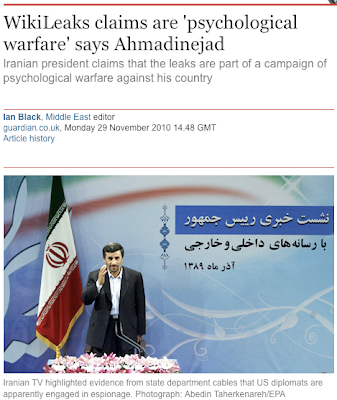
Wikileaks pisses off Hillary Clinton...and Mahmoud Ahmadinejad...and Sarah Palin.

Now, let's say that I were an average American citizen, who—let's say—wants to hold democratically elected (directly or [usually very...] indirectly) figures in its government accountable for their habitual excesses and deceptions.
Let's say that I've noticed it's difficult to do this, as my government—like most governments—is a bloated, cynical, bureaucratic, militarist nightmare. So much so that it apparently has no center of gravity morally or even strategically.
Let's suppose that, furthermore, control over media—and, therefore, over public discourse—in the United States is monopolized by a handful of multinational corporations, all of whom in effect collude with governments in order to maximize the financial and political benefits that accrue to a fraction of 1 percent of the world's population—a tiny, wealthy elite with the greatest interest in maintaining the status quo, with all of its injustices and irrationalities.
Let's pretend for a moment that all of the preceding is true.

Wouldn't I be likely to conclude that a single piece of information that manages to piss off Hillary Clinton and Mahmoud Ahmadinejad and Sarah Palin...well, wouldn't I be likely to conclude that such a release of information is a good thing?

Sunday, November 28, 2010

Wikileaks leaks more leaks!

Some of the tidbits of information that have been leaked. And other stuff. (More and better-labeled links re this to come tomorrowish, as it is late as I type.)

A writer for The Guardian (UK) asks an appropriate question: "Why do editors committed to press freedom attack Wikileaks?" Possible answer: because they aren't actually committed to press freedom. Why not? Because they're nothing but the hired stooges of the multinational business interests that own the world's mainstream media...? Just a thought.

Of course, these Wikileaks-opposing editors would argue that, as our free-press-loving government claims, the release of these documents is dangerous, and not merely embarrassing.

But, as it turns out, there's no evidence that any Wikileaks releases have hurt anyone.

Saturday, October 23, 2010

Crib From This gets Hitched.

I know—dumb title; but who cares.

Over the years, we here at Crib From This have characterized the writings, spoken remarks, and ideas of Christopher Hitchens variously as dumb, smart, funny, and irrelevant [this is not a typo—ed.]. Through the thick and thin of these reactions to his work, it remains that Hitch is among the few commentators to appear regularly in the 'mainstream media' (whose ranks Hitchens—previously a longtime columnist for The Nation magazine—joined when he emerged as an early and ardent propagandist for prosecuting the Iraq War) to reliably possess any kind of panache or even sense of humor. So when Hitch revealed, a number of months ago, that he had been diagnosed with a life-threatening form of esophageal cancer, we, of course, felt that this was some pretty crap news.

So, in any event, when we happened accidentally upon a couple of his recent contributions to his column in Slate, we were pleasantly surprised to find that both are pithy and of a high caliber. Neither of them is—as Hitch has sometimes been perceived to be—controversial or even provocative. Rather, they both communicate successfully more-or-less obvious truths that lots of other commentators and/or media lack the clearheadedness or intellectual distance from the daily news cycle to state. This is the kind of commentary that is so thoroughly lacking right now and why 'the news', as it were, has become so unworthy of anyone's serious attention over the past six months or year-or-so.

Anyway, we link, first, to Hitchens's lucid take on the recent, bizarre, Rick Sanchez episode. Rick Sanchez is, by the way, a person I had never previously heard of and someone whose career, etc., I fail to find at all interesting. And this is precisely why Hitchens nails it: he doesn't find Sanchez or his remarks to be particularly interesting either. Part of the reason for this, Hitchens argues, is that it simply isn't controversial to "note the effectiveness of the Jewish Lobby."

And we link, second, to an article in which Hitchens reflects upon the inanities and utter lack of substance detectable in the supposed political 'debates' preceding the upcoming mid-term elections occurring across the country. A taste:
Asking my hosts in Connecticut if there was anything worth noting about the upcoming elections in their great state, I received the reply, "Well, we have a guy who wants to be senator who lied about his record of service in Vietnam, and a woman who wants to be senator who has run World Wrestling Entertainment and seems like a tough lady." Though full enough of curiosity to occupy, say, one course of lunch, that still didn't seem to furnish enough material to keep the mind focused on politics for very long.

And this dearth—of genuine topics and of convincing or even plausible candidates—appears to extend from coast to coast. In New York, a rather shopworn son of one Democratic dynasty (and ex-member by marriage of another) is "facing off," as people like to say, against a provincial thug with a line in pseudo-tough talk. In California, where the urgent question of something suspiciously like state failure is staring the electorate in the face, the Brown-Whitman contest hasn't yet risen even to the level of the trivial.
Hitch then carries this discussion in the direction of a general, broadly applicable, and yet incisive and satisfying question:
Consider: What normal person would consider risking their career and their family life in order to undergo the incessant barrage of intrusive questioning about every aspect of their lives since well before college? To face the constant pettifogging and chatter of Facebook and Twitter and have to boast of how many false friends they had made in a weird cyberland? And if only that was the least of it. Then comes the treadmill of fundraising and the unending tyranny of the opinion polls, which many media systems now use as a substitute for news and as a means of creating stories rather than reporting them. And, even if it "works," most of your time in Washington would be spent raising the dough to hang on to your job. No wonder that the best lack all conviction.

This may seem to discount or ignore the apparent flood of new political volunteers who go to make up the Tea Party movement. But how fresh and original are these faces? They come from a long and frankly somewhat boring tradition of anti-incumbency and anti-Washington rhetoric, and they are rather an insult to anyone with anything of a political memory. Since when is it truly insurgent to rail against the state of affairs in the nation's capital? How long did it take Gingrich's "rebel" forces in the mid-1990s to become soft-bottomed incumbents in their turn? Many of the cynical veterans of that moment, from Dick Armey to John Boehner, are the effective managers and controllers of the allegedly spontaneous Tea Party wave we see today.

Populism imposes its own humiliations on anyone considering a run. How many times can you stand in front of an audience and state: "I will always put the people of X first"? (Quite a lot of times, to judge by recent campaigns.) This is to say no more than that you will be a megaphone for sectional interests and regional mood swings and resentment, a confession that, to you, all politics is yokel.
I think that pieces like these—more reflective, more genial, less polemical, and yet every bit as unwavering—suit Hitchens's authorial voice just fine. It's almost as though his longtime infatuation with Orwell has begun to rub off on his style in a more direct way. I like it. Let's hope that the new, 'mature Hitchens' is able to stick around for a good while longer, because we need people to be writing like this in the midst of our present political/cultural landscape.

So, for as long as he continues to turn out work of a high caliber, we say: we'll gladly Hitch our wagons.

Saturday, October 9, 2010

"How completely isolated a world the German people live in..."


I'd like to share with you an excerpt from William Shirer's famous book The Rise and Fall of the Third Reich. Shirer, a newspaper reporter who lived in Berlin throughout the 1930s and into the early years of World War II, recounts how startled he had been at the ease with which German propaganda managed to fool an ever-more gullible German public. What follows is Shirer's description of the headlines of German newspapers during August, 1939, during the final days leading up to Germany's wholly unprovoked invasion of Poland:
In Berlin [...] a foreign observer could watch the way the press, under Goebbels' expert direction, was swindling the gullible German people. For six years, since the Nazi "co-ordination" of the daily newspapers, which had meant the destruction of a free press, the citizens had been cut off from the truth of what was going on in the world. For a time the Swiss German-language newspapers from Zurich and Basel could be purchased at the leading newsstands in Germany and these presented objective news. But in recent years their sale in the Reich had been either prohibited or limited to a few copies. For Germans who could read English or French, there were occasionally a few copies of the London and Paris journals available, though not enough to reach more than a handful of persons.
"How completely isolated a world the German people live in," I noted in my diary on August 10, 1939. "A glance at the newspapers yesterday and today reminds you of it." I had returned to Germany from a brief leave in Washington, New York and Paris, and coming up in the train from my home in Switzerland ten days before I had bought a batch of Berlin and Rhineland newspapers. They quickly propelled one back to the cockeyed world of Nazism, which was as unlike the world I had just left as if it had been on another planet. I noted further on August 10, after I had arrived in Berlin:
Whereas all the rest of the world considers that the peace is about to be broken by Germany, that it is Germany that is threatening to attack Poland... here in Germany, in the world the local newspapers create, the very reverse is maintained ... What the Nazi papers are proclaiming is this: that it is Poland which is disturbing the peace of Europe; Poland which is threatening Germany with armed invasion...

"Poland, Look Out!" warns the B.Z. [cft note: Berliner Arbeiterzeitung] headline, adding: Answer to Poland, the Runner-Amok [Amokläuffer] against Peace and Right in Europe!"

Or the headline in Der Fuehrer, daily paper of Karlsruhe, which I bought on the train: "Warsaw Threatens Bombardment of Danzig—Unbelievable Agitation of the Polish Archmadness [Polnischen Groessenwahsn]!"

You ask: But the German people can't possibly believe these lies? Then you talk to them. So many do.
By Saturday, August 26, the date originally set by Hitler for the attack on Poland, Goebbels' press campaign had reached its climax. I noted in my diary some of the headlines.
The B.Z.: "Complete Chaos in Poland—German Families Flee—Polish Soldiers Push to the Edge of the German Border!" The 12-Uhr Blatt: "This Playing With Fire Going Too Far—Three German Passenger Planes Shot At by Poles—In Corridor Many German Farmhouses in Flames!"

On my way to Broadcast House at midnight I picked up the Sunday edition (August 27) of the Voelkischer Beobachter. Across the whole top of the front page were inch-high headlines:
WHOLE OF POLAND IN WAR FEVER! 1,5000,000 MEN MOBILIZED! UNINTERRUPTED TROOP TRANSPORT TOWARD THE FRONTIER! CHAOS IN UPPER SILESIA!
There was no mention, of course, of any German mobilization, though, as we have seen, Germany had been mobilized for a fortnight.

The truth is a beautiful thing, even when it stings a bit. Do you suppose that the great William Shirer was spinning in his grave during the whole Weapons of Mass Destruction deception/embarrassment, which was aided and abetted by our American—putatively free, democratic—press?

I think it's fair to say that Shirer, like many in America's longstanding tradition of democratic patriots and truth-tellers, would be disappointed. He expected better of our elected leaders. We, unfortunately, have seen far too much arrogance and corruption among our leaders and their corporate handlers to reasonably hold the same expectation. But we can work hard to rebuild a genuine American republic in which future generations might reasonably expect it, just as Shirer did.

Saturday, June 12, 2010

How does Google mean?
...or: "Everything and More"

No, I'm not going to weigh in on Google's (lack of) aesthetic sense, as demonstrated by the search engine's widely panned and short-lived experiment on Thursday during which a large photograph took the place of the usual plain, white background. Because who cares, really.

No, I'm much more interested in pointing out something that I've noticed over the past month or so that appears to the left of the results of an ordinary Google search. Here's a photo I snapped of it:

Anyone?

What immediately comes to my mind, whenever I glance at this side-bar (which I've done many times) is the title of the only published piece of writing by the late David Foster Wallace that I was never able to make it all the way to the end of. I refer to 2003's Everything and More, subtitled: A Compact History of Infinity. This book-length essay, intended (naively) for the general reading public, was Wallace's audacious, gimmicky and controversial attempt to explain set theory ("multiple infinities")—created (or maybe 'discovered'?) by the 19th century German mathematician Georg Cantor—without really using any actual math.

But, more than Wallace's book, it just strikes me that the words and hyperlinks featured in the above snapshot amount to a kind of smart-ass collage or accidental poem. In other words, with your initial search, Google is providing you with "everything." Should "everything" fail to sate your appetite for page upon page of relevant* material, follow the hyperlink, for Google offers you still "more" than mere infinity.

I guess I'm really just thinking about a constellation of things. First, the fact that we don't often talk about Web pages in ways that take account of how arrangements of words, images and—for example—navigational functions impact conveyed meaning. This can encompass both "intentional" and "unintentional" meanings; it can refer to the ways in which words, images and hyperlinks function as collages of juxtapositions, oppositions and organizational schemes. Furthermore, meaning is impacted not only by what exists on the Web page but by what is left out. Finally, meaning is shaped by the sets of expectations that users bring to bear when using a Web page. This is particularly interesting in reference to search engines, in the case of which the user's attention is almost always focused upon the expectation that he or she will encounter immediately thereafter a spectrum of (categories of?) content.

And, of course, there's the Marshall McLuhan-esque question: what, after all, do I mean when I refer to the "content" with which we expect a search engine to "connect" us?

All right. Hope that makes some kind of sense. Time for bed.

ADDENDUM:
It occurs to me that there's significance as regards user-expectations to be attached to the basic function of a search engine: (i) the sheer act of typing words into Google's interface signifies the expectation/intention of obtaining information, data or some other kind of non-tangible artifact, whose 'form' and to some extent, 'content', must be
fixed or predictable to you—otherwise (i.e., were results to provide inscrutable artifacts or incomprehensible information), how could you anticipate that the results might have any value to you?; and (ii) usually, the object or objects of a search are characterized simultaneously and to an equal degree by a basic lack of familiarity—otherwise, why would you need to "search" for it in the first place?
In both i and ii are to be found the complicated interplay of contradictions between 'form' and 'content', as well as between anticipated familiarity and anticipated unfamiliarity. In an Internet search, one's capacity to comprehend and derive use from unfamiliar content is conditioned by one's reasonable expectation of familiarity of form.
(Here are some more quotations and aphorisms from the late, great Marshall McLuhan, some of which deal with the form/content dyad.)


_________________
* In the sense of popular and of containing such keywords as are to be found on a given Web location, irrespective of things like context and other 'meaning'-derived metrics.

Tuesday, November 3, 2009

These Times: Nobody ever believes anything anybody ever has to say about anything...

...and why should he (or she)?

As an illustration of the Samuel Beckett-esque times in which we live, take a look at this most recent post from the left-leaning economics blogger Yves Smith, in which she reveals that she -- in her capacity as one among a "small group of bloggers" -- was invited to participate in a pseudo-off-the-record discussion with "senior officials" of the Obama Treasury Department. Smith:
It wasn’t obvious what the objective of the meeting was (aside the obvious idea that if they were nice to us we might reciprocate. Unfortunately, some of us are not housebroken). I will give them credit for having the session be almost entirely a Q&A, not much in the way of presentation. One official made some remarks about the state of financial institutions; later another said a few things about regulatory reform. The funniest moment was when, right after the spiel on regulatory reform, Steve Waldman said, “I’ve read your bill and I think it’s terrible.” They did offer to go over it with him. It will be interesting to see if that happens.

Four of us [bloggers of various political orientations from the aforementioned "small group"] had a drink afterward and none of us felt that we learned anything (not that we expected to per se; if the ground rules are “not for attribution” in an official setting, we are certainly not going to be told anything new or juicy). But my feeling, and it seemed to be shared, was that we bloggers and the government officials kept talking past each other, in that one of us would ask a question, the reply would leave the questioner or someone in the audience unsatisfied, there might be a follow up question (either same person or someone interested), get another responsive-sounding but not really answer, and then another person would get the floor. The fact that the social convention of no individual hogging air time meant that no one could follow a particular line of inquiry very far.

My bottom line is that the people we met are very cognitively captured, assuming one can take their remarks at face value. Although they kept stressing all the things that had changed or they were planning to change, the polite pushback from pretty all [sic] the attendees was that what Treasury thought of as major progress was insufficient. It was instructive to observe that Tyler Cowen, who is on the other side of the ideological page from yours truly, had pretty much the same concerns as your humble blogger does.

[...]
Read the rest of this fascinating-if-frustrating post-meeting report at the blog Naked Capitalism.

LATE-BREAKING ADDENDUM:
It occurs to me that I nowhere explained what's "Samuel Beckett-esque" about our "times." Not sure that's really the correct characterization. Well, anyway, you have a lot of men (and some women) in suits talking back-and-forth, everyone politely waiting his turn, statements being made that take the form of answers and questions without always actually necessarily being answers and questions (or even maybe statements), and in the end it's all sound and fury, signifying nothing. Or something. (As it were.)

Saturday, October 17, 2009

Propaganda Alert: Wall Street's grip on media.
Or: Access journalism, the elimination of dissent & the recoveryless recovery.

The re-ascendancy of Goldman Sachs, et al., was made possible by US taxpayers -- who weren't, by the way, consulted about it -- having forked-over billions and billions of dollars, in accordance with TARP and related measures, enacted in the moment of crisis (in 'extraordinary circumstances'!!!) as necessary for the very preservation of the United States economy.

And yet, despite the fact that the vast majority of US citizens are getting massively screwed by this state of affairs (and, let's face it, most of us are struggling right now just to make ends meet...it's not just the ultra-poor that are getting screwed, but the middle class), we hear nothing about this fact. It's reported or even so much as mentioned by no prominent media, including the declining 'traditional' press and the massive entertainment organizations that call themselves 'cable news'. And scarcer still is any piece of reporting that points out explicitly the fact that the small cadre of super-wealthy bankers are enriching themselves at the expense of the middle class. (And don't even get me started on the pitiful state of social services for poor people!)

So: why are the media nothing more than stenographers for the banking industry's public relations specialists?

To learn more, have a look at the spirited commentary of Naked Capitalism's Yves Smith: MSM Reporting as Propaganda (No One Minds Our New Financial Lords and Masters Edition).

In this piece, the author grapples with some of the sinister trends in financial news coverage (and in news coverage in general) and tries to sort out what accounts for the fact that the news reporting of the "mainstream" media are not just 'slanted', but -- and this is not hyperbole -- downright dysfunctional. In other words, propaganda. Here's a taste (I have emphasized certain passages using boldface):
Access journalism has created what is in many respects a controlled press. And that matters because people are far more suggestible than most of us wants to admit to ourselves.

Let us start with the cheerleading in the media over Wall Street, and in particular, Goldman earnings. Matt Taibbi, in “Good News on Wall Street Means… What Exactly?,” tells us why this is so distorted:
It’s literally amazing to me that our press corps hasn’t yet managed to draw a distinction between good news on Wall Street for companies like Goldman, and good news in reality.

I watched carefully the reporting of the Dow breaking 10,000 the other day and not anywhere did I see a major news organization include a paragraph of the “On the other hand, so fucking what?” sort, one that might point out that unemployment is still at a staggering high, foreclosures are racing along at a terrifying clip, and real people are struggling more than ever. In fact the dichotomy between the economic health of ordinary people and the traditional “market indicators” is not merely a non-story, it is a sort of taboo — unmentionable in major news coverage.
The press has been on a downslope for at least a decade, as a result of strained budgets and vastly more effective government and business spin control (and it was already pretty good at that, see the BBC series, The Century of the Self, via Google video, for a real eye-opener). I met a reporter who had been overseas for six years, opening an important foreign office for the Wall Street Journal. He was stunned when he came back in 1999 to see how much reporting had changed in his absence. He said it was impossible to get to the bottom of most stories in a normal news cycle because companies had become very sophisticated in controlling their message and access.

I couldn’t tell immediately, but one of my friends remarked in 2000 that the reporting was increasingly reminiscent of what she had grown up with in communist Poland. The state of the US media became evident to me when I lived in Australia during the run-up and the first two years of the Gulf War. I would regularly e-mail people in the States about stories I thought were important and I suspected might not be getting much play in the US. My correspondents were media junkies. 85% of the time, a story that had gotten widespread coverage in Australia appeared not to have been released in the US. And the other 15%, it didn’t get much attention (for instance, buried in the middle of the first section of the New York Times). And remember, Australia was an ally and sent troops to the Iraq. [...]

Please do read the rest.

Saturday, October 10, 2009

Well, here's to hoping that Obama will turn out to be a Theodore Roosvelt, not a Henry Kissinger.


Does this look like a man who spent his time thinking: What are my political opponents going to say about the fact that I have been awarded the Nobel Peace Prize?? I mean, all I've done is negotiate one lousy peace between Russia and Japan, and other than that, I've busted some trusts and before that I rode around on horseback a lot.

President Barack Obama's not the first person -- and certainly not the first American -- to receive the Nobel Peace Prize without really having "done anything" to deserve it.

I'd take that any day over 1925's banker/soon-to-be-vice president-of-the-US Charles G. Dawes version, in which you win the coveted prize for doing something that seems in the short-term to hold the promise of peace but that a couple of years later clearly has had basically no success whatsoever in preserving peace.


And I'd even prefer 1925's Charles G. Dawes version to 1973's Henry Kissinger version, in which an arrogant liar and war criminal who has respect neither for the rule of law nor for human life takes home the medal for bringing to an end a war that he thereafter goes on to extend for years (for reasons of prestige, despite the resulting escalation in the loss of life on an unimaginable scale...).

Washington DC's professional chatterers like Slate's John Dickerson are the only people who are getting their undies in a bundle about Obama's Nobel Peace Prize. Whatever the Republicans try to throw, it ain't gonna stick. Nobody -- whether she likes Obama or not -- will change her position as much as an inch in one direction or the other because of winning the damn Nobel Peace Prize.

Anyone whose day is made because of Obama's win -- and apparently, internationally (especially in the Third World) there are lots of such people -- is going to celebrate it, and -- as usual -- nobody gives a shit what the GOP's Southern Meathead Brigade has to say about it.


Friday, September 25, 2009

David Brooks: Polite, bespectacled, unrepentant war propagandist again flashes his bloodthirsty fangs.

I'm glad I'm not the only one noticing a pattern here.

By way of an item posted today on the blog PhuckPolitics.com, Crib From This is happy to find itself in the position of bringing to the reader's attention this week's (perhaps this month's) required reading: a piece -- unrelenting in its honesty and buttressed powerfully by a torrent of damning quotations -- exposé of the sophistic, tendentious, arrogant, and mendacious tactics and rhetoric of David Brooks.

Written by Glenn Greenwald, the piece, which appears in Salon.com, calls to our attention Brooks's repeated tendency suddenly to launch into a tough-guy routine whenever, according to his Realpolitik-style calculations, he senses the need to bully his readers his into supporting whatever military adventure it is that week serve the interests of his underlying, fanatical neoconservative interests.

But wait! you protest. David Brooks as nothing more than an arrogant neoconservative hack? David Brooks as a low-rent Joseph Goebbels?? But he's so polite. And those glasses he wears make him seem like a thoughtful person, an intellectual. Not an ideologue!


Well, shit, I'm not saying I wouldn't have a beer with the guy. But, you know, there are a lot of people with whom I'd be happy to have a beer. That doesn't mean that I'd entrust them with their own freaking column in The New York Times.

Greenwald, having noticed that Brooks is now bringing his tough guy game to the deadly, chaotic and increasingly unpopular American intervention in Afghanistan, reminds us that "Brooks was writing all the same things in late 2002 and early 2003 about Iraq -- though, back then, he did so from the pages of Rupert Murdoch and Bill Kristol's The Weekly Standard." Lest we forget all of the now-inconvenient statements that Brooks would prefer we forget about, Greenwald has come to our rescue:
In today's New York Times, the grizzled warrior David Brooks performs a chest-beating war dance over Afghanistan of the type he and his tough guy comrades perfected in the run-up to the Iraq War.  It's filled with self-glorifying "war-is-hell" neocon platitudes that make the speaker feel tough and strong.  No more hiding like cowards in our bases.  It's time to send "small groups of American men and women [] outside the wire in dangerous places."  Those opposing escalation are succumbing to the "illusion of the easy path."  Chomping on a cigar in his war room, he roars:  "all out or all in."  The central question: will we "surrender the place to the Taliban?," etc. etc.

When I went back to read some of that this morning, I was -- as always -- struck by how extreme and noxious it all was:  the snide, hubristic superiority combined with absolute wrongness about everything.  What people like David Brooks were saying back then was so severe -- so severely wrong, pompous, blind, warmongering and, as it turns out, destructive -- that no matter how many times one reviews the record of the leading opinion-makers of that era, one will never be inured to how poisonous they are.

All of this would be a fascinating study for historians if the people responsible were figures of the past.  But they're not.  They're the opposite.  The same people shaping our debates now are the same ones who did all of that, and they haven't changed at all.  They're doing the same things now that they did then.  When you go read what they said back then, that's what makes it so remarkable and noteworthy.  David Brooks got promoted within our establishment commentariat to The New York Times after (one might say:  because of) the ignorant bile and amoral idiocy he continuously spewed while at The Weekly Standard.  According to National Journal's recently convened "panel of Congressional and Political Insiders," Brooks is now the commentator who "who most help[s] to shape their own opinion or worldview" -- second only to Tom "Suck On This" Friedman.  Charles Krauthammer came in third.  Ponder that for a minute.


Just read some of what Brooks wrote about Iraq.  It's absolutely astounding that someone with this record doesn't refrain from prancing around as a war expert for the rest of their lives.  In fact, in a society where honor and integrity were valued just a minimal amount, a record like this would likely cause any decent and honorable person, wallowing in shame, to seriously contemplate throwing themselves off a bridge:

David Brooks, Weekly Standard, February 6, 2003:
I MADE THE MISTAKE of watching French news the night of Colin Powell's presentation before the Security Council. . . . Then they brought on a single "expert" to analyze Powell's presentation. This fellow, who looked to be about 25 and quite pleased with himself, was completely dismissive. The Powell presentation was a mere TV show, he sniffed. It's impossible to trust any of the intelligence data Powell presented because the CIA is notorious for lying and manipulation. The presenter showed a photograph of a weapons plant, and then the same site after it had been sanitized and the soil scraped. The expert was unimpressed: The Americans could simply have lied about the dates when the pictures were taken. Maybe the clean site is actually the earlier picture, he said.

That was depressing enough. Then there were a series of interviews with French politicians of the left and right. They were worse. At least the TV expert had acknowledged that Powell did present some evidence, even if he thought it was fabricated. The politicians responded to Powell's address as if it had never taken place. They simply ignored what Powell said and repeated that there is no evidence that Saddam has weapons of mass destruction and that, in any case, the inspection system is effective.
This was not a response. It was simple obliviousness, a powerful unwillingness to confront the question honestly. This made the politicians seem impervious to argument, reason, evidence, or anything else. Maybe in the bowels of the French elite there are people rethinking their nation's position, but there was no hint of it on the evening news.

Which made me think that maybe we are being ethnocentric. As good, naive Americans, we think that if only we can show the world the seriousness of the threat Saddam poses, then they will embrace our response. In our good, innocent way, we assume that in persuading our allies we are confronted with a problem of understanding.

But suppose we are confronted with a problem of courage? Perhaps the French and the Germans are simply not brave enough to confront Saddam. . . .

Or suppose we are confronted with a problem of character? Perhaps the French and the Germans understand the risk Saddam poses to the world order. Perhaps they know that they are in danger as much as anybody. They simply would rather see American men and women--rather than French and German men and women--dying to preserve their safety. . . . Far better, from this cynical perspective, to signal that you will not take on the terrorists--so as to earn their good will amidst the uncertain times ahead.
David Brooks, Weekly Standard, March 7, 2003:
I do suspect that the decision to pursue this confrontational course emerges from Bush's own nature. He is a man of his word. He expects others to be that way too. It is indisputably true that Saddam has not disarmed. If people are going to vote against a resolution saying Saddam has not disarmed then they are liars. Bush wants them to do it in public, where history can easily judge them. Needless to say, neither the French nor the Russians nor the Chinese believe that honesty has anything to do with diplomacy. They see the process through an entirely different lens.
David Brooks, Weekly Standard, January 29, 2003:
This was speech as autobiography. President Bush once again revealed his character, and demonstrated why so many Americans, whether they agree with this or that policy proposal, basically trust him and feel he shares their values. Most Americans will not follow the details of this or that line in the address. But they will go about their day on Wednesday knowing that whatever comes in the next few months, they have a good leader at the helm.
David Brooks, Weekly Standard, February 21, 2003:
I mentioned that I barely know Paul Wolfowitz, which is true. But I do admire him enormously, not only because he is both a genuine scholar and an effective policy practitioner, not only because he has been right on most of the major issues during his career, but because he is now the focus of world anti-Semitism. He carries the burden of their hatred, which emanates not only from the Arab world and France, but from some people in our own country, which I had so long underestimated.
David Brooks, Weekly Standard, November 11, 2002:
In dealing with Saddam, then, we are not dealing with a normal thug or bully . . . The Baathist ideology requires continual conflict and bloodshed. . . . The CIA and the State Department might think otherwise, but we are not all game theorists. Human beings are not all rational actors carefully calculating their interests. Certain people--many people, in fact--are driven by goals, ideals, and beliefs. Saddam Hussein has taken such awful risks throughout his career not because he "miscalculated," as the game theorists assert, but because he was chasing his vision. He was following the dictates of the Baathist ideology, which calls for warfare, bloodshed, revolution, and conflict, on and on, against one and all, until the end of time.
David Brooks, Weekly Standard, September 30, 2002:
EITHER SADDAM HUSSEIN will remain in power or he will be deposed. President Bush has suggested deposing him, but as the debate over that proposal has evolved, an interesting pattern has emerged. The people in the peace camp attack President Bush's plan, but they are unwilling to face the implications of their own. Almost nobody in the peace camp will stand up and say that Saddam Hussein is not a fundamental problem for the world. Almost nobody in that camp is willing even to describe what the world will look like if the peace camp's advice is taken and Saddam is permitted to remain in power in Baghdad, working away on his biological, chemical, and nuclear weapons programs . . .


You begin to realize that they are not arguing about Iraq. They are not arguing at all. They are just repeating the hatreds they cultivated in the 1960s, and during the Reagan years, and during the Florida imbroglio after the last presidential election. They are playing culture war, and they are disguising their eruptions as position-taking on Iraq, a country about which they haven't even taken the trouble to inform themselves. . . . For most in the peace camp, there is only the fog. The debate is dominated by people who don't seem to know about Iraq and don't care. Their positions are not influenced by the facts of world affairs.
David Brooks, Weekly Standard, March 17, 2003:
So now we stand at an epochal moment. The debate is over. The case has gone to the jury, and the jury is history. Events will soon reveal who was right, Bush or Chirac. . . . But there are two nations whose destinies hang in the balance. The first, of course, is Iraq. Will Iraqis enjoy freedom, more of the same tyranny, or a new kind of tyranny? The second is the United States. If the effort to oust Saddam fails, we will be back in the 1970s. We will live in a nation crippled by self-doubt. If we succeed, we will be a nation infused with confidence. We will have done a great thing for the world, and other great things will await.
Look at that last paragraph.  He proclaimed that "events will soon reveal who was right, Bush or Chirac."  On the eve of the war he cheered on, as he celebrated the fact that "the debate is over" and war was imminent and inevitable, he identically vowed:  "Events will show who was right, George W. Bush or Jacques Chirac."  Soon we would know.

Did Brooks ever tell his readers what we found out about that? [...]
You get one guess as to the the answer to this question. Seriously, though: read the whole piece. It gives you that creepy Orwellian feeling that you get when you notice that the people with power and influence in our country are lying to us not only about the present, but they are lying most of all about the past.

Is it mere coincidence that the same militaristic and neoconservative goons who are lying to us about the past and -- as Greenwald points out -- unwilling to hold themselves to an ethical standard that demands telling the truth to the best of your ability at all times, is it any surprise that these are the same ideologues that espouse the trashing of the American public school system and the transfer of that system into the hands of private, for-profit businesses? Or that they are the same people who want to trash public television and who have removed any and all former laws against the consolidation of media?

It's really regrettable, but Greenwald has a damn good point when he asks: what does this stuff say about us as a society?

By nature, the present blogger tends to eschew defeatism as much as possible. He endeavors always to channel his outrage into some kind of rational thinking or reflection or -- in very rare instances -- action. He does this because dwelling on how screwed-up the world is can become a self-fulfilling prophecy. Having said that, he also knows that he must nonetheless always continue to learn as much as he can about how screwed up the world is, because if he doesn't, that just makes him one of the hundreds of thousands of starving-artist-types who don't recognize that they're consigned to being culturally-bourgeois-as-hell hypocrites and that it's better simply to recognize this fact: the fact that pretty much anyone reading and I daresay writing a blog is by definition among an exceedingly lucky subsection of the world population which -- for all of its good intentions -- lives off of the past and present and -- in the case of our parents' generation -- future misery, death, misfortune and hopelessness of millions of others.

This poses an existential problem that we won't go into right now because frankly I need to eat lunch, and I'm sure that I'm sort of at low blood-sugar and am probably rambling incoherently.

But anyway, re: my cognizance of current deplorable political realities, I'm happy to say that I commented on the dark aspects of David Brooks previously, only in that case, I was main concerned with his views and writing on domestic policy/politics.

In an item posted approximately a year ago, Crib From This took to task the New York Times columnist and former Weekly Standard mainstay David Brooks for the mendacity, hypocrisy and tendentiousness of his putatively startled and dismayed response to the ascendancy of Sarah Palin, and the brand of hillbilly-resentment-populism espoused by the voters within the Republican Party whom she enthralled. To revisit these remarks briefly:
The subtext of [Brooks's] commentary is [...] that the GOP is being taken over by the pro-Sarah Palin 'grassroots' and all but ditched by its traditional (rich, suburban, etc.) base.

The columnist, conveniently, has failed to mention his own frequent and cloying forays into GOP-styled populism. In other words, Brooks could be said to deserve at least some of the blame for ushering in the party's new era. True, he is no Rush Limbaugh and has never sought actively to recruit the rural, anti-cosmopolitan, anti-elite, anti-intellectual, racist cadre, whose seeming ascendancy he now bemoans.

In contrast to the inbred hooliganism of Limbaugh/Hannity, Brooks -- to appropriate a device that appears in the concluding paragraphs of one of his recent columns -- commits a sin of omission. Until recent weeks -- around the time of the McCain/Palin rallies in which the GOP 'salt of the earth'-faithful screamed death threats intended for Obama, passed around an 'Obama'-labeled stuffed monkey toy and other racist knick-knacks, and called Obama a "terrorist," a "socialist," a "Muslim," and someone who "doesn't love this country the way you and I do" (oh wait, that last one was said repeatedly by Sarah Palin herself) -- I have never once seen Brooks point out that the GOP's cultivation of a mean-spirited, anti-intellectual, anti-urban, anti-elitism sentiment was beginning to lead down a slippery slope, which everyone could see in plain sight. Nope. Despite his supposed 'moderate' conservatism, not a single column inch. No, it took the advent of angry, racist mobs, televised and YouTubed for all to see, for David Brooks to level with his readers and finally admit that Palin was a cynical selection, condescending to the voters and dangerous for the country and to the office of the presidency. What gives, David?

To be fair, let's remember that for the last decade, Brooks has probably been too distracted to sound a note of caution regarding the GOP's ongoing brain drain and its inevitable consequences. Over the two terms of Bush/Cheney, Brooks has had a lot of neoconservative and neoliberal agenda-pushing to get through -- often by stealth, which eats up even more of a busy columnist's day. After all, the man's schedule was already so taxing as to include things like
  • disseminating neoconservative and neoliberal ideology by masking it as snarky-but-lovable pop-sociology;
  • applauding middle America for its unrefined taste (in more than one book whose title includes the word 'paradise'); [...]
  • being sure to time his fully formed policy stances in such a way as to perpetuate the illusion that careful deliberation and the measured weighing-of-options precedes their articulation;
  • kissing the asses of Catholic people;
  • in effect if not by design, playing 'good cop' to William's (both Kristol and Bennett) 'bad cop' in the pushing of neoconservative foreign policy adventures and the continued scorched-earth defunding of the domestic public sector;
  • lamenting the disappearance of 1950's middle-brow reading culture, and other (pre-Palin) instances of the shameless peddling of cheap nostalgia;
  • and panegyrizing George W. Bush's "self-confident" and "committed," leadership of the Iraq War -- as recently as July 2007, while enthusing over Bush's "unconquerable faith in the rightness of his Big Idea."
Jeez, David: you've managed to express what all of us feel deep down in our hearts, but what none of us could find the words to say: the rightness of Bush's Big Idea! So that's wherein lies George W. Bush's secret; how he pulls off being such a great and beloved president!

Brooks never had a negative word to say about Bush's neo-McCarthyist electoral strategy. Nor did he bother to wince along with the rest of us thinking human beings as we watched Cheney, Rumsfeld, and their crack squad of war criminals falsify intelligence, engage in character assassination of any/all figures of opposition, and censor dissent in the run-up to the Iraq War.

But no matter. Brooks appears recently to have updated his appraisal of George W. Bush, right about the time (early October, 2008) at which he felt compelled finally to come out and admit that Sarah Palin is BAD NEWS.
Now, the present blogger must have been in an exceedingly generous mood when he made the preceding observations. That probably had something to do with Barack Obama's fresh victory in the presidential election, which -- despite the fact that I hate having to be reminded of how ineffectual, wooden, bought-off and ruthlessly supportive of sinister neoliberal policy agendae, Democratic politicians are when they actually hold positions of power -- I maintain to have been a result that is preferable by far than handing keys to the White House to John "Decrepit Tough Guy" McCain.

Anyway, I put it to anyone who has stayed with this post all the way to the bottom: Which neoconservative political operative is more harmful to this country? The shrill and disingenuous William Kristol? Or the polite, bespectacled and occasionally shrill David Brooks?