| The Colbert Report | Mon - Thurs 11:30pm / 10:30c | |||
| Jesus Is a Liberal Democrat | ||||
| ||||
Showing posts with label Republican Party. Show all posts
Showing posts with label Republican Party. Show all posts
Sunday, December 26, 2010
Stephen Colbert applauds Bill O'Reilly's brilliant borderline-heresy.
Hilarious Stephen Colbert monologue from earlier this month. Merry Christmas, y'all.


Saturday, November 20, 2010
GOP Congressmen to America's 65,000 Unemployed: Stop eating food.
(This item by way of the back-in-business PhuckPolitics.)
On Thursday, the newly emboldened, self-congratulatory, and Wall Street-subsidized House Republicans "torpedoed a bill to extend benefits for the long-term unemployed" (The Washington Post). Just get an eyeful of this Old Boy's (Hair) Club (For Men):
 It seems that the $12 billion price tag of intervening on behalf of those teetering on the brink of total bankruptcy and ruin is too steep for these steely-eyed Protectors of
 Industrial/Financial Interests The American Way. Look at the determination in their, uh, gut. The sense of honor and profundity in their Latte-sipping gait.
They just saved America $12 billion. Phew! I'd be drinking me some coffee, too. It's a tough job, pulling our nation back from the brink of financial apocalypse, but somebody's gotta do it.
Of course, the Bush Tax Cuts for the ultra-wealthy cost the nation $3 trillion (Alexander Stille), and that's only over the first eight years of the cuts' existence! Were those cuts to expire on schedule, as the Dems are apparently going to be too weak-kneed to insist—which, by the way, is insane, depressing and humiliating...if ever there were an issue on which the Dems should refuse to compromise....—"the projected cost of the Bush tax cuts to the federal budget over the next ten years is $3.9 trillion, an average of 1.4 percent of the country’s total economic activity (GDP) per year" (CAP). If the Republicans and their conservative Democrat accomplices succeed in actually extending the the tax cuts for the ultra-wealthy, the resulting drain on the US deficit would be an additional $4 million!
But, like I said, the Republicans should be proud of themselves that they've once again succeeded in cynically screwing over the struggling American families that are most vulnerable by sparing the US deficit that whopping $12 billion.
On Thursday, the newly emboldened, self-congratulatory, and Wall Street-subsidized House Republicans "torpedoed a bill to extend benefits for the long-term unemployed" (The Washington Post). Just get an eyeful of this Old Boy's (Hair) Club (For Men):

They just saved America $12 billion. Phew! I'd be drinking me some coffee, too. It's a tough job, pulling our nation back from the brink of financial apocalypse, but somebody's gotta do it.
Of course, the Bush Tax Cuts for the ultra-wealthy cost the nation $3 trillion (Alexander Stille), and that's only over the first eight years of the cuts' existence! Were those cuts to expire on schedule, as the Dems are apparently going to be too weak-kneed to insist—which, by the way, is insane, depressing and humiliating...if ever there were an issue on which the Dems should refuse to compromise....—"the projected cost of the Bush tax cuts to the federal budget over the next ten years is $3.9 trillion, an average of 1.4 percent of the country’s total economic activity (GDP) per year" (CAP). If the Republicans and their conservative Democrat accomplices succeed in actually extending the the tax cuts for the ultra-wealthy, the resulting drain on the US deficit would be an additional $4 million!
But, like I said, the Republicans should be proud of themselves that they've once again succeeded in cynically screwing over the struggling American families that are most vulnerable by sparing the US deficit that whopping $12 billion.
Thursday, August 5, 2010
The GOP wants to repeal the 14th Ammendment?
Stop paying attention to the news for a couple of days (or months), and this is the kind of great stuff that you miss out on. Get a load of the Grand Old Party's latest coordinated, demagogic/gestural exercise in—wink, wink—double-speak: in an effort to ratchet-up the appearance of being 'tough on illegal immigrants' (and, one surmises, in order to make damn certain that the Republicans lose the Hispanic vote once and for all [The Atlantic]), Senate Republicans are embracing the idea of holding hearings to determine whether or not to repeal the 14th Amendment to our nation's Constitution (NPR report).
We turn to the commentary of the frequently hilarious Democralypse Now, who reminds us of how excruciatingly embarrassing it is to pay attention to anything John McCain gets up to these days, as he begs for the support of the Republican far-Right:
Read the full article.
We turn to the commentary of the frequently hilarious Democralypse Now, who reminds us of how excruciatingly embarrassing it is to pay attention to anything John McCain gets up to these days, as he begs for the support of the Republican far-Right:
"You know, look, I know it's babies we're talking about and it's hard to be tough on babies but let's remember we're talking about illegal aliens coming to this country for the purpose of birthing a child, not because they love the kid, cause they want that child to provide them the benefits of U.S. citizenship."—Attorney Wendy Murphy arguing to repeal the 14th amendment on Fox News (where else?)
When you have to start your sentence with the words "You know, look, I know it's babies we're talking about and it's hard to be tough on babies," perhaps that's a point you shouldn't be making.
I don't know, call me old fashioned, but any way you slice it, hating on babies just doesn't seem to be a very tasteful, not to mention, winning strategy.
Oooooh, sounds like Republicans just found themselves the perfect new rallying cry to fire up the base and boot that no good Barry fellow out of the White House and back into the harsh Kenyan wilderness where he belongs. This time, in the form of wretched diaper-wearing ne'r-do-wells looking for a free lunch, bottle of formula, lactating nipple, or whatever the case may be, by committing the unforgivable crime of being born within the nation's beautiful borders (Alaska included!), or at the very least, one of its lesser "territories" like Guam or "American" Samoa. The sweetly, conservative-named "anchor babies."
No, no, we're not talking about the adorable new cartoon infants to join Dora the Explorer on her maritime adventures, but something far far more sinister: pregnant women desperately climbing barbed-wire border fences (and dodging armed gangs of trigger-happy white supremacists) all for the chance to drop a tiny brown automatic U.S. citizen out of their gross foreigner wombs onto once-pure, now-sullied American soil.
[...]
Almost as amazing as watching Republicans try to out-crazy each other with terrible, untenable ideas, aimed at those most disadvantaged and unable to defend themselves, is the comical lengths some Republicans, such as certain former Prisoners of War turned current Prisoners of Wingnuts, are willing to go to try not to have to support this crazy idea, during an otherwise ho-hum morning press conference.
“We’re talking about the stimulus right now,” John McCain said, before darting off to the elevators down the hall from the Senate studio, where he again declined to take a question. Reporters eventually caught up with McCain in the basement of the Capitol, where he was walking toward to the man-operated train connecting the Senate with the Russell office building.Now, typically there is something both hilariously funny and tragically sad about witnessing a withered old man shed every last fiber of his integrity en route to becoming a soulless, brain-dead puppet of the right, dancing (err, at least attempting) slowly around an issue as clear-cut and obvious as taking away the constitutional rights of the toothless, under-1 crowd who use pacifiers and diapers, need constant 24-hour care and coddling, and can't even do anything for themselves.
TPMDC asked, “Do you support the Minority Leader’s push for hearings into the repeal of birthright citizenship?”
“Sure, why not?” McCain said briefly.
“Do you support the idea itself?”
“I support the idea of having hearings,” McCain said.
“Do you have a problem with the 14th amendment?” another reporter asked.
“You’re changing the constitution of the United States,” McCain said. “I support the concept of holding hearings.”
“I support the concept of holding hearings,” McCain repeated, turning to the rail car conductor.
“Let’s go!” he snapped. "I don't have anything to add to that."
Read the full article.
Friday, July 23, 2010
Magnificent speechification: Grayson does it with style.
The bill calling for the much-needed extension of unemployment benefits has finally been passed by both houses of the federal legislature—the Senate passed it on Wednesday and the House got around to doing so yesterday. So I realize that, with respect to the political issue, this post is not exactly timely.
I wish, nevertheless, to share with my enlightened readers this absolute triumph of rhetoric/oratory that was delivered by Rep. Alan Grayson, Democrat of Orlando, Florida during the House 'debate' that preceded the bill's passage. Now, we've seen previous examples of Grayson's deadpan wit, his knack for using invective to tasteful and brilliant effect, and his panache and cogency as a debater on substantive issues.
But so rousing is the perfect little specimen of succinct speechifying that Grayson brought to the floor last Wednesday that I went and transcribed the whole damn two-minute speech for you. Now you, my readers, can never credibly question my love and devotion to you. Enjoy:
Thanks to PhuckPolitics.com for bringing this to my attention. That blog contains a link to a video of the speech, along with its blogger's exuberant commentary.
I wish, nevertheless, to share with my enlightened readers this absolute triumph of rhetoric/oratory that was delivered by Rep. Alan Grayson, Democrat of Orlando, Florida during the House 'debate' that preceded the bill's passage. Now, we've seen previous examples of Grayson's deadpan wit, his knack for using invective to tasteful and brilliant effect, and his panache and cogency as a debater on substantive issues.
 |
| And herewith, the House doth Grayson rock. |
My grandfather, in the 1930s, spent several years of his life, every single day, at the dump, looking for things there that he could sell. Looking for things that he could take to the market and sell, because there was no other way for him to survive the 1930s and the Great Depression.
There was no unemployment insurance back then. There was no state benefits back then. There was no help for the people who had [no] jobs. All they could do, like my grandfather—supporting a family of seven—was to go to the dump and desperately try to find something he could sell.
And that, my friends, is the America that the Republicans are trying to revive. The America of desperate straits and, for them, cheap labor. The America where people have nothing, hope for nothing and are desperate to live for the next day. That is what the Republicans are trying to resurrect—day after day, week after week, and now month after month.
I've got news for my Republican friends: every single person who's going to receive unemployment insurance under this bill is unemployed. Every single one of them doesn't have a job. And that's why they need this money.
Now, I know what the Republicans are thinking:
"Why don't they just sell some stock? If they're in really dire straits, maybe they could take some of their art collection and send it off to the auctioneer. And if they're in deep, deep trouble, maybe these unemployed could sell one of their yachts."
That's what the Republicans are thinking right now.
But that's not the life of ordinary people—the 99 percent of America that actually has to work for a living, that doesn't just clip coupons and live off of interest and dividends, like my Republican friends do.
That's why we need this bill to pass: because of the 99 percent of America that deals with reality everyday. The people who will lose their homes if this doesn't pass. The people who will be living in their cars if this doesn't pass. That's why we need this to pass.
And I will say this to Republicans who have blocked this bill now for months and kept food out of the mouths of children. I say to them now:
May God have mercy on your souls.
I yield back.
Thanks to PhuckPolitics.com for bringing this to my attention. That blog contains a link to a video of the speech, along with its blogger's exuberant commentary.
Friday, January 8, 2010
Racist Tea Bagger issues domestic terrorist threat.
Terrorism is unacceptable, whatever the color of the terrorist's skin.
 It's an important point for those of us who oppose violent extremism to make. Stand up for education, freedom of expression, civil liberties and civil discourse and denounce violence, chauvinism, willful ignorance and hate.

Friday, December 11, 2009
Okay, this means war. Public Enemy #1: the elitist plutocrats of the US Chamber of Commerce.
At least the Dems -- in contrast to the members of the GOP -- in Congress aren't readily and openly whoring themselves out to the US Chamber of Commerce.
From AP News, by way of Yahoo! News:
If ever there was an entity that is contemptuous of the basic, day-to-day existence of the ordinary, middle class American citizen and family in 2009 (and there was/is!), it is the US Chamber of Commerce. It is a truly despicable assemblage of liars and crooks, an organization of cigar-chomping Mr. Spacely-type Captains of Oligarchy.
Of course the US Chamber of Commerce is against the regulation and oversight! I mean, weren't excessive market regulation/oversight and rampant consumer protections the things that plunged us into this economic crisis in the first place?? Oh, wait.....
Anyway, what do you expect from an organization that opposes the prosecution of private contractors in Iraq who gang-raped American and Iraqi women?.
The history books of the future shall surely look back on this moment as the finest hour of laissez faire capitalism and its apologists.....
From AP News, by way of Yahoo! News:
WASHINGTON – A bipartisan coalition in the House voted late Thursday to make it easier for corporations to engage in complex derivatives trades without government restrictions, eroding the reach of proposed regulations to govern Wall Street.
Democratic attempts to toughen the legislation failed.
Though not major setbacks, the votes illustrated the difficulties facing House Financial Services Committee Chairman Barney Frank and the Obama administration as they seek to pass legislation aimed at preventing a recurrence of last year's Wall Street crisis.
Key votes loomed ahead, with a final vote on the sweeping legislation scheduled Friday.
Democrats hoped to fend off an amendment Friday that would eliminate the creation of an independent Consumer Finance Protection Agency. The agency is a central element of the Democrats' legislation and the Obama administration's proposed regulatory changes.
The amendment was offered by Rep. Walt Minnick, a conservative Democrat from Idaho, and seven other centrist Democrats. The U.S. Chamber of Commerce, which has been running national television ads against the creation of a consumer agency, said it would base its support for lawmakers in next year's elections, in part, on how they voted on the amendment.
"I think we're going to beat the Minnick amendment, but it's a real test," Frank, D-Mass., said Thursday. Creating a consumer agency is a top priority for consumer groups and for labor organizations such as the AFL-CIO.
Democratic leaders also were pushing changes that would add further restrictions on banks and financial institutions. One, vigorously opposed by banks, would let bankruptcy judges rewrite mortgages to lower homeowners' monthly payments.
A coalition of banking organizations on Thursday sent lawmakers a letter urging them to vote against the amendment. The House previously passed bankruptcy-mortgage legislation, but it failed in the Senate.
The legislation imposes new regulations on derivatives, aiming to prevent manipulation in and bring transparency to a $600 trillion global market. But an amendment by New York Democrat Scott Murphy, adopted 304-124 Thursday night, exempted businesses that trade in derivatives, not as financial speculators, but to hedge against market fluctuations such as currency rates or gasoline prices. The amendment also provided an exception for businesses that are not considered too big to be a risk to the financial system.
A Democratic effort to make more companies subject to derivatives regulation failed 279-150.
The Chamber of Commerce circulated a letter Thursday urging lawmakers to vote for the Murphy amendment and against the broader regulation. [...]
If ever there was an entity that is contemptuous of the basic, day-to-day existence of the ordinary, middle class American citizen and family in 2009 (and there was/is!), it is the US Chamber of Commerce. It is a truly despicable assemblage of liars and crooks, an organization of cigar-chomping Mr. Spacely-type Captains of Oligarchy.
Of course the US Chamber of Commerce is against the regulation and oversight! I mean, weren't excessive market regulation/oversight and rampant consumer protections the things that plunged us into this economic crisis in the first place?? Oh, wait.....
Anyway, what do you expect from an organization that opposes the prosecution of private contractors in Iraq who gang-raped American and Iraqi women?.
The history books of the future shall surely look back on this moment as the finest hour of laissez faire capitalism and its apologists.....
Wednesday, September 30, 2009
Surprise, surprise...
...The Republican Party really has become the party of the South.
The following graph breaks down by region the 'favorability rating' of the Grand Old Party:

I mean, it's not even close!
These data, culled from recent polling, were translated into graph form in a piece that appeared in The Washington Monthly earlier this month. I discovered it through a link posted on Andrew Sullivan's blog.
The following graph breaks down by region the 'favorability rating' of the Grand Old Party:

These data, culled from recent polling, were translated into graph form in a piece that appeared in The Washington Monthly earlier this month. I discovered it through a link posted on Andrew Sullivan's blog.
Saturday, September 19, 2009
"Bias" = BS.
Would everyone just shut up with all of the shit about "bias"? Please? From a recent study conducted by the Pew Research Center for the People & the Press (by way of a recent item in FiveThirtyEight.com):
Here are some questions that come to mind -- variations of which suggest themselves more or less every time statistics are presented in popular news reporting and that are never accorded so much as lip-service -- with these empty data:
The public’s assessment of the accuracy of news stories is now at its lowest level in more than two decades of Pew Research surveys, and Americans’ views of media bias and independence now match previous lows. . . . Republicans continue to be highly critical of the news media in nearly all respects. However, much of the growth in negative attitudes toward the news media over the last two years is driven by increasingly unfavorable evaluations by Democrats. . . . The partisan gaps in several of these opinions, which had widened considerably over the past decade, have narrowed.Okay, let me make clear that I'm not criticizing the notion that calculating such figures can be useful or informative. What I despise, however, is the utter lack of contextualization, theoretical apparatus or coherent interpretation to accompany these data.
Here are some questions that come to mind -- variations of which suggest themselves more or less every time statistics are presented in popular news reporting and that are never accorded so much as lip-service -- with these empty data:
- Is there really something lurking in the concept of "bias" that retains its meaning and/or coherence when abstracted from specific contexts and conceptualizations?
- What is the difference between news coverage with a "bias" and news coverage that evidences advocacy of a particular point of view or that privileges certain points of view over others?
- To what extent can "bias," as it's used in this study, be said to mean, "advocacy of particular persons, groups, values or interests that cloaks itself as impartial or objective," and to what extent can it be said to mean, "a shift in the nature or purpose of 'media' from a model that operates under the pretense of impartiality to a model that sheds this pretense in favor of partisan advocacy?"
- To what extent can the "Democrats" and "Republicans" cited in the study be said to conceptualize the relation between the putative "[in]accuracy" of media and the putative "bias" of media?
- Doesn't the question of whether news media are "biased" skip over the essential contextual issue, which is: To what extent does (or had previously) each respondent expect media to be something other than "biased"?
- How can a figure representing perceived "bias" mean anything at all if it is not calibrated with painstaking attention to the fact that, in addition to being a term that means different things to different people in different contexts, the term "bias" is necessarily relative and can only mean anything by way of its relation to constellations of variables?
Monday, September 14, 2009
Obama: the bargain, the moment of truth and health care.
I've been asked by one of our favorite readers if I might weigh in as to my thoughts on President Obama's health care speech of last Wednesday. Here's my long-winded (but I hope not pedantic or, uh, boring...) reply.
In approaching the health care address, as in approaching all things Obama-related, I divide my assessments into two distinct categories: (1) substantive and (2) operational.
By the first category, I mean, you know, the content: What does it say as a matter of pure policy?, etc., etc. By the second, I refer to the impact and significance that the speech would appear to have operationally, specifically with respect to its embeddedness within salient and underlying political contingencies and discourses.
Some background for my thinking:
Obama differs from other presidents of my lifetime in that he has, in fact, managed to surprise me by occasionally saying something so smart and incisive that it strikes me as something more than simply operational or tactical. In fact, I'm convinced that that's what made Obama appealing to people on the left in the first place: At his best, he offers us much-needed relief from the interminable Samuel Beckett-speak of 20th Century Presidential Personae -- cant that has been particularly excruciating over the course of the previous four presidencies.
Obama speaks and thinks in a way that makes sense to us: It's partly a generational/demographic thing, and it's partly a matter of sheer charisma. It's could even be bollocks: he's got them. (Bollocks are testicles, kiddies.) Not compared to Theodore Roosevelt, maybe, but compared to pretty much any president since JFK. Of course, considering the competition, that's maybe not saying a whole lot...
I remember during the presidential primaries or something, I was explaining to my friend what I thought was actually potentially fresh and worthwhile about Obama, and I phrased it this way:
If you're not going to go out there and actively work to usher in The Revolution, then Obama's your man. In other words: OK, if you want to vote for Kucinich, do it. if you want to vote for Nader, do it. (I did that once and have no regrets.) I applaud you. If you want to start a new, intelligent leftish political movement, then go for it. God knows, we could use something like that. These are worthwhile and commendable projects.
But, I continued, if not -- i.e., if you're going to participate in the political system, warts (of which there are many) and all -- then Obama represents the closest thing to a genuinely progressive force that the political system can in fact, in this moment and time, successfully produce. Vote for Obama, and you'll know that at least you're supporting without a doubt the best thing that our tattered, and bought-and-sold-many-times-over political system can deliver.
Obama was and is NOT Dennis Kucinich. He's not Ralph Nader, and he's not Jimmy Carter. That is part of the point of Obama being Obama: He's not a lost cause and doesn't represent lost causes. He's a winner. He's one of the Beautiful People, with all of the good and bad that comes along with that.
Obama can and does play ball with the big boys. He is and always has been a political realist, and he sold himself to us as a political realist. He beat the Clintons not just because he represented a superior political vision (which he did, by an infinitesimal degree of difference), but because he out-smarted the Clintons.
It wasn't just luck that turned John McCain's campaign into such a disaster: It was the Obama campaign's tactical superiority: Out-flanking your opponent, faking him out, making him sweat over -- and waste money in -- the wrong state at the wrong time, by deliberately sending misleading signals about your own campaign's concerns.
Within a day of the McCain campaign's having trotted out Sarah Palin (as I remarked on that occasion), it dawned upon me: the Republicans are throwing the election.
In retrospect, it seems clear to me that part of the reason this happened is because the Obama campaign forced them into retreating. And: prevailing rhetoric and received wisdom aside, the GOP is still in retreat, if not chaos.
The trouble is that Obama's victory meant -- and means -- that those of us on the left who brought him to office would have to come face-to-face with the limitations of our screwed up and corrupt system, limitations that we didn't really have to face up to in the same way when we were toiling under the tyranny of the Bush/Cheney cabal. With those guys, we could take out our frustration on the other side, for stealing elections. We could decry the stupidity and self-centeredness of the idiots who actually preferred those asshole to Gore or Kerry (not that we loved those guys either...), who at least could speak in complete sentences.
It seems perverse to put it this way, but in Bush/Cheney, we had on our hands a fine distraction that was from the real culprits of the demise of the United States: our nightmare of a de-funded public infrastructure, the menace of neoliberalism and public-private partnerships, a completely unregulated financial sector, masses of political and economic capital concentrated in the hands of fewer and fewer people, the deterioration of the trustworthy news and information (not that we ever had much of that...), the calcification of class, status and racial divisions, a powerful neoconservative lobby, etc., etc., etc....
And so, entirely contrary to the conventional wisdom about Obama being a man who delivers pretty speeches, all form and no substance, for the first time in a long time we have a president who -- for better and, undoubtedly, for worse -- is something more than merely a symbol: He embodies the limited reach of the political left. Or, rather: Obama is the closest thing we have and can have to left-minded president.
And the ugly thing that nobody wants to face up to is that "the left" by this definition -- that is, the left, insofar as the left subsists in the realm of the possible -- is not very damn far left. It is to this phenomenon that I am referring with the titular "moment of truth."
It is this structural limitation that we see embodied in Obama. For a president is more than merely a man: he is a nexus of powerful political and financial interests. Just look at how people become president, what processes make it possible.
Presidents must, of necessity, be products of the status quo. Whether or not they are able (like the aforementioned Teddy Roosevelt and a few others), over the course of their tenure in the Oval Office, to become an active force in transcending or transforming the very status quo that produced them is a function of innumerable factors that lie outside of the control of a single man, and even outside of the control -- contrary to the view favored by conspiracy theorists -- of any single group of interested parties.
In any event, it is the left of -- appallingly -- Tim Geithner and Larry Summers, of Arne Duncan and the Clintons and Gordon Brown and Tony Blair. I mean, that's what passes for the left.
But people who get mad at Obama for this fact -- as we all do -- are wasting their energy, and they are pointing their finger at the wrong person. Obama is exactly what he said he was and exactly what we knew he would be. Even if we didn't know we knew it.
Sometimes it's not an easy thing to digest. Obama's not a hypocrite. To the extent that anyone has expected Obama's political program to be genuinely progressive, she has been kidding herself.
And so, anyway, that brings us back to Wednesday's health care speech. Here's what I thought: Substantively, it contained the inevitable disappointments and a few very positive developments. On the disappointment side, it seemed pretty eager to chuck the so-called "public option," but that was all but sure to happen. And anyway, I'm not all that convinced it makes much of a difference, considering that the government already owns all sorts of stuff that it doesn't own "on paper," like the big banks and the auto industry. So, when it comes down to it, what difference does it make what it's "called"? Now, being the tenacious opponent of neoliberalism that I am, I reserve the right to change my mind on that one, if, let's say, all health care is going to end up being "left to the market to...urm...solve." But even were that the case it wouldn't be anything new: It describes precisely the horrible non- system that we have now. Other substantive disappointments include Obama's continued pandering to senior citizens -- although somewhat less shamelessly than on previous occasions -- and that inevitable fact that Obama had to make a point of declaring a policy of 'fiscal prudence', especially as regards the federal deficit, which was politically a necessary move, but is also as far as I'm concerned completely bogus (like all claims within the bogus field of economics).
Substantively speaking, the best -- or most encouraging -- thing about the speech in my opinion had to do with the fact that it went some way toward framing health insurance reform in moral terms, which, as far as I'm concerned, is the Alpha and Omega of the health care issue. But, hey, that's me.
More important was that the speech was, operationally speaking, a bit of a masterstroke, as far as I'm concerned. As I've mentioned in the past, I'm fairly certain that the whole right-wing circus show of last month -- a.k.a., neo-Nazis at town hall meetings -- was something that the Obama administration and the Dems generally not only welcomed but allowed to crest (and then some!).
In the grand scheme of things, this 'August strategy' has served Obama and the Dems well in that it has:
It had all lingered just long enough at its vomit-inducing stage, and Obama, who has been holding back and eluding the spotlight -- "But, Mr. President: your poll numbers!" -- and at the perfect moment, does a commendable job of delivering what might stand as among the skilled rhetorician's most-impressive-yet feats of oratory:
If nothing else, it makes the Fox News thugs look one-foot-tall.*
________________
* In addition, that is, to sounding -- and being -- dumb.
In approaching the health care address, as in approaching all things Obama-related, I divide my assessments into two distinct categories: (1) substantive and (2) operational.
By the first category, I mean, you know, the content: What does it say as a matter of pure policy?, etc., etc. By the second, I refer to the impact and significance that the speech would appear to have operationally, specifically with respect to its embeddedness within salient and underlying political contingencies and discourses.
Some background for my thinking:
Obama differs from other presidents of my lifetime in that he has, in fact, managed to surprise me by occasionally saying something so smart and incisive that it strikes me as something more than simply operational or tactical. In fact, I'm convinced that that's what made Obama appealing to people on the left in the first place: At his best, he offers us much-needed relief from the interminable Samuel Beckett-speak of 20th Century Presidential Personae -- cant that has been particularly excruciating over the course of the previous four presidencies.
Obama speaks and thinks in a way that makes sense to us: It's partly a generational/demographic thing, and it's partly a matter of sheer charisma. It's could even be bollocks: he's got them. (Bollocks are testicles, kiddies.) Not compared to Theodore Roosevelt, maybe, but compared to pretty much any president since JFK. Of course, considering the competition, that's maybe not saying a whole lot...
I remember during the presidential primaries or something, I was explaining to my friend what I thought was actually potentially fresh and worthwhile about Obama, and I phrased it this way:
If you're not going to go out there and actively work to usher in The Revolution, then Obama's your man. In other words: OK, if you want to vote for Kucinich, do it. if you want to vote for Nader, do it. (I did that once and have no regrets.) I applaud you. If you want to start a new, intelligent leftish political movement, then go for it. God knows, we could use something like that. These are worthwhile and commendable projects.
But, I continued, if not -- i.e., if you're going to participate in the political system, warts (of which there are many) and all -- then Obama represents the closest thing to a genuinely progressive force that the political system can in fact, in this moment and time, successfully produce. Vote for Obama, and you'll know that at least you're supporting without a doubt the best thing that our tattered, and bought-and-sold-many-times-over political system can deliver.
Obama was and is NOT Dennis Kucinich. He's not Ralph Nader, and he's not Jimmy Carter. That is part of the point of Obama being Obama: He's not a lost cause and doesn't represent lost causes. He's a winner. He's one of the Beautiful People, with all of the good and bad that comes along with that.
Obama can and does play ball with the big boys. He is and always has been a political realist, and he sold himself to us as a political realist. He beat the Clintons not just because he represented a superior political vision (which he did, by an infinitesimal degree of difference), but because he out-smarted the Clintons.
It wasn't just luck that turned John McCain's campaign into such a disaster: It was the Obama campaign's tactical superiority: Out-flanking your opponent, faking him out, making him sweat over -- and waste money in -- the wrong state at the wrong time, by deliberately sending misleading signals about your own campaign's concerns.
Within a day of the McCain campaign's having trotted out Sarah Palin (as I remarked on that occasion), it dawned upon me: the Republicans are throwing the election.
In retrospect, it seems clear to me that part of the reason this happened is because the Obama campaign forced them into retreating. And: prevailing rhetoric and received wisdom aside, the GOP is still in retreat, if not chaos.
The trouble is that Obama's victory meant -- and means -- that those of us on the left who brought him to office would have to come face-to-face with the limitations of our screwed up and corrupt system, limitations that we didn't really have to face up to in the same way when we were toiling under the tyranny of the Bush/Cheney cabal. With those guys, we could take out our frustration on the other side, for stealing elections. We could decry the stupidity and self-centeredness of the idiots who actually preferred those asshole to Gore or Kerry (not that we loved those guys either...), who at least could speak in complete sentences.
It seems perverse to put it this way, but in Bush/Cheney, we had on our hands a fine distraction that was from the real culprits of the demise of the United States: our nightmare of a de-funded public infrastructure, the menace of neoliberalism and public-private partnerships, a completely unregulated financial sector, masses of political and economic capital concentrated in the hands of fewer and fewer people, the deterioration of the trustworthy news and information (not that we ever had much of that...), the calcification of class, status and racial divisions, a powerful neoconservative lobby, etc., etc., etc....
And so, entirely contrary to the conventional wisdom about Obama being a man who delivers pretty speeches, all form and no substance, for the first time in a long time we have a president who -- for better and, undoubtedly, for worse -- is something more than merely a symbol: He embodies the limited reach of the political left. Or, rather: Obama is the closest thing we have and can have to left-minded president.
And the ugly thing that nobody wants to face up to is that "the left" by this definition -- that is, the left, insofar as the left subsists in the realm of the possible -- is not very damn far left. It is to this phenomenon that I am referring with the titular "moment of truth."
It is this structural limitation that we see embodied in Obama. For a president is more than merely a man: he is a nexus of powerful political and financial interests. Just look at how people become president, what processes make it possible.
Presidents must, of necessity, be products of the status quo. Whether or not they are able (like the aforementioned Teddy Roosevelt and a few others), over the course of their tenure in the Oval Office, to become an active force in transcending or transforming the very status quo that produced them is a function of innumerable factors that lie outside of the control of a single man, and even outside of the control -- contrary to the view favored by conspiracy theorists -- of any single group of interested parties.
In any event, it is the left of -- appallingly -- Tim Geithner and Larry Summers, of Arne Duncan and the Clintons and Gordon Brown and Tony Blair. I mean, that's what passes for the left.
But people who get mad at Obama for this fact -- as we all do -- are wasting their energy, and they are pointing their finger at the wrong person. Obama is exactly what he said he was and exactly what we knew he would be. Even if we didn't know we knew it.
Sometimes it's not an easy thing to digest. Obama's not a hypocrite. To the extent that anyone has expected Obama's political program to be genuinely progressive, she has been kidding herself.
And so, anyway, that brings us back to Wednesday's health care speech. Here's what I thought: Substantively, it contained the inevitable disappointments and a few very positive developments. On the disappointment side, it seemed pretty eager to chuck the so-called "public option," but that was all but sure to happen. And anyway, I'm not all that convinced it makes much of a difference, considering that the government already owns all sorts of stuff that it doesn't own "on paper," like the big banks and the auto industry. So, when it comes down to it, what difference does it make what it's "called"? Now, being the tenacious opponent of neoliberalism that I am, I reserve the right to change my mind on that one, if, let's say, all health care is going to end up being "left to the market to...urm...solve." But even were that the case it wouldn't be anything new: It describes precisely the horrible non- system that we have now. Other substantive disappointments include Obama's continued pandering to senior citizens -- although somewhat less shamelessly than on previous occasions -- and that inevitable fact that Obama had to make a point of declaring a policy of 'fiscal prudence', especially as regards the federal deficit, which was politically a necessary move, but is also as far as I'm concerned completely bogus (like all claims within the bogus field of economics).
Substantively speaking, the best -- or most encouraging -- thing about the speech in my opinion had to do with the fact that it went some way toward framing health insurance reform in moral terms, which, as far as I'm concerned, is the Alpha and Omega of the health care issue. But, hey, that's me.
More important was that the speech was, operationally speaking, a bit of a masterstroke, as far as I'm concerned. As I've mentioned in the past, I'm fairly certain that the whole right-wing circus show of last month -- a.k.a., neo-Nazis at town hall meetings -- was something that the Obama administration and the Dems generally not only welcomed but allowed to crest (and then some!).
In the grand scheme of things, this 'August strategy' has served Obama and the Dems well in that it has:
- linked perceptions of any putative 'Republican position' on health care to the handiwork of the Southern Racist Right,
- galvanized the Democratic base through its visceral, disgusted reaction to the aforementioned SRR, and
- fostered the commonsense presumption among 'mainstream Americans' (read: the upper-middle class suburban people who voted Obama into office in the first place and on whose support his health care agenda turns) that opposition to any moderate-yet-ambitious (read: Obamian) reform measure is identified primarily with people who are 'outside the mainstream' (read: poor, uneducated white trash, with whom upper-middle class suburbanites do not wish to be identified [and who pay their high property taxes for this very reason!]).
It had all lingered just long enough at its vomit-inducing stage, and Obama, who has been holding back and eluding the spotlight -- "But, Mr. President: your poll numbers!" -- and at the perfect moment, does a commendable job of delivering what might stand as among the skilled rhetorician's most-impressive-yet feats of oratory:
That large-heartedness -- that concern and regard for the plight of others -- is not a partisan feeling. It's not a Republican or a Democratic feeling. It, too, is part of the American character -- our ability to stand in other people's shoes; a recognition that we are all in this together, and when fortune turns against one of us, others are there to lend a helping hand; a belief that in this country, hard work and responsibility should be rewarded by some measure of security and fair play; and an acknowledgment that sometimes government has to step in to help deliver on that promise.I'm just as cynical as the next man, but I must say, this is some quality stuff.
This has always been the history of our progress. In 1935, when over half of our seniors could not support themselves and millions had seen their savings wiped away, there were those who argued that Social Security would lead to socialism, but the men and women of Congress stood fast, and we are all the better for it. In 1965, when some argued that Medicare represented a government takeover of health care, members of Congress -- Democrats and Republicans -- did not back down. They joined together so that all of us could enter our golden years with some basic peace of mind.
You see, our predecessors understood that government could not, and should not, solve every problem. They understood that there are instances when the gains in security from government action are not worth the added constraints on our freedom. But they also understood that the danger of too much government is matched by the perils of too little; that without the leavening hand of wise policy, markets can crash, monopolies can stifle competition, the vulnerable can be exploited. And they knew that when any government measure, no matter how carefully crafted or beneficial, is subject to scorn; when any efforts to help people in need are attacked as un-American; when facts and reason are thrown overboard and only timidity passes for wisdom, and we can no longer even engage in a civil conversation with each other over the things that truly matter -- that at that point we don't merely lose our capacity to solve big challenges. We lose something essential about ourselves.
That was true then. It remains true today. I understand how difficult this health care debate has been. I know that many in this country are deeply skeptical that government is looking out for them. I understand that the politically safe move would be to kick the can further down the road -- to defer reform one more year, or one more election, or one more term.
But that is not what the moment calls for. That's not what we came here to do. We did not come to fear the future. We came here to shape it. I still believe we can act even when it's hard. (Applause.) I still believe -- I still believe that we can act when it's hard. I still believe we can replace acrimony with civility, and gridlock with progress. I still believe we can do great things, and that here and now we will meet history's test.
Because that's who we are. That is our calling. That is our character. Thank you, God bless you, and may God bless the United States of America. (Applause.)
If nothing else, it makes the Fox News thugs look one-foot-tall.*
________________
* In addition, that is, to sounding -- and being -- dumb.
Friday, September 11, 2009
Analysis of Obama's health care address.
I've been laboring over a couple of posts that will probably never see the light of day because they're too meandering and/or abstruse (even by my usual standards). So that's why I haven't posted anything in a few days. Anyway. So,
Sean Quinn of FiveThirtyEight.com has written a cogent analysis of President Obama's Wednesday night address before a joint session of Congress on the subject of new health care legislation:
And here's a decent reflection in Salon.com.
Sean Quinn of FiveThirtyEight.com has written a cogent analysis of President Obama's Wednesday night address before a joint session of Congress on the subject of new health care legislation:
My initial reaction to reading and then watching President Obama’s speech last night was that it was a very strong speech, one even more effectively delivered than written. There were two notable “show, don’t tell” moments that I thought were particularly helpful on the President’s behalf.Read the rest of Quinn's piece here.
First was the high-profile, notorious Joe Wilson moment, a serious breach of decorum (in the U.S.) that served to underscore the exact point Obama had been making: we’d like to have a substantive contribution from Republicans, not the lying – his word – histrionic nihilism we’ve been seeing. Cue Joe Wilson with lying histrionics. Well done, Joe. It pissed people off, made a money-bomb for his opponent Ron Miller, and was similar to the way Dems (although certainly not Republicans) reacted to Sarah Palin’s acid floor speech at the convention on Sept 2, 2008. We saw the few Republicans who were in field offices last year motivated by Palin’s presence on the ticket but not McCain’s; we also saw many more people showing up to Obama offices in part galvanized by opposition to her sneering speech (and overall Palinosity).
The second “show, don’t tell” moment was the one on the issue of tort reform that Republicans hold dear. When Obama mentioned this subject and suggested a practical approach that accounted for across-the-aisle concerns, Republicans cheered. Obama continued, engaged by their cheering, and within his body language and tone of voice it struck me that he seemed to have shifted into live negotiation rather than a one-way speech. Optically, it was a show of good faith that seemed to give truth to his offer of open-doorism. It was a visceral, good guy, higher ground moment.

And here's a decent reflection in Salon.com.
Tuesday, September 1, 2009
McCain to Cheney: "You're wrong, asshole."

I like the fact that John McCain and other Republicans -- perhaps a majority of them veterans -- speak out against Cheney's bullshit. The fact is that torture is so patently immoral that it really needs to be seen as the kind of thing, as Slavoj Zizek has stated, that nobody should ever have to point out, much less debate on its merits.
But the fact that McCain is willing to demur publicly and categorically is good for reasons pertaining to what maybe could be called public discourse. Let me explain: The present reader and I agree that, of course, legally sanctioned torture is beyond the pale. That the notion of legally sanctioned torture has so much as appeared in the public conversation (and it has) is itself a nauseating and Orwellian phenomenon.
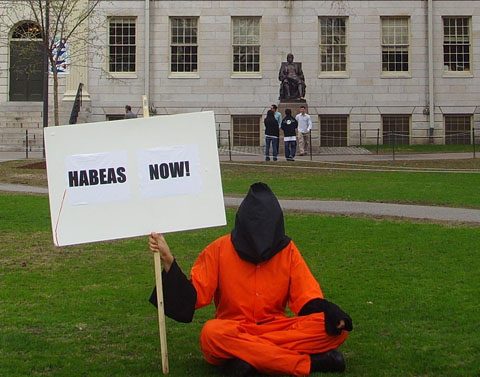 So: When such a specter is unleashed upon 'civilization', how can it be made obvious to all of our ovine fellow citizens that it is, of course, beyond the pale and self-undermining for our ostensibly free, democratic society to engage in legally-sanctioned torture?
It isn't a matter of convincing people, because anybody who's able to think it through is of course going to oppose it. The problem is those people who don't think but feel. Or, more specifically, who feel in the place of thinking. These are the people for whom Dick Cheney's propaganda proved so effective in mobilizing the bovine United States population into supporting his Hundred Years Oil War.
How do you influence them if you can't convince them? Counter-propaganda? No. That merely serves to further radicalize the terms of the 'debate'. No, you make sure that the discourse is framed in such a way as to oppose clear-thinking, historically minded and morality-based against Cheney's wing-nut fringe.
If the emerging framework -- the one that casts Cheney as the wing-nut/liar that he is -- is to prove durable, we need the John McCains to continue speaking out. The long-term effect of this, I hope, is that during the next Presidential election, we will no longer have candidates of either major party issuing pledges to emulate Jack Bauer in their national security policies.
Friday, August 21, 2009
Robert Reich poses a very good question about health care reform.

Why the Gang of Six is Deciding Health Care for Three Hundred Million of Us
Saturday, August 15, 2009
HYPOCRITES!! (Part II):
Health care, Medicare Part D and generational politics.
At the conclusion of Part I of this discussion, I mentioned the hypocrisy and intellectual dishonesty of Republicans who oppose a public health insurance option, yet have nothing negative to say about Medicare and Social Security, which, when combined with Medicaid, represent by far the most expensive government entitlement programs currently in existence.
The Republicans, like the Democrats, would never be caught opposing these unfunded programs because they are massively popular with the most active and influential sectors of the electorate: the elderly. As the Baby Boomers continue to age -- and increasingly bottleneck the system -- this popularity of these programs is unlikely to decline.
So, somehow, these government-administered entitlements do not get mentioned in the same breath as Congressional/Obamian health insurance reform when hard-Right ideologues and thugs hit the pavement or spread lies over the Internet about death panels and whatnot.
Thing is: Many of those who decry health reform as "socialistic" are themselves willing and continuing recipients of Medicare and Social Security Benefits. Thus, I should like suggest that these people are a bunch of crusty old self-centered whiners and liars, and that we ought to declare a generational war!
Doesn't it shame them that they would deny to succeeding generations the same entitlements from which they themselves have benefited, from the Social Security Act to the GI Bill to Medicare to Medicaid, up to and including the Medicare Part D prescription drug benefit for those 65 years of age and older that was passed, without funding and in between the two largest tax cuts for the wealthy ever to be passed into law?
Nothing -- including military spending! -- even comes close to the costliness of these programs. Apparently, Americans 65 and older are simply more deserving of this bounty than those of my generation. My generation, by contrast, has been weathering an inhospitable economic and educational environment. Ours is an age in which the notion of class mobility has long been a cruel joke. Our experience is one of the accumulation of debts, of forgoing health insurance, of meager opportunities.
I'm not arguing that the Great Depression was a walk in the park. I am, however, arguing that, in the wake of the Social Security Act, the radical expansion of opportunities for higher education represented in the GI Bill and in the proliferation of colleges and universities in order to accommodate the Baby Boom, the United States enjoyed a sustained period of economic, social and cultural progress.
Anyway, in my limited experience with such things, the clearest, most objective and most focused discussion of the recent political-historical context of Republican flip-flopping on government-coordinated public health insurance plans is contained in a recent episode of the PBS series Frontline, titled: Ten Trillion and Counting. (You may wish to click here for a link to streaming video of the entire episode, which is well worth your time.)
The piece actually tackles the subject of the United States' skyrocketing national debt. but its discussion of George W. Bush's passage of Medicare Part D -- sandwiched between the passage of the two largest tax cuts for the wealthy in United States history -- could not be more relevant to our present discussion. Here is that section of the episode:
Here's part of the transcript:
The Republicans, like the Democrats, would never be caught opposing these unfunded programs because they are massively popular with the most active and influential sectors of the electorate: the elderly. As the Baby Boomers continue to age -- and increasingly bottleneck the system -- this popularity of these programs is unlikely to decline.
So, somehow, these government-administered entitlements do not get mentioned in the same breath as Congressional/Obamian health insurance reform when hard-Right ideologues and thugs hit the pavement or spread lies over the Internet about death panels and whatnot.
Thing is: Many of those who decry health reform as "socialistic" are themselves willing and continuing recipients of Medicare and Social Security Benefits. Thus, I should like suggest that these people are a bunch of crusty old self-centered whiners and liars, and that we ought to declare a generational war!
Doesn't it shame them that they would deny to succeeding generations the same entitlements from which they themselves have benefited, from the Social Security Act to the GI Bill to Medicare to Medicaid, up to and including the Medicare Part D prescription drug benefit for those 65 years of age and older that was passed, without funding and in between the two largest tax cuts for the wealthy ever to be passed into law?
Nothing -- including military spending! -- even comes close to the costliness of these programs. Apparently, Americans 65 and older are simply more deserving of this bounty than those of my generation. My generation, by contrast, has been weathering an inhospitable economic and educational environment. Ours is an age in which the notion of class mobility has long been a cruel joke. Our experience is one of the accumulation of debts, of forgoing health insurance, of meager opportunities.
I'm not arguing that the Great Depression was a walk in the park. I am, however, arguing that, in the wake of the Social Security Act, the radical expansion of opportunities for higher education represented in the GI Bill and in the proliferation of colleges and universities in order to accommodate the Baby Boom, the United States enjoyed a sustained period of economic, social and cultural progress.
Anyway, in my limited experience with such things, the clearest, most objective and most focused discussion of the recent political-historical context of Republican flip-flopping on government-coordinated public health insurance plans is contained in a recent episode of the PBS series Frontline, titled: Ten Trillion and Counting. (You may wish to click here for a link to streaming video of the entire episode, which is well worth your time.)
The piece actually tackles the subject of the United States' skyrocketing national debt. but its discussion of George W. Bush's passage of Medicare Part D -- sandwiched between the passage of the two largest tax cuts for the wealthy in United States history -- could not be more relevant to our present discussion. Here is that section of the episode:
Here's part of the transcript:
FORREST SAWYER: It finally passed by five votes.I think this is worth bringing up next time one finds himself in a bar, confronted by someone who insists that Obama is a socialist or that the Democrats are the big spenders... It was, after all, Bill Clinton who balanced the budget.
[on camera] Why would a small government conservative initiate a program that is so massive?
JACKIE CALMES, The New York Times: Politics.
FORREST SAWYER: What do you mean?
JACKIE CALMES: There's no group that votes at the rate and in the numbers as those over 55, and 65 and over certainly. And Democrats, as well as Republicans, want to please seniors, and that's why our entire budget is tilted towards programs for seniors.
FORREST SAWYER: [voice-over] The reason that the Bush administration could pass Medicare part D was that the Republican Congress in 2002 had let a rule called "pay as you go" lapse. It was a rule established by the first President Bush and a Democratic Congress to enforce fiscal discipline.
GREGG IP: His father endured some very serious political pain to do the right thing to get the deficit down. And one of the steps was that a rule called "pay-go," or pay as you go. And this rule basically meant that if you wanted to introduce a new tax cut or a new spending program, you had to find a way to pay for it with an offsetting tax increase or spending cut. Well, in 2002, that rule expired.
ALICE RIVLIN, Dir., Office of Management & Budget, 1994-96: In the Clinton years, we had the "pay-go" rule, pay as you go, and that meant we couldn't pass a lot of good-sounding ideas, including Medicare prescription drugs. It's not that nobody thought of that in the '90s. A lot of people thought of it. But we couldn't pay for it. To pay for it, we would have had to have done a tax increase or cut out some other spending in major proportions, and nobody wanted to do that, so we didn't do it.
FORREST SAWYER: But the Bush administration did do it. With "pay-go" no longer restraining spending, they had pushed through Medicare part D, a program that's projected over time to cost as much as $8 trillion.
DAVID WESSEL: They did not come up with a way to raise taxes or cut spending somewhere else to pay for it, so they just passed this thing. It goes into law. It's a promise to elderly people that we'll pay- subsidize their drugs, and we borrow every year to pay for it. And in the end, it's more expensive than the war in Iraq because the war in Iraq ends at some point. Certainly, it will end now that Obama's president. But the prescription drug benefit will go on forever.
FORREST SAWYER: It will go on forever because it's a promise made by the federal government to its citizens. Seniors are entitled to this benefit, just the as they are entitled to Social Security and Medicare itself. These entitlements are all enormously popular, but they're also enormously expensive. Medicare part D alone will cost $60 billion this year.
JACKIE CALMES: The expense of that over time, unfunded liabilities for the government, at a time when more people are reaching retirement age and qualifying for Medicare, added more to the long-term obligations of the government than all of Social Security.
FORREST SAWYER: Medicare part D was the largest spending bill the president signed, but there were dozens of others. During his first five years as president, with a Republican-controlled House and Senate, George Bush never vetoed a spending bill. Fiscal conservatives in his own party accused him of being the biggest spender since World War II.
Friday, August 14, 2009
A heroic moment in conversation with the Deranged Right on health care.
Anecdote time.
Gypsy Sun and Rainbows, a longtime friend of Crib From This, recently found himself at one of his local watering holes, engaged in a political conversation with his
I mean... Cause, how would that work, exactly? Kind of difficult to picture... That's what happens, Republicans, when you simply memorize talking points without actually thinking through what (or, for that matter, whether) they mean!!
But wait: It gets better! I give you, the Crib From This community, courtesy of Gypsy Sun and Rainbows, the Deranged Dixiecrat Right in its full glory:
I think that I am not the only one for whom the Rightist rhetoric is increasingly alarming/disconcerting: Where does this venom and hatred come from? Why are so many people making themselves impossible to talk to? What's behind all this? Just incoherent hatred of taxes?
(Incoherent because Medicare, Medicaid & Social Security combined are currently by far the biggest national expense, and we are borrowing trillions of dollars from China to pay for it, instead of just taxing the Viagra-addled dicks off of those crusty old bastards!!! ["Greatest Generation," MY ASS!!!!?])
Just racism? Just propaganda about "socialism" and whatever? What the hell is behind this out-of-control turn that Rightist rhetoric has taken?
A few Right-wing apologists say: "These health care protests are no worse than the Left-wing protests during the lead up to the Iraq War!"
But that's a bit of a stretch, don't you think?
Why is it a stretch? Because nobody took those war protesters seriously. Tell me I'm crazy, but that seems fairly obvious to me.... Was there any moment during the run-up to Iraq upon which you recall thinking: "Maybe we're not really going to go to war??!!!"
No. The Iraq War was a done deal, long before it was even mentioned to the American People, and we all knew that at the time. The Right-wing anti-health care astroturf campaign, by contrast, threatens to derail the entire debate.
But, I repeat: What the hell is behind the disturbing militarization of Rightist rhetoric?
Gypsy Sun and Rainbows weighs in:
Now, admittedly, I've never exactly met these people, but from what you and some others have said, it seems like a lot of the people saying this type of thing are people of whom you'd expect different -- more sober and less hysterical -- behavior.
Fortunately, unlike the health care nut jobs, I gather that the "birthers," as people seem to be calling them, are not exactly ever going to have the numbers to make anybody have to care about their bullshit, which I think makes it unquestionably a GOOD thing for the Democrats and for Obama: Even though all of the rhetoric and posturing is extremely unsettling, it definitely helps keep the Republican't Party* submerged in its present untrustworthy/uneducated/fanatic/non-mainstream cesspool.
By the way, although by no means do I wish to legitimize these so-called 'birthers', I would like to point out that there is so much evidence out there at present of Obama's having been born in Hawaii that it is almost unbelievable that anyone -- even mentally unbalanced people -- could actually continue to harbor doubts about this.
Specifically, in addition to all of the other evidence, there are numerous clippings from different Hawaii newspapers announcing Obama's birth!
Click here to see one of them. Ha ha ha!! Are there people who actually see stuff like this and STILL BELIEVE that he wasn't born in Hawaii??
___________________
* I just thought this up as I typed it. I'm sure I can't be the first. It's just too obvious.
Gypsy Sun and Rainbows, a longtime friend of Crib From This, recently found himself at one of his local watering holes, engaged in a political conversation with his
good friend who also happens to be rightist ideologue, who claimed that there was a provision in the Congressional/Obama Health Care reform proposal that allows for abortions of people up to fifteen years old. Whew!Whew, indeed! But that's the kind of dissembling that is so incomprehensible that even the person who believes he believes it can't actually, at the end of the day, believe it.
I mean... Cause, how would that work, exactly? Kind of difficult to picture... That's what happens, Republicans, when you simply memorize talking points without actually thinking through what (or, for that matter, whether) they mean!!
But wait: It gets better! I give you, the Crib From This community, courtesy of Gypsy Sun and Rainbows, the Deranged Dixiecrat Right in its full glory:
Also, we were at a bar and a random drunk dude came to our table and my friend and he struck up a conversation and he happened to also be a rightist ideologue who predicted (with my friend) that Obama was leading the United States into the worst depression in history AND that we would have another Civil War within the next two years. Whew!Yes, you read correctly. This man thinks that there's going to be another CIVIL WAR within the NEXT TWO YEARS! To which our correspondent, Gypsy Sun and Rainbows, responded, in the heroic moment to which our title refers:
When the guy brought up the Civil War thing, I said: "Yeah, if it happens, it will because of people like YOU."YYYYEEEEESSSSS!!! And Gypsy Sun knocks one clean out of the park!!!
I think that I am not the only one for whom the Rightist rhetoric is increasingly alarming/disconcerting: Where does this venom and hatred come from? Why are so many people making themselves impossible to talk to? What's behind all this? Just incoherent hatred of taxes?
(Incoherent because Medicare, Medicaid & Social Security combined are currently by far the biggest national expense, and we are borrowing trillions of dollars from China to pay for it, instead of just taxing the Viagra-addled dicks off of those crusty old bastards!!! ["Greatest Generation," MY ASS!!!!?])
Just racism? Just propaganda about "socialism" and whatever? What the hell is behind this out-of-control turn that Rightist rhetoric has taken?
A few Right-wing apologists say: "These health care protests are no worse than the Left-wing protests during the lead up to the Iraq War!"
But that's a bit of a stretch, don't you think?
Why is it a stretch? Because nobody took those war protesters seriously. Tell me I'm crazy, but that seems fairly obvious to me.... Was there any moment during the run-up to Iraq upon which you recall thinking: "Maybe we're not really going to go to war??!!!"
No. The Iraq War was a done deal, long before it was even mentioned to the American People, and we all knew that at the time. The Right-wing anti-health care astroturf campaign, by contrast, threatens to derail the entire debate.
But, I repeat: What the hell is behind the disturbing militarization of Rightist rhetoric?
Gypsy Sun and Rainbows weighs in:
Yeah, kind of brings us back to our Sarah Palin debate. Since this health care stuff began, I think I am beginning to understand your concern [about the Right's increasingly ominous and irresponsible rhetoric]. Death Panels? It's been debunked, but people still believe it. Same with Obama's birth certificate thing.Right. What I personally find alarming is the sheer number of people who seem to be obsessed fanatically with these kinds of bizarre things.
Now, admittedly, I've never exactly met these people, but from what you and some others have said, it seems like a lot of the people saying this type of thing are people of whom you'd expect different -- more sober and less hysterical -- behavior.
Fortunately, unlike the health care nut jobs, I gather that the "birthers," as people seem to be calling them, are not exactly ever going to have the numbers to make anybody have to care about their bullshit, which I think makes it unquestionably a GOOD thing for the Democrats and for Obama: Even though all of the rhetoric and posturing is extremely unsettling, it definitely helps keep the Republican't Party* submerged in its present untrustworthy/uneducated/fanatic/non-mainstream cesspool.
By the way, although by no means do I wish to legitimize these so-called 'birthers', I would like to point out that there is so much evidence out there at present of Obama's having been born in Hawaii that it is almost unbelievable that anyone -- even mentally unbalanced people -- could actually continue to harbor doubts about this.
Specifically, in addition to all of the other evidence, there are numerous clippings from different Hawaii newspapers announcing Obama's birth!
Click here to see one of them. Ha ha ha!! Are there people who actually see stuff like this and STILL BELIEVE that he wasn't born in Hawaii??
___________________
* I just thought this up as I typed it. I'm sure I can't be the first. It's just too obvious.
Saturday, June 20, 2009
Continuing the Iran discussion.
The following is a response that the Blogger had attempted to post in response to the most recent comment from "DMA" in an ongoing conversation on the Iran protests and its political ramifications domestically and internationally, and other matters about which neither party has expertise or insight.
Do you mean the first "I" in "situation"?
Anyway, let's take a step back from the goings-on in Iran and consider the political positioning that is going on domestically: the GOP is -- as is to be expected -- attempting to capitalize on our visceral reaction to the repugnance of the absurdly titled "Supreme Leader" and regime. Particularly before the SL's Friday speech, which threatened the protesters with violent government retribution, the line was: "Well, Obama needs to stand up more for the people," etc.
Now, this is a familiar dynamic: Obama's initial expressed reaction, as you and I discussed previously, was in fact pitch-perfect. Not because it somehow eschewed expressing solidarity with the protesters' cause, but because it honored their cause, in its independence, the fact that it is rooted within Iranian society and not imposed (or 'rigged') by external ideological forces and because a more robust reaction would have ham-fistedly undermined the expressed purpose and function of his massively successful Cairo speech. Which, by the way, almost certainly had a galvanizing effect on the Iranians' perceptions of their own capacity for self-assertion and self-governance from within.
The Republicans, by contrast, wanted to come across as "heroes" of freedom and democracy, replicating -- as is to be expected -- the tenor and rhetoric of the Cold War and applying it to a situation to which it is inapplicable. Specifically, the posture that McCain would advocate that the president adopt is to in essence underestimate and misconstrue the very autonomy that the protesters are expressing in their demand for political and social emancipation. McCain's and Company's is the old-fashioned, patting-ourselves-on-the-back version of international policy, in which we appropriate the courage and hard work of movements in other countries -- even educated ones like Iran -- and decide that it's suddenly all about the United States. That the United States should somehow be in the spotlight, in essence, playing the tough guy and speaking on behalf of those who know perfectly well how to speak for themselves. The GOP, as always, embodies the seediest combination of paternalism, braggadocio, myopia and ignorance of historicity.
Part of your post, DMA, reminds me of why the Republicans are so willing to display these traits, flaws and all:
I saw in the paper today the Supreme Allah-Prophet Douchebag Over-Religious Cocksucking Bearded Motherfucking Shi'ite Jizz-Guzzling Leader said something threatening a crackdown on the protests.
I'm not singling DMA out, because this formulation could as easily have been my own -- well, minus the weird anti-Islam slurs and probably without the knock against beards, which I find to be a perfectly acceptable and at times exceedingly tasteful fashion as regards facial hair...
Anyway, the point is that Americans are right to experience seething rage against something or someone on the international scene who is perpetrating injustice. However, when we are in John Wayne mode, we're not always doing our best thinking. And I don't mean this in the way it might seem: I'm not suggesting that it is problematic for us to feel pangs of moral indignation. Quite the opposite: I think that the kind of thinking that this reaction beclouds is precisely our moral thinking.
In what ways? For one thing, we'll often end up feeling moral outrage vicariously and as though on behalf of a foreign population. In other words, we'll start seething so much against the foreign despot that we forget entirely about the REAL cause for celebration, which is the courage of the protesters. In essence, we let our hatred for the despot occlude the actual stars of the show altogether. This is more than simply hazy moral thinking. This kind of myopia in American discourse lies at the root of the most appalling and immoral actions our government has perpetrated in its interactions with the international world.
For example: think about Iraq. We had to make Saddam Hussein into our enemy. That he was an enemy to his own people was pure afterthought (and anyway, implicates the USA for having installed him and armed him in the first place). Anybody who thinks otherwise should ask himself: how many Americans have died in Iraq since the beginning of the war? I bet you have a rough estimate in your head. For the record, it turns out that the current number is 4,316, each and every one a tragedy. Now, ask yourself: how many Iraqis have died in the war? Admit it: you have no idea. I sure don't. In contradistinction to its familiarity with the American death toll figure, even Google News is apparently stumped by the Iraqi death toll question. Still think the Iraq War is all about the Iraqi people? To point out that most Iraqis are better off now than under Saddam is a spineless and patronizing evasion of the question.
Now, having said all of this, I think that after Friday's demagogic speech on the part of the "SL," it's probably a brand new situation that is poised to get really ugly really quickly. If the logic of the punditocracy is sound (a big if), the whole idea of negotiating over the nuclear program is basically off the table now, one way or the other, and, according to this thinking, Obama is apparently already transitioning to his, as it were, liberation theology mode, wherein celebrating the cause of the protesters and exposing as much as possible the thug-like brutality of the authoritarian regime are the orders of the day. Could be interesting.
Do you mean the first "I" in "situation"?
Anyway, let's take a step back from the goings-on in Iran and consider the political positioning that is going on domestically: the GOP is -- as is to be expected -- attempting to capitalize on our visceral reaction to the repugnance of the absurdly titled "Supreme Leader" and regime. Particularly before the SL's Friday speech, which threatened the protesters with violent government retribution, the line was: "Well, Obama needs to stand up more for the people," etc.
Now, this is a familiar dynamic: Obama's initial expressed reaction, as you and I discussed previously, was in fact pitch-perfect. Not because it somehow eschewed expressing solidarity with the protesters' cause, but because it honored their cause, in its independence, the fact that it is rooted within Iranian society and not imposed (or 'rigged') by external ideological forces and because a more robust reaction would have ham-fistedly undermined the expressed purpose and function of his massively successful Cairo speech. Which, by the way, almost certainly had a galvanizing effect on the Iranians' perceptions of their own capacity for self-assertion and self-governance from within.
The Republicans, by contrast, wanted to come across as "heroes" of freedom and democracy, replicating -- as is to be expected -- the tenor and rhetoric of the Cold War and applying it to a situation to which it is inapplicable. Specifically, the posture that McCain would advocate that the president adopt is to in essence underestimate and misconstrue the very autonomy that the protesters are expressing in their demand for political and social emancipation. McCain's and Company's is the old-fashioned, patting-ourselves-on-the-back version of international policy, in which we appropriate the courage and hard work of movements in other countries -- even educated ones like Iran -- and decide that it's suddenly all about the United States. That the United States should somehow be in the spotlight, in essence, playing the tough guy and speaking on behalf of those who know perfectly well how to speak for themselves. The GOP, as always, embodies the seediest combination of paternalism, braggadocio, myopia and ignorance of historicity.
Part of your post, DMA, reminds me of why the Republicans are so willing to display these traits, flaws and all:
I saw in the paper today the Supreme Allah-Prophet Douchebag Over-Religious Cocksucking Bearded Motherfucking Shi'ite Jizz-Guzzling Leader said something threatening a crackdown on the protests.
I'm not singling DMA out, because this formulation could as easily have been my own -- well, minus the weird anti-Islam slurs and probably without the knock against beards, which I find to be a perfectly acceptable and at times exceedingly tasteful fashion as regards facial hair...
Anyway, the point is that Americans are right to experience seething rage against something or someone on the international scene who is perpetrating injustice. However, when we are in John Wayne mode, we're not always doing our best thinking. And I don't mean this in the way it might seem: I'm not suggesting that it is problematic for us to feel pangs of moral indignation. Quite the opposite: I think that the kind of thinking that this reaction beclouds is precisely our moral thinking.
In what ways? For one thing, we'll often end up feeling moral outrage vicariously and as though on behalf of a foreign population. In other words, we'll start seething so much against the foreign despot that we forget entirely about the REAL cause for celebration, which is the courage of the protesters. In essence, we let our hatred for the despot occlude the actual stars of the show altogether. This is more than simply hazy moral thinking. This kind of myopia in American discourse lies at the root of the most appalling and immoral actions our government has perpetrated in its interactions with the international world.
For example: think about Iraq. We had to make Saddam Hussein into our enemy. That he was an enemy to his own people was pure afterthought (and anyway, implicates the USA for having installed him and armed him in the first place). Anybody who thinks otherwise should ask himself: how many Americans have died in Iraq since the beginning of the war? I bet you have a rough estimate in your head. For the record, it turns out that the current number is 4,316, each and every one a tragedy. Now, ask yourself: how many Iraqis have died in the war? Admit it: you have no idea. I sure don't. In contradistinction to its familiarity with the American death toll figure, even Google News is apparently stumped by the Iraqi death toll question. Still think the Iraq War is all about the Iraqi people? To point out that most Iraqis are better off now than under Saddam is a spineless and patronizing evasion of the question.
Now, having said all of this, I think that after Friday's demagogic speech on the part of the "SL," it's probably a brand new situation that is poised to get really ugly really quickly. If the logic of the punditocracy is sound (a big if), the whole idea of negotiating over the nuclear program is basically off the table now, one way or the other, and, according to this thinking, Obama is apparently already transitioning to his, as it were, liberation theology mode, wherein celebrating the cause of the protesters and exposing as much as possible the thug-like brutality of the authoritarian regime are the orders of the day. Could be interesting.
Saturday, March 7, 2009
The GOP fraternity's quandary:
What to do about Rush?
 The New York Times's Timothy Egan weighed in a couple of days ago on the apparent non-news story of the moment: a game of 'hot potato' being played among various factions of the Republican Party. The hot potato they're tossing back and forth is the grotesque, meaty melon of Rush Limbaugh. Below is excerpted Egan's blog entry on the subject, titled Fears of a Clown:
Once upon a time, you could drive to the most remote reaches of the United States and escape Rush Limbaugh. But from the Mogollon Mountains of New Mexico to the Badlands of South Dakota, where only the delicious twang of a country tune or the high-pitched pleadings of a lone lunatic came over the AM dial, there is now the Mighty El Rushbo.Apart from a couple of unconvincing conclusions that Egan reaches later in the piece, this seems a pretty decent analysis of a current political/media sideshow (that I confess I haven't been following very closely). Egan correctly identifies the 'straw-man' technique that has for the last 20 years or longer been one of the GOP's most consistent and elegantly executed tactics. The key to pulling it off -- and the reason why the Democrats hadn't been any good at it in the pre-Obama era -- is doing it with a sense of humor. Why is a sense of humor so important?
As someone who spends a lot of time on the road, I used to find Limbaugh to be an obnoxious but entertaining companion, his eruptions more reliable than Old Faithful. But now that Limbaugh has become something else — the face of the Republican Party, by a White House that has played him brilliantly — he has been transformed into car-wreck-quality spectacle, at once scary and sad.
Behold:
The sweaty, swollen man in the black, half-buttoned shirt who ranted for nearly 90 minutes Saturday at the Conservative Political Action Conference. He reiterated his desire to see the president of his country fail. He misstated the Constitution’s intent while accusing President Obama of “bastardizing” the document. He made fun of one man’s service in Vietnam, to laughter.
David Letterman compared him to an Eastern European gangster. But he looked more like a bouncer at a strip club who spent all his tips on one bad outfit. And for the Republican Party, Limbaugh has become very much a vice.
Smarter Republicans know he is not good for them. As the conservative writer David Frum[*] said recently, “If you’re a talk radio host and you have five million who listen and there are 50 million who hate you, you make a nice living. If you’re a Republican party, you’re marginalized.”
Consider that in the past, Limbaugh-hatred was either (1) shrill and way too earnest or (2) holier-than-thou and self-congratulatory. The first tendency had the effect of expanding Limbaugh's power and influence because it rewarded him for cloaking his run-of-the-mill intellectual dishonesty in an aura of mischief and insouciance. This insouciance, at once contagious and 'empowering' to his audience, was applied to the task of caricaturing ever-more-outrageously various Democratic Party sacred cows (feminism, multiculturalism, political correctness etc.). This seemed a particular thorn in the side of the Democratic Party throughout much of the 90s (in fact, perhaps beginning with Michael Dukakis's failed 1988 presidential bid): the Dems were the squares, who -- in the eyes of many a country bumpkin and many a Wall Street trader alike -- didn't "get" it. In that era, the Dems allowed Rush to frame discourses in his own increasingly ludicrous (and, spiritually, racist and fascistic) terms. The Dems lacked the savvy to respond in a way that is disposed structurally to draw attention to the very 'straw man'-ness of his 'straw man' criticisms.
 Circumstances have changed. It is this very savvy that the intuitive politician Barack Obama possesses in spades. Our new president wields this powerful weapon deftly, and thus, he exposes convincingly the hysterical patchiness of the rantings of Limbaugh and ilk, and he manages to do so in such a way as to charm your mother's pants off! The talent of the Republican Party for 'messaging' and propaganda has long been superior to that of the Democrats. But, ever since the majority of the public turned against the Iraq War, it's been painfully clear that its effectiveness has run its course.
The GOP sloganeering- and outrage-machine is fueled not on ideas but on sound-bites that serve as stand-ins for ideas. Once its pattern of rhetorical brinkmanship is exposed in all of its fraudulence -- as was done spectacularly in the aftermath of the invasion of Iraq -- there's no recourse to a coherent set of underlying principles or ideas. In other words, it, like Fox News, is all smoke-and-mirrors.
Obama knows how to deal with smoke-and-mirrors. All you have to do is pucker up and blow the smoke away. The Elephant will then see its own naked reflection. And it will be ashamed.
The second tendency that I outline above -- that of self-righteousness -- made the Democrats fall into the trap that their antagonist had set for them: that of embodying the very caricature that America's favorite squishy-necked pill-popper had spent all of his hate-energy expounding. This not only appeared to Limbaugh's audience to confirm the validity of what he was saying, but it simultaneously further endeared him to his fanatical audience. Remember: this is an audience that has lived through its Savior vicariously. Rush's audience couldn't help but take personally any and all insults/slights that were directed against him. His not inconsiderable talent is that of making his devoted listener feel that he has something at stake in Limbaugh's treatment among the chattering classes. The egomaniac's egomaniac, el Rushbo beckons his avid listener to see the world through Rush's beady eyes. As Limbaugh would have it, the politician or journalist who behaves dismissively toward Rush is, in fact, behaving dismissively toward them and 'their kind', however narrowly circumscribed this category (racially, for instance) might be.
Even worse for the Dems of the 90s: self-righteousness is the character flaw that conditions the ugly act of scolding, and the best way to provoke somebody's irrational fury against an amorphous 'enemy' -- especially when the somebody in question has an inferiority complex to begin with -- is to scold him.**
Now the GOP is at last forced to come to terms with its ideological incoherence, the fracturing of the myriad marriages of convenience that were holding together its recent political alliances. Inevitably, this involves lots of finger-pointing. And, sure enough, it is not now the Democratic Party, but indeed Rush Limbaugh who comes across both as shrill and as taking himself way too seriously. As Egan observes correctly, the Dems have done a masterful job of exploiting this situation, and are reaping considerable benefit. The vast majority of voters identify the Democratic Party as the party of competent adults.
 True, it is primarily Obama's administration -- and not Congressional Dems -- that enjoys this deserved reputation. But with George W. Bush's parting gift, the economy, in a free-fall -- the unemployment rate, an astounding 8.1 percent, is the highest it's been in twenty-five years --, all of these idiotic "no" votes among Republicans on any and all Obama-sponsored stimulus or spending packages are likely to come back to bite the GOP in the ass.
The continuing series of callow, nakedly partisan whine-fests from the likes of House Majority Leader John "Indignant Hillbilly" Boehner contribute to the stiff scent that's in the air: that of a major political party marginalizing itself seemingly out of existence... The Democrats, as long as they don't fall back into the traps of moral righteousness, multiculturalism as practiced in the early 90s,*** and so-called political correctness, will continue to reap benefits from turning the spotlight in the direction of the GOP airing its own dirty-laundry.
 Obama's Chief of Staff Rahm Emanuel, like him or hate him (why bother choosing?), is a good mouthpiece for talking trash about Limbaugh precisely because Emanuel's a dick and doesn't pretend otherwise. Counterintuitive as it might seem, the fact that there is obviously something calculated behind the Dems' going after Limbaugh is actually what makes it work so well. This is because it is precisely the interaction between calculation and execution that makes this and any non-news story so damned entertaining. It's like watching a baseball team pull off a sacrifice fly to score an RBI.
A brief note on moral righteousness. It is true that certain species of moral righteousness play a role in Obama's shtick, but that's not the part of his shtick that is in any way partisan. Obama reserves this righteousness for affirming values about which there is near-unanimity -- values that are no less significant for their universality.
Obama will denounce torture, for instance, but opposition to torture is still -- THANK GOD -- a defining moral principle held among the vast majority of Americans, the exceptions including some truly slimy, invidious creeps like William Kristol and Alan Dershowitz. Anyway, as long as Dems don't start to press so hard as to actually create sympathy for Limbaugh, they'll benefit from this approach.
Actually, I take that back. It occurs to me that as soon as things get to the point at which Limbaugh becomes an object of sympathy, his relevance is at that moment forever demolished.
_________________
* For the record, while I'll concede that David Frum is probably a little bit smarter than Rush Limbaugh (although certainly nowhere near as successful -- by any measure), in no way should this be confused with acceptance of the completely fallacious notion that David Frum is smart.
** See Hitler, Adolph.
*** Mind you, I'm not against multiculturalism as such. I simply dislike some of the idiotic excesses that came along with it when middle school principals, etc., started getting their unenlightened paws on it. Uh, if that sounds a little wooden, I'll just say that I do actually espouse a principled criticism, but I'm not in the mood right now to go into the details of it.
Tuesday, November 11, 2008
Sound the Death-Knell for Dixie (Part Two):
David Brooks discovers GOP racism for the first time.
I'm going to talk a bit more about the politics of resentment. My reason is this: I continue to be amazed as to how simultaneously correct and naive recent comments by conservative journalist David Brooks on the future trajectory of his party have been. Brooks has predicted, both in his New York Times column and in his frequent appearances alongside Mark Shields on The News Hour with Jim Lehrer -- and I'm paraphrasing here but not exaggerating --, that it will take ten to fifteen years for the Republican Party to get its shit together intellectually and politically. The subtext of his commentary is -- and it's not as though he needs to say it -- that the GOP is being taken over by the pro-Sarah Palin 'grassroots' and all but ditched by its traditional (rich, suburban, etc.) base.
 The columnist, conveniently, has failed to mention his own frequent and cloying forays into GOP-styled populism. In other words, Brooks could be said to deserve at least some of the blame for ushering in the party's new era. True, he is no Rush Limbaugh and has never sought actively to recruit the rural, anti-cosmopolitan, anti-elite, anti-intellectual, racist cadre, whose seeming ascendancy he now bemoans.

In contrast to the inbred hooliganism of Limbaugh/Hannity, Brooks -- to appropriate a device that appears in the concluding paragraphs of one of his recent columns -- commits a sin of omission. Until recent weeks -- around the time of the McCain/Palin rallies in which the GOP 'salt of the earth'-faithful screamed death threats intended for Obama, passed around an 'Obama'-labeled stuffed monkey toy and other racist knick-knacks, and called Obama a "terrorist," a "socialist," a "Muslim," and someone who "doesn't love this country the way you and I do" (oh wait, that last one was said repeatedly by Sarah Palin herself) -- I have never once seen Brooks point out that the GOP's cultivation of a mean-spirited, anti-intellectual, anti-urban, anti-elitism sentiment was beginning to lead down a slippery slope, which everyone could see in plain sight. Nope. Despite his supposed 'moderate' conservatism, not a single column inch. No, it took the advent of angry, racist mobs, televised and YouTubed for all to see, for David Brooks to level with his readers and finally admit that Palin was a cynical selection, condescending to the voters and dangerous for the country and to the office of the presidency. What gives, David?
To be fair, let's remember that for the last decade, Brooks has probably been too distracted to sound a note of caution regarding the GOP's ongoing brain drain and its inevitable consequences. Over the two terms of Bush/Cheney, Brooks has had a lot of neoconservative and neoliberal agenda-pushing to get through-- often by stealth, which eats up even more of a busy columnist's day. After all, the man's schedule was already so taxing as to include things like
Brooks never had a negative word to say about Bush's neo-McCarthyist electoral strategy. Nor did he bother to wince along with the rest of us thinking human beings as we watched Cheney, Rumsfeld, and their crack squad of war criminals falsify intelligence, engage in character assassination of any/all figures of opposition, and censor dissent in the run-up to the Iraq War.
But no matter. Brooks appears recently to have updated his appraisal of George W. Bush, right about the time (early October, 2008) at which he felt compelled finally to come out and admit that Sarah Palin is BAD NEWS. Brooks made the following remarks at an event sponsored by the Atlantic Monthly, on October 9, 2008:
 As I remarked previously, the most recent example of this type of non-ideological, non-forward-looking politics that comes to mind is the phenomenon of the Dixiecrats, whose rhetorical dichotomies -- which are circumscribed as simple-mindedly as possible, in the interest of maximum versatility and in order to appeal to simple-minded people -- of local v. global, religious v. educated, upstanding v. immoral, are exactly the same dichotomies that McCain and especially Palin (or rather, her hard-Right/neocon Handlers) set out to tap into. What's interesting about this essential connection to Dixiecrat politics is that it's come -- in more ways than one -- full circle. I'll elaborate on this in a moment. (And this is subject to which I shall return in subsequent posts.)
You might ask: OK, Tom we've heard you sound off about the cultural politics of resentment and the GOP. And we get what you mean about the Dixiecrats: they were resentful of (1) the industrial/increasingly cosmopolitan North for everything from the Emancipation Proclamation to Reconstruction, LBJ and the Civil Rights Bill -- the latter being the last straw; (2) they hated black people and were resentful of any measure resulting in the shaking-up of the Southern caste system, particularly because measures that treated with dignity persons of color were seen as decreasing the status of poor whites. (Or whatever...those kinds of things.)
But, you ask, how does this example map onto the structure or modus operandi of the current Republican Party? I mean, we know that McCain's campaign -- particularly that shrill, none-too-bright woman who dressed to kill -- was speaking a coded -- and sometimes not-so-coded -- language of racism at rallies, and in advertising and propaganda. But, what resentments are the Republicans, specifically, tapping into?
 Aha! I respond. That's just it: the great thing about resentment is that it doesn't need to be attached to something specific. This is what I was attempting to describe in a recent post, in which I pointed out that resentment is not an idea, but rather, a cluster of emotions, reactions and instinctive postures of self-preservation. And the laundry list of resentments -- particularly among rural, uneducated white voters -- to which McCain and Palin catered as -- eventually -- the exclusive centerpiece of their campaign needn't be pinned down in all that much detail in order for us to see objectively that it existed.
But just to demonstrate the extensiveness of this laundry list, let's try our hand at a thought experiment: let's just accept for the moment, arguendo, that I'm correct in saying that the racism that bubbled to the surface in dramatic fashion during the McCain/Palin rallies evidences the fact that there are lingering resentments among parts of the South (and rural north) connected straightforwardly to historical Southern secessionist and segregationist mentalities. Remember, there need only be a subconscious hint of this lingering attitude for my Dixiecrat thesis to have legs.
Now, let's take a step back and think of political attitudes that have developed more recently in the rural north and in the South (and perhaps, until this past election, in lower-middle-class [or extremely nouveau riche outer suburbs). Think of the decades of careful and well-funded Right wing inculcation and brainwashing that descended upon these areas. For instance, Rush Limbaugh, whose audience expanded considerably with the advent of the Clinton administration. More and more Limbaugh clones flood the AM airwaves across the fruited plains. Then comes Fox News. Then comes George W. Bush: even more divisive a figure, and even more than Clinton mired in the rhetoric, Doublespeak and umbrage-taking of the 1960's. (I will shortly be posting an item that fleshes out my thinking on the culture wars, particularly during the Clinton and Bush II administrations.)
Now: think of how simple a task it would be to attach myriad contemporary political issues to the coattails of these lingering resentments. Anyone among us can rattle off the obvious themes that map onto the basic structure: xenophobia, hatreds that often come along with especially ignorance saturated species of militarism, racism, reverse classism, resentment of the educated, various forms of anti-Semitism, suspicion toward people with credentials, distrust of people with accents, anti-feminism, fear of gays and lesbians, fear of gay marriage, disdain for people who are more educated than they are, disdain of academia generally (for its supposed 'liberalism'), disdain for 'mainstream media' generally (for their supposed 'liberalism'), and finally, much-stoked militant opposition to, quote-unquote, "activist judges," a specious concept in and of itself, and anyway, a concept which very few of those who fear it have any understanding at all.
So, basically, although it seems clear to me that the Dixiecrat political posture is the one that feeds Rightist populist rhetoric, the Republican Party can and does steer it in whatever direction it wants, in the service of any in a spectrum of ideological ends that has -- per se -- no material, cultural or political relationship to anything the Dixiecrats would have recognized or even comprehended. And -- despite Brooks's apparent surprise in noticing this -- the Republicans have been up to this for a long time.
So, among the poor and lower-middle-class racists whom McCain courted, the underlying resistance to Obama had to do with nothing more than the fact that he is black and has a funny name. But McCain's henchmen didn't need to say anything close to that, and they didn't need to THINK that in order to take political advantage of entrenched racist sentiment.
I had a history professor once who said -- cornily (but pithily) -- "there are no bad guys in history." There are no 'bad guys' in politics, either. There are just 'instinctive politicians', or 'tough politicians', or 'savvy strategists'. You see? The so-called 'elites' in the press have their own euphemisms, too; rhetoric that prevents the reporters themselves from having to think of it for the ugly thing it in fact is. How often have you heard 'mainstream media' praise Karl Rove for his
See what I mean? Media inoculate themselves from harsh truths more rampantly than even voters do, and to a much greater extent than to which media inoculate their viewers. And Obama was an 'other'. That is all he needed to be, and strategically that's the only slight-of-hand McCain's people needed to pull off in order to court effectively the racist vote.
'We don't know about his history and background'. 'He needs to give the full story on his relationship with ACORN'. 'Why hasn't Mr. Obama come clean about the full extent of his relationship with domestic terrorist Bill Ayers, with whom, my friends, and let us make no mistake, Mr. Obama so dangerously pal-ed-around'. 'Barack Obama: too radical for America'. 'Barack Hussein Obama'. 'That One'.**
This racist side of the GOP is by no means new. Whatever the psychological tricks that David Brooks needs to play in order to convince himself that he was not a willing participant in the GOP's longstanding Deal with the Devil: tapping into the voting power of this angry mob. Sure, this mob is resentful (as it had been previously) of quote-unquote liberal ideas, espoused and propagated by the quote-unquote liberal media, and forced upon our children by quote-unquote liberal academe. But it's also resentful of ideas, resentful of media, and resentful of academe. AND IT HAS BEEN, ALL ALONG. Every bit as much as it has been racist all along.
In an upcoming post, I will continue to discuss the reasons why I feel Obama's victory might possibly mark the end of Dixiecrat politics. But just to give you a taste of the sweet elixir of victory, let's return to the dismayed David Brooks, in conversation with Mark Shields and Jim Lehrer on the November 7 broadcast of The News Hour with Jim Lehrer [emphasis is mine]:
* If the 2004 Plotz piece to which I have referred leaves you hungry for more fun at the expense of Brooks at his pandering worst, see these contemporaneous -- roughly speaking -- pieces by Nicholas von Hoffman (whose discussion of Brooks's tendency to flatter/legitimate the ignorance of the our country's vast uneducated populations is not dissimilar to the point I keep trying to articulate about the manipulative function of resentment in politics) and Michael Kinsley, from the latter of which I cannot resist quoting:
But beyond even Brooks's occasional proclivity for baffling fence-sitting: cultural politics have sure taken a turn for the toxic (to say the absolute least) since 2004, hasn't it? His veneration of the armies of red-blooded, poor, uneducated, simple-minded "Joe Six-Packs" strewn majestically across fly-over country looks pretty fucking naive -- not to mention hypocritical and even dangerous -- in the era of Sarah Palin's shrill racism- and hate-fueled brand of borderline-fascistic populism, no?
So: David, when exactly did stoking the flames of regressive, repressive, reactionary, xenophobic, 'Know-Nothing' and (let's face it, fundamentally anti-democratic) populism switch from being optimistic/patriotic to being "anti-intellectual"?
Also, in retrospect, it's too bad about the "Louisiana Superdome on wheels" line, no? I mean, it's simple bad luck, and I'm not going to pin it on him. But it's awfully poignant, ¿non?
** Heh. Look. The expression 'the other' has such a effete/academic sound to it. But, in establishing the use-value of this term as a means by which to describe identifiable, real-world phenomena, need we look any further than this weird-ass phrase that was uttered by McCain in reference to Obama at the second debate of the general election? You're not going to find a more obvious example of the othering of one's political opponent than this. I mean, it's not even 'that guy' or 'my opponent'. An entire human being, collapsed into the unadorned, monosyllabic 'one'. And not 'this one': 'that one'. Now, lest we get in over our heads in the amateur-psychology/cultural studies department, before we attach too much significance to the utterance of this mind-bending phrase, it is also important to keep in mind that John McCain is a babbling old coot.
 The columnist, conveniently, has failed to mention his own frequent and cloying forays into GOP-styled populism. In other words, Brooks could be said to deserve at least some of the blame for ushering in the party's new era. True, he is no Rush Limbaugh and has never sought actively to recruit the rural, anti-cosmopolitan, anti-elite, anti-intellectual, racist cadre, whose seeming ascendancy he now bemoans.
In contrast to the inbred hooliganism of Limbaugh/Hannity, Brooks -- to appropriate a device that appears in the concluding paragraphs of one of his recent columns -- commits a sin of omission. Until recent weeks -- around the time of the McCain/Palin rallies in which the GOP 'salt of the earth'-faithful screamed death threats intended for Obama, passed around an 'Obama'-labeled stuffed monkey toy and other racist knick-knacks, and called Obama a "terrorist," a "socialist," a "Muslim," and someone who "doesn't love this country the way you and I do" (oh wait, that last one was said repeatedly by Sarah Palin herself) -- I have never once seen Brooks point out that the GOP's cultivation of a mean-spirited, anti-intellectual, anti-urban, anti-elitism sentiment was beginning to lead down a slippery slope, which everyone could see in plain sight. Nope. Despite his supposed 'moderate' conservatism, not a single column inch. No, it took the advent of angry, racist mobs, televised and YouTubed for all to see, for David Brooks to level with his readers and finally admit that Palin was a cynical selection, condescending to the voters and dangerous for the country and to the office of the presidency. What gives, David?
To be fair, let's remember that for the last decade, Brooks has probably been too distracted to sound a note of caution regarding the GOP's ongoing brain drain and its inevitable consequences. Over the two terms of Bush/Cheney, Brooks has had a lot of neoconservative and neoliberal agenda-pushing to get through-- often by stealth, which eats up even more of a busy columnist's day. After all, the man's schedule was already so taxing as to include things like
- disseminating neoconservative and neoliberal ideology by masking it as snarky-but-lovable pop-sociology;
- applauding middle America for its unrefined taste (in more than one book whose title includes the word 'paradise');*
- being sure to time his fully formed policy stances in such a way as to perpetuate the illusion that careful deliberation and the measured weighing-of-options precedes their articulation;
- kissing the asses of Catholic people, in effect if not by design, playing 'good cop' to William's (both Kristol and Bennett) 'bad cop' in the pushing of neoconservative foreign policy adventures and the continued scorched-earth defunding of the domestic public sector;
- lamenting the disappearance of 1950's middle-brow reading culture, and other (pre-Palin) instances of the shameless peddling of cheap nostalgia;
- and panegyrizing George W. Bush's "self-confident" and "committed," leadership of the Iraq War -- as recently as July 2007, while enthusing over Bush's "unconquerable faith in the rightness of his Big Idea."
Brooks never had a negative word to say about Bush's neo-McCarthyist electoral strategy. Nor did he bother to wince along with the rest of us thinking human beings as we watched Cheney, Rumsfeld, and their crack squad of war criminals falsify intelligence, engage in character assassination of any/all figures of opposition, and censor dissent in the run-up to the Iraq War.
But no matter. Brooks appears recently to have updated his appraisal of George W. Bush, right about the time (early October, 2008) at which he felt compelled finally to come out and admit that Sarah Palin is BAD NEWS. Brooks made the following remarks at an event sponsored by the Atlantic Monthly, on October 9, 2008:
[Palin] represents a fatal cancer to the Republican Party. When I first started in journalism, I worked at The National Review for Bill Buckley. And Buckley famously said he'd rather be ruled by the first 2,000 names in the Boston phone book than by the Harvard faculty. But he didn't think those were the only two options. He thought it was important to have people on the conservative side who celebrated ideas, who celebrated learning. And his whole life was based on that, and that was also true for a lot of the other conservatives in the Reagan era. Reagan had an immense faith in the power of ideas. But there has been a counter, more populist tradition, which is not only to scorn liberal ideas but to scorn ideas entirely. And I'm afraid that Sarah Palin has those prejudices. I think President Bush has those prejudices.Brooks is none too pleased about what he calls -- euphemistically -- the 'populist' turn his party has taken. What he's describing is the Republican Party's descent -- encapsulated in the whiny and incoherent failure that was the McCain presidential campaign -- into a movement lacking entirely a vision of how to govern, in what way, and for what reason (and for that matter, whether or not governance should be dismantled entirely). In other words, it's turned -- decisively and demonstrably -- into a party that caters to resentments. And little -- if anything -- more than that.
 As I remarked previously, the most recent example of this type of non-ideological, non-forward-looking politics that comes to mind is the phenomenon of the Dixiecrats, whose rhetorical dichotomies -- which are circumscribed as simple-mindedly as possible, in the interest of maximum versatility and in order to appeal to simple-minded people -- of local v. global, religious v. educated, upstanding v. immoral, are exactly the same dichotomies that McCain and especially Palin (or rather, her hard-Right/neocon Handlers) set out to tap into. What's interesting about this essential connection to Dixiecrat politics is that it's come -- in more ways than one -- full circle. I'll elaborate on this in a moment. (And this is subject to which I shall return in subsequent posts.)
You might ask: OK, Tom we've heard you sound off about the cultural politics of resentment and the GOP. And we get what you mean about the Dixiecrats: they were resentful of (1) the industrial/increasingly cosmopolitan North for everything from the Emancipation Proclamation to Reconstruction, LBJ and the Civil Rights Bill -- the latter being the last straw; (2) they hated black people and were resentful of any measure resulting in the shaking-up of the Southern caste system, particularly because measures that treated with dignity persons of color were seen as decreasing the status of poor whites. (Or whatever...those kinds of things.)
But, you ask, how does this example map onto the structure or modus operandi of the current Republican Party? I mean, we know that McCain's campaign -- particularly that shrill, none-too-bright woman who dressed to kill -- was speaking a coded -- and sometimes not-so-coded -- language of racism at rallies, and in advertising and propaganda. But, what resentments are the Republicans, specifically, tapping into?
 Aha! I respond. That's just it: the great thing about resentment is that it doesn't need to be attached to something specific. This is what I was attempting to describe in a recent post, in which I pointed out that resentment is not an idea, but rather, a cluster of emotions, reactions and instinctive postures of self-preservation. And the laundry list of resentments -- particularly among rural, uneducated white voters -- to which McCain and Palin catered as -- eventually -- the exclusive centerpiece of their campaign needn't be pinned down in all that much detail in order for us to see objectively that it existed.
But just to demonstrate the extensiveness of this laundry list, let's try our hand at a thought experiment: let's just accept for the moment, arguendo, that I'm correct in saying that the racism that bubbled to the surface in dramatic fashion during the McCain/Palin rallies evidences the fact that there are lingering resentments among parts of the South (and rural north) connected straightforwardly to historical Southern secessionist and segregationist mentalities. Remember, there need only be a subconscious hint of this lingering attitude for my Dixiecrat thesis to have legs.
Now, let's take a step back and think of political attitudes that have developed more recently in the rural north and in the South (and perhaps, until this past election, in lower-middle-class [or extremely nouveau riche outer suburbs). Think of the decades of careful and well-funded Right wing inculcation and brainwashing that descended upon these areas. For instance, Rush Limbaugh, whose audience expanded considerably with the advent of the Clinton administration. More and more Limbaugh clones flood the AM airwaves across the fruited plains. Then comes Fox News. Then comes George W. Bush: even more divisive a figure, and even more than Clinton mired in the rhetoric, Doublespeak and umbrage-taking of the 1960's. (I will shortly be posting an item that fleshes out my thinking on the culture wars, particularly during the Clinton and Bush II administrations.)
Now: think of how simple a task it would be to attach myriad contemporary political issues to the coattails of these lingering resentments. Anyone among us can rattle off the obvious themes that map onto the basic structure: xenophobia, hatreds that often come along with especially ignorance saturated species of militarism, racism, reverse classism, resentment of the educated, various forms of anti-Semitism, suspicion toward people with credentials, distrust of people with accents, anti-feminism, fear of gays and lesbians, fear of gay marriage, disdain for people who are more educated than they are, disdain of academia generally (for its supposed 'liberalism'), disdain for 'mainstream media' generally (for their supposed 'liberalism'), and finally, much-stoked militant opposition to, quote-unquote, "activist judges," a specious concept in and of itself, and anyway, a concept which very few of those who fear it have any understanding at all.
So, basically, although it seems clear to me that the Dixiecrat political posture is the one that feeds Rightist populist rhetoric, the Republican Party can and does steer it in whatever direction it wants, in the service of any in a spectrum of ideological ends that has -- per se -- no material, cultural or political relationship to anything the Dixiecrats would have recognized or even comprehended. And -- despite Brooks's apparent surprise in noticing this -- the Republicans have been up to this for a long time.
So, among the poor and lower-middle-class racists whom McCain courted, the underlying resistance to Obama had to do with nothing more than the fact that he is black and has a funny name. But McCain's henchmen didn't need to say anything close to that, and they didn't need to THINK that in order to take political advantage of entrenched racist sentiment.
I had a history professor once who said -- cornily (but pithily) -- "there are no bad guys in history." There are no 'bad guys' in politics, either. There are just 'instinctive politicians', or 'tough politicians', or 'savvy strategists'. You see? The so-called 'elites' in the press have their own euphemisms, too; rhetoric that prevents the reporters themselves from having to think of it for the ugly thing it in fact is. How often have you heard 'mainstream media' praise Karl Rove for his
acumen at tapping into our nation's overflowing wellspring of religious- and racial-bigotry, and converting this bigotry into political capital.
See what I mean? Media inoculate themselves from harsh truths more rampantly than even voters do, and to a much greater extent than to which media inoculate their viewers. And Obama was an 'other'. That is all he needed to be, and strategically that's the only slight-of-hand McCain's people needed to pull off in order to court effectively the racist vote.
'We don't know about his history and background'. 'He needs to give the full story on his relationship with ACORN'. 'Why hasn't Mr. Obama come clean about the full extent of his relationship with domestic terrorist Bill Ayers, with whom, my friends, and let us make no mistake, Mr. Obama so dangerously pal-ed-around'. 'Barack Obama: too radical for America'. 'Barack Hussein Obama'. 'That One'.**
This racist side of the GOP is by no means new. Whatever the psychological tricks that David Brooks needs to play in order to convince himself that he was not a willing participant in the GOP's longstanding Deal with the Devil: tapping into the voting power of this angry mob. Sure, this mob is resentful (as it had been previously) of quote-unquote liberal ideas, espoused and propagated by the quote-unquote liberal media, and forced upon our children by quote-unquote liberal academe. But it's also resentful of ideas, resentful of media, and resentful of academe. AND IT HAS BEEN, ALL ALONG. Every bit as much as it has been racist all along.
In an upcoming post, I will continue to discuss the reasons why I feel Obama's victory might possibly mark the end of Dixiecrat politics. But just to give you a taste of the sweet elixir of victory, let's return to the dismayed David Brooks, in conversation with Mark Shields and Jim Lehrer on the November 7 broadcast of The News Hour with Jim Lehrer [emphasis is mine]:
JIM LEHRER: Both of you, first to you, Mark, end of this week, three days after the election, any lingering pieces of wisdom that you have not shared with us up until now, in other words, something that struck you that has not been said?______________
MARK SHIELDS: Just a couple of quick things, Jim. One is that the Republican Party is facing a real problem in those four western states of Colorado, Nevada, New Mexico, and Arizona. ... because the estrangement from the Latino community, which is a growing part of the electorate, and estrangement from westerners in general.
But the other thing is that the only age cohort in the entire electorate that John McCain carried were voters over the age of 65. Voters under the age of 30 voted 2 percent plus Democrat in 2000. They voted 12 percent plus Democrat in 2004 and by 35 percent in 2008. And you see it moving up the ladder to 30- to 44-year-olds, as well. So the formula I use is probably a little bit of an overstatement, but right now the Democrats, young Democrats, are moving from a room of their own to an apartment of their own hopefully to a home of their own, while Republicans are moving from their own home to the rest home to the funeral home. And...
JIM LEHRER: Oh, my.
MARK SHIELDS: And that's a problem for the Republicans.
DAVID BROOKS: Well, I guess I completely agree. If you're in a shrinking group, you're probably Republican. The growing groups are Democratic. The thing that strikes me -- and this has become a big debate, especially in the Democratic Party -- what sort of victory was it? Andy Kohut was on the program yesterday, said it was a victory for the middle. The middle asserted itself. That's how I read the returns, which suggests sort of a measured way ahead for Obama. Other people, however, say, no, it was a realigning election like 1980 with Reagan. It was a liberal victory. We should pursue a more liberal agenda, and interpreting that result has become a big debate.
JIM LEHRER: All right.
MARK SHIELDS: Oh, excuse me. Just one thing. Voters do want a more active government, a lot more than they did in 2000 and even 2004.
DAVID BROOKS: I disagree. But we'll get to that.
MARK SHIELDS: Well, those are the exit polls.
JIM LEHRER: Thank you, Mark. Thank you, David. ...
* If the 2004 Plotz piece to which I have referred leaves you hungry for more fun at the expense of Brooks at his pandering worst, see these contemporaneous -- roughly speaking -- pieces by Nicholas von Hoffman (whose discussion of Brooks's tendency to flatter/legitimate the ignorance of the our country's vast uneducated populations is not dissimilar to the point I keep trying to articulate about the manipulative function of resentment in politics) and Michael Kinsley, from the latter of which I cannot resist quoting:
The Brooks sociological method has four components: fearless generalizing, clever coinage, jokes and shopping lists. ... Brooks defends his generalizations as poetic hyperbole ... When he says that a store in a suburban mall is ''barely visible because of the curvature of the earth,'' that is poetic hyperbole. When he claims that it is impossible to spend more than $20 for dinner in a Red Lobster, that is just wrong, and mystifyingly so. ... [T]he difference between sociology and shtick.These criticisms leveled against Brooks resonated in 2004, and -- comparatively-- this resonance has expanded by several orders of magnitude in November 2008. They underscore Brooks's tendency to be noncommittal, to equivocate and change his positions in a manner that smacks of tactical shifting. Plotz's discussion of Brooks's position(s) on the Iraq War -- which Brooks supported initially, along with many chatterers who were supposedly to his left, but more-or-less abandoned wishy-washily as a cause worthy of column inches when the issue became muddled and overcomplicated. These kinds of shifts, the tendency to evade personal accountability for having supported unambiguously a policy that ended up causing international chaos, the unprecedented scaling back of American civil liberties, the deaths of thousands of Americans and tens of thousands of Iraqis, conforms to the kind of neocon modus operandi with which we typically identify intellectually dishonest neoconservative charlatans like the unrepentant sniffer-of-Palin's-panties William Kristol, for whose Weekly Standard the nominally and temperamentally more moderate David Brooks did, after all, write, before landing his New York Times gig.
At the very least, Brooks does not let the sociology get in the way of the shtick, and he wields a mean shoehorn when he needs the theory to fit the joke. Among some of the formerly young, ''the energy that once went into sex and raving now goes into salads.'' O.K., that's funny. So is essentially the same joke a few pages later, when Brooks writes that ''bathroom tile is their cocaine.'' Except that now he's referring to a different one of his demographic slices, which undermines the claim to sociology. And when another joke surfaces three times, it undermines the shtick as well. The ''16-foot refrigerators with the through-the-door goat cheese and guacamole delivery systems''? Ha ha. A large Home Depot salesman ''looking like an S.U.V. in human form''? Ha ha ha. S.U.V.'s ''so big they look like the Louisiana Superdome on wheels''? Enough already.
''In America, it is acceptable to cut off any driver in a vehicle that costs a third more than yours. That's called democracy.'' True? Funny? Wouldn't the joke work just as well the other way? ''. . . a third less than yours. That's called capitalism.'' And if it works both ways as a joke, it must not work at all as a sociological insight.
But beyond even Brooks's occasional proclivity for baffling fence-sitting: cultural politics have sure taken a turn for the toxic (to say the absolute least) since 2004, hasn't it? His veneration of the armies of red-blooded, poor, uneducated, simple-minded "Joe Six-Packs" strewn majestically across fly-over country looks pretty fucking naive -- not to mention hypocritical and even dangerous -- in the era of Sarah Palin's shrill racism- and hate-fueled brand of borderline-fascistic populism, no?
So: David, when exactly did stoking the flames of regressive, repressive, reactionary, xenophobic, 'Know-Nothing' and (let's face it, fundamentally anti-democratic) populism switch from being optimistic/patriotic to being "anti-intellectual"?
Also, in retrospect, it's too bad about the "Louisiana Superdome on wheels" line, no? I mean, it's simple bad luck, and I'm not going to pin it on him. But it's awfully poignant, ¿non?
** Heh. Look. The expression 'the other' has such a effete/academic sound to it. But, in establishing the use-value of this term as a means by which to describe identifiable, real-world phenomena, need we look any further than this weird-ass phrase that was uttered by McCain in reference to Obama at the second debate of the general election? You're not going to find a more obvious example of the othering of one's political opponent than this. I mean, it's not even 'that guy' or 'my opponent'. An entire human being, collapsed into the unadorned, monosyllabic 'one'. And not 'this one': 'that one'. Now, lest we get in over our heads in the amateur-psychology/cultural studies department, before we attach too much significance to the utterance of this mind-bending phrase, it is also important to keep in mind that John McCain is a babbling old coot.
Subscribe to:
Posts (Atom)


 Posts
Posts


